Vad det 2026 U.S. Peptidomklassificering har faktiskt ändrats
Februari 2026 tillkännagivande att 14 peptider skulle omklassificeras var inte en regel. Det var ett uttalande från HHS-sekreteraren i en podcast i februari 27, 2026, och från och med mars 7, 2026 inget federalt registermeddelande hade utfärdats och ingen uppdaterad lista hade publicerats (Peptide Journal, mars 2026).
Tolv av dessa ämnen togs bort från kategorin 2 den april 15, 2026, träder i kraft cirka en vecka senare, men enbart avlägsnandet tillät ingenting: det placerade dem inte på 503A-bulkslistan eller i kategorin 1, och sammansättning på grundval av detta innebar regulatorisk risk (Orrick, april 2026).

I juli 2026, en rådgivande FDA-kommitté rekommenderas 6 av 7 nominerade peptider för 503A bulkslistan, med rösträkningar från 8-6-1 till 6-7-1 (LumaLex, juli 2026). Den rekommendationen är endast rådgivande: FDA måste fortfarande slutföra regler för meddelanden och kommentarer och kan acceptera, ändra eller avböja den. FDA-personalen hävdade att ingen av de sju var välkarakteriserad.
En oreglerad regelbok höjer värdet av autentisering på leverantörssidan snarare än att sänka det.
Varför peptidleverantörsautentisering börjar med identitet, Inte renhet
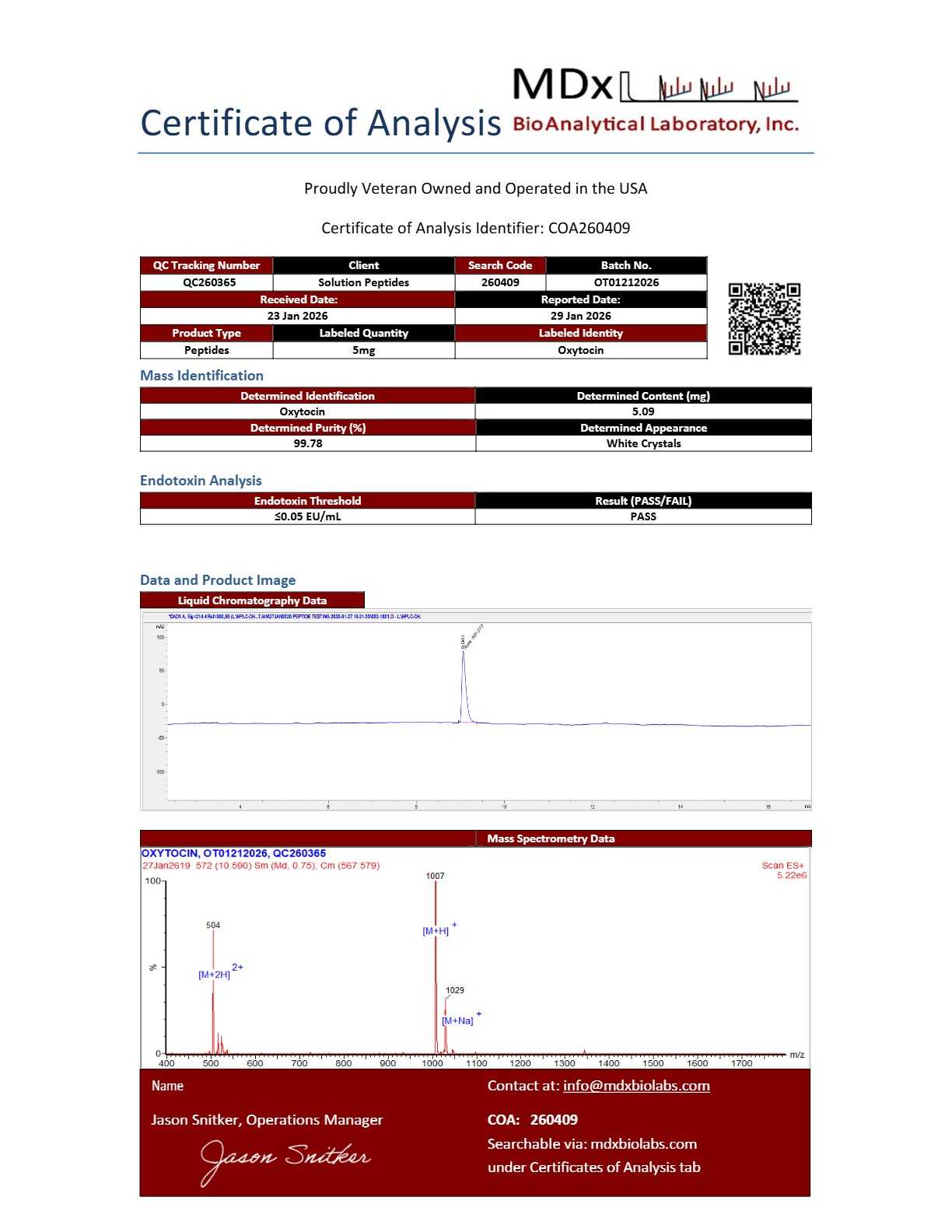
Den där osäkra regelboken är precis varför den första kontrollen är identitet, inte renhet. Bekräftelse av peptididentitet kommer före varje renhetssiffra, eftersom de två mätningarna svarar på olika frågor. HPLC-renhet är förhållandet mellan huvudtopparea och total integrerad topparea, och den beräkningen är blind för vatten och salter: ett prov kan läsa 99% ren efter område och fortfarande vara fel förening (Peptid Trust, "Nettopeptidinnehåll vs renhet", 2026-07-31). Renhet och innehåll svarar på två olika frågor, och ingen av dem är "är det här peptiden jag beställde?”
Massmatchning mot den teoretiska massan svarar på det. Amerikanska peptider beskriver LC-MS identitetsbekräftelse som en jämförelse av den observerade massan med den teoretiska massan beräknad från den avsedda aminosyrasekvensen, med MS/MS som lägger till b-jon- och y-jonstegen som stöder sekvensordning snarare än enbart total massa (2026-06-06). Samma källa visar varför massunderlaget måste anges: en peptid med formeln C65H101N17O18S har en monoisotopisk massa på 1455.71 Da mot en genomsnittlig massa på 1456.66 Och, ungefär 1 Ja förutom, så en okvalificerad "match" är tvetydig.
Key Takeaway: En renhetsprocent talar om hur mycket av toppen som är en sak. Endast en massmatch mot din angivna sekvens säger dig vilken sak det är.
Vårt fynd: Siffran på 98 % renhet som ser ut som bevis på identitet är den enskilt vanligaste felläsningen vid leverantörsutvärdering. En hög area-% och en väsentligt lägre nettopeptidhalt kan båda ärligt rapporteras för samma batch, vilket är anledningen till att ett parti med lågt innehåll kan ha ett rubrikens renhetsnummer som inte säger något om hur mycket peptid flaskan innehåller.
Felläget är tyst. En felsekvens eller trunkerad peptid kan klara en area-%-kontroll och till och med dela en retentionstid med den förväntade föreningen, eftersom orelaterade molekyler kan samelueras. Massoffset namnger problemet istället: +16 Da pekar på oxidation, -18 Då till uttorkning, och en saknad aminosyra till trunkering (Amerikanska peptider, 2026-06-06). Fråga efter den observerade massan, den teoretiska massan, och grunden som används för båda.
Läsa renhetsdata utan att bli vilseledd av rubriknumret
När identiteten är klar, renhetssiffran kan avläsas för vad den faktiskt mäter. Peptidrenhetsdata svarar på en snävare fråga än de flesta köpare antar. A purity figure describes the share of the detected signal that belongs to the target sequence. It does not describe how much peptide sits in the vial.
Typical research-grade specifications sit at ≥95% by HPLC, with high-purity grades at ≥98% (ChemVerify’s peptide purity testing guide, mars 2026). Values above 99% deserve scrutiny for sequences longer than 30 residues unless high-resolution chromatographic data accompanies them. The same guide notes that purity is commonly reported by UV absorbance around 214–220 nm, and that the wavelength matters because impurities respond differently at different wavelengths.
Then comes the part the headline hides. Lyophilized peptides typically contain 60–85% net peptide content (ChemVerify, mars 2026). The rest is counter-ions, residual water and trace solvent. A 10 mg weigh-out at 70% content yields roughly 7 mg peptid, which explains the shortfall many labs hit when they calculate an assay from the balance reading alone.
Peptid Counter-ion removal has limits. A 2020 review of counter-ion behavior in peptides found that TFA exchange reaches up to 98% efficacy after repeated cycles but does not completely remove TFA anions (PMC 7761850, december 2020). Those anions can bond directly to basic residues or sit adsorbed in the lyophilizate.
Vårt fynd: A 10 mg weigh-out at 70% net peptide content delivers roughly 7 mg peptid. Budget assays against content, not against the vial label.
Dokumentation: Vad ett partispecifikt COA måste innehålla
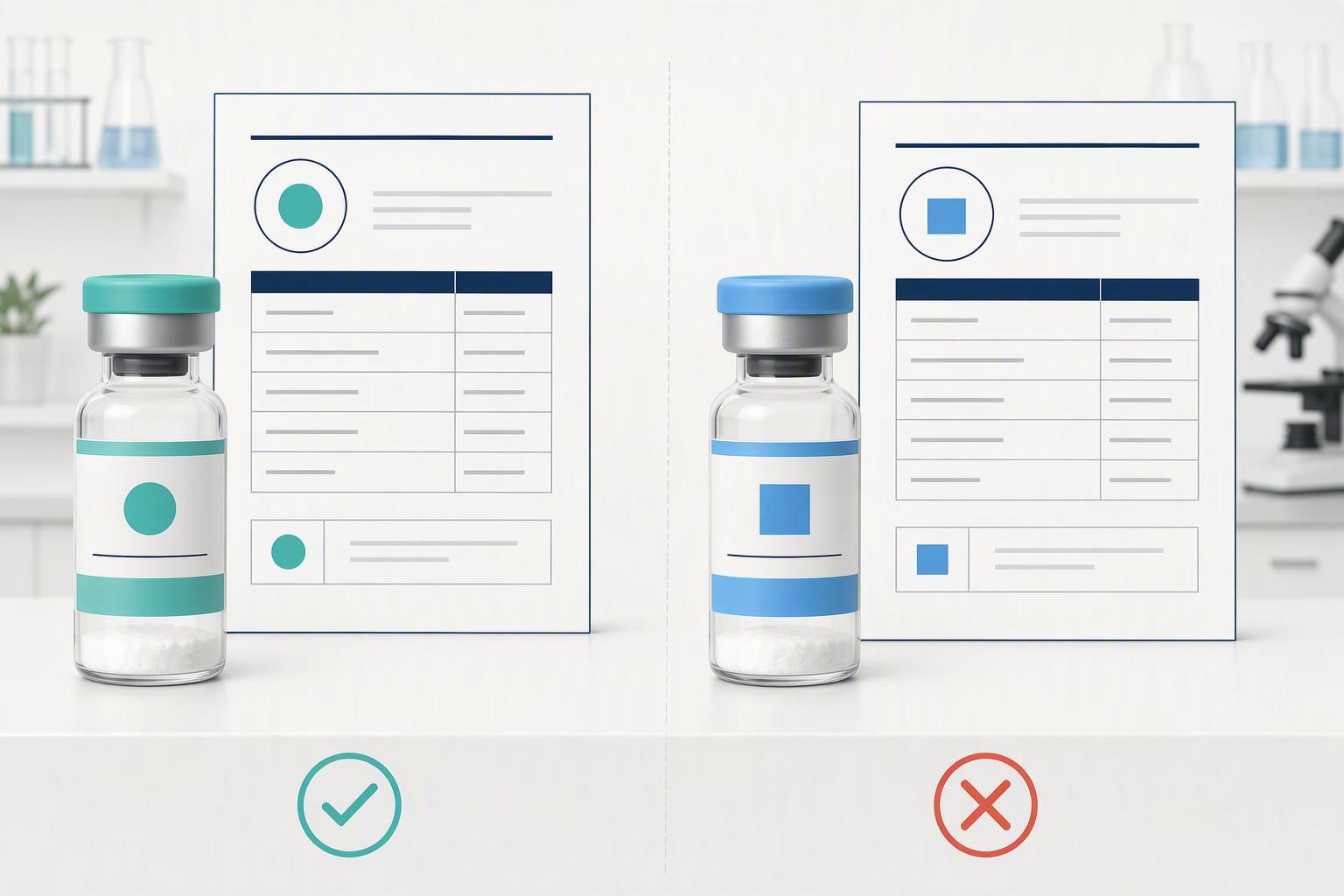
With identity and content understood, the next safeguard is the paperwork that ties both to your vial. A peptide certificate of analysis is only useful if it belongs to the vial in your hand. The batch or lot number printed on the COA must match the batch or lot number on the vial label, and the document must be issued for that specific lot rather than for the product line in general. Finnrick’s guide to reading a certificate of analysis states the batch ID rule plainly: no batch ID on a sample means no valid test. The same guide sets the minimum panel a peptide COA should carry, which is identity confirmation, renhet, and potency or quantity.
⚠️ Varning: These failure modes show up as ordinary conditions, not dramatic ones. A generic COA arrives instead of a lot-specific one. The lot number on the COA does not match the vial label. Batch documents are reused across shipments. The testing laboratory is never named. Raw data is not available on request.
A COA is a supplier-issued document, and a supplier-issued document is not independent verification. Where a supplier claims independent testing, the claim is checkable only if it names the third-party laboratory, the test date, the analytical method, and whether the underlying raw data can be accessed. Without those four details, the document confirms that testing happened somewhere, not that it happened to your lot.
Chain of Custody: Uppsättningen kvitto att använda
Spps Synthesis Documentation covers what the supplier did before shipping; custody covers everything after. Peptide chain of custody is the record set your laboratory creates between the moment a vial arrives and the moment its contents are consumed, and it is the only part of supplier authentication you control entirely. A supplier can hand you a clean certificate and still leave you unable to show how the material was handled afterward.
The record set has five linked entries. The receiving log captures receipt date, bärare, partinummer, skick vid ankomst, and the name of the person who opened the package. The storage record names the location (freezer, shelf, box position) and the target temperature. The access log records who withdrew the vial and when. The reconstitution entry holds the diluent, volym, datum, and the resulting concentration. The aliquoting and distribution record tracks each daughter vial to its user or downstream experiment.
Temperature and freeze-thaw records belong alongside the batch file, not in a separate notebook, because they are what turn a set of entries into an auditable history. Lot-number traceability is the thread: if the lot number on the receiving log does not match the lot number on the certificate and the vial label, the record set breaks at its first link and nothing downstream can be reconstructed.
Key Takeaway: Custody records are what let a laboratory demonstrate that a research material was handled as a research material, from receipt through use, without relying on the supplier’s account of what happened before it shipped.
Separera forskningsmaterial från terapeutiska påståenden

The custody record is yours to keep; the last check is about the supplier’s own words. The fastest supplier-language test is this: a page that promises an outcome has told you about its claim discipline, not about its chemistry. Legitimate research suppliers keep their language on compound identity, purity documentation and laboratory procurement. Therapeutic, diagnostic, clinical and personal-use claims sit outside that vocabulary, and their presence is a signal about how the supplier handles the boundary, not proof of what is in the vial.
Apply the test to the product page, the certificate of analysis and the order confirmation. If any of the three describes a physiological effect, a dosing protocol or a benefit to a person, the supplier Peptide Melanotan Ii has moved from supplying laboratories to addressing consumers. That shift usually shows up before the documentation gaps do, which makes it a useful early filter when you are comparing vendors.
För tips: The language test is a claim-discipline check, not a chemistry check. A supplier page that promises an outcome has told you something about its claim discipline, not about its chemistry.
The materials discussed in this article are for laboratory research use only and are not for human or veterinary use. Nothing here is a therapeutic, diagnostic or clinical claim, and nothing here should be read as guidance for personal use.
Vanliga misstag att undvika
Most peptide supplier authentication failures trace back to reading one number instead of the whole record. Each mistake below is common because it feels like diligence, and each has a specific fix.
Treating a purity percentage as proof of identity. A purity figure says how much of the sample is the target peak, not that the peak is the right molecule. Fix: require a mass spectrometry result that matches the theoretical mass of the stated sequence before you accept any purity value.
Accepting a generic or reused COA. Vendors sometimes supply a template certificate covering a product line rather than the lot in hand. Fix: check that the lot number on the certificate matches the lot number on the vial label, and reject the shipment if it does not.
Ignoring net peptide content when calculating a weigh-out. Renhet och innehåll är separata mått, so a high-purity, Biotage Peptide Synthesizer low-content lot delivers less peptide than the mass suggests. Fix: calculate from the content or assay value, not the purity percentage.
Keeping no custody record. Without a receipt-to-use trail, you cannot show what arrived, när, or how it was stored. Fix: log receipt date, massa, skick vid ankomst, and storage location at the point of intake.
Letting therapeutic-adjacent marketing language pass unchallenged. Claims that imply human use shift a research material into a regulatory category it does not belong in. Fix: treat that language as a documentation defect and ask the supplier to correct it in writing.
⚠️ Varning: The most consequential mistake is a high purity number on a low-content lot. Both figures can be accurate and the pairing still misleads anyone who reads only the purity line, because the weigh-out they calculate will be short. Peptide Ll 37
Resultat: Hur ett verifierat leverantörsförhållande ser ut
A verified supplier relationship is not a feeling about a vendor. It is a batch file you can hand to a colleague and have them reach the same conclusion. Peptide supplier authentication ends in a folder, not a verdict. Cem Peptide
That folder carries six things. A lot-specific COA whose lot number matches the vial label. An identity result matched against theoretical mass, not just a pass mark. A purity figure sitting beside a net peptide content figure, so the two numbers can be read together. A named testing laboratory with a test date and the method used. A custody record running from receipt to use. And supplier language that stays on research use, in the marketing copy as well as the certificate.
The stretch goal is worth asking for. Where a supplier offers raw analytical data or independent third-party verification, request it. A supplier that can produce it is telling you something a clean PDF cannot.
MOL Ändringar is a peptide synthesis and modification organization that operates Class 100 ultrasteril renrumsproduktion, with QC including HPLC, MS och sterilitetstestning, and supports mg-to-kg scale-up.
If you are comparing suppliers against this checklist, talk to an expert or compare capabilities directly. MOL Changes har ett kommersiellt intresse av peptidkvalitetsstandarder, and this article is written so the same checks apply to any supplier, including this one.
Vanliga frågor
Kan ett peptidcertifikat för analys ersätta oberoende testning?
Inga. A COA is the supplier’s own record, and it cannot verify itself. The batch ID rule applies here: the document is only meaningful when its lot number matches the vial label and it reports the full panel for that specific lot, not a representative or historical result. Independent testing by a laboratory you selected is the only check that sits outside the supplier’s control. Treat the COA as the claim and third-party analysis as the confirmation.
Vad ska jag göra när partinumret inte stämmer överens med etiketten?
Stop and do not use the material. A mismatch means you cannot tie the analytical results to the vial in your hand, which breaks the entire documentation chain regardless of how good the reported numbers look. Contact the supplier in writing, request the correct lot-specific COA, and keep the correspondence. If the supplier cannot produce a matching record, that is your answer about their documentation practice.
Hur jämför jag ett betyg på ≥95 % mot ett betyg på ≥98 % för en given analys?
Compare the grade against the method and the assay, not against the number alone. A ≥98% figure measured by one HPLC method is not automatically superior to a ≥95% figure measured by a stricter one, because purity percentage is method-dependent. Ask which method produced the value, request the chromatogram rather than the summary line, and match the grade to what your assay actually requires.
Can I check a supplier’s stated testing laboratory?
Ja, and you should. Ask for the laboratory’s name and confirm it is a real, independent facility with the capability to run the panel reported. A named laboratory you can contact is a verifiable claim; an unnamed “third-party lab” is not. If the supplier will not identify the laboratory, treat the testing claim as unverified.
Slutsats
The five safeguards form one repeatable workflow: confirm identity against the theoretical sequence, read purity alongside content and assay, require a lot-specific certificate of analysis, keep a receipt-to-use record set, and hold research materials separate from therapeutic claims. Run them in that order on any supplier, and the result is a supplier-agnostic verdict rather than a trust exercise.
That standard does not depend on where U.S. rules land. Reclassification would change the paperwork a supplier is expected to produce, not the underlying questions a buyer needs answered. Identitet, innehåll, dokumentation, vårdnad, and claim discipline stay the same checks whether the material sits in a research or a regulated category.
The next action is concrete. Build the batch file for the next lot you receive: sekvens, partinummer, COA, analytical report, mottagande, and storage record. Then run the five checks against it before the material enters use. Peptide supplier authentication becomes routine once the file exists and each lot is measured against it.