Varför en generisk LIMS-utvärdering misslyckas Peptid QA
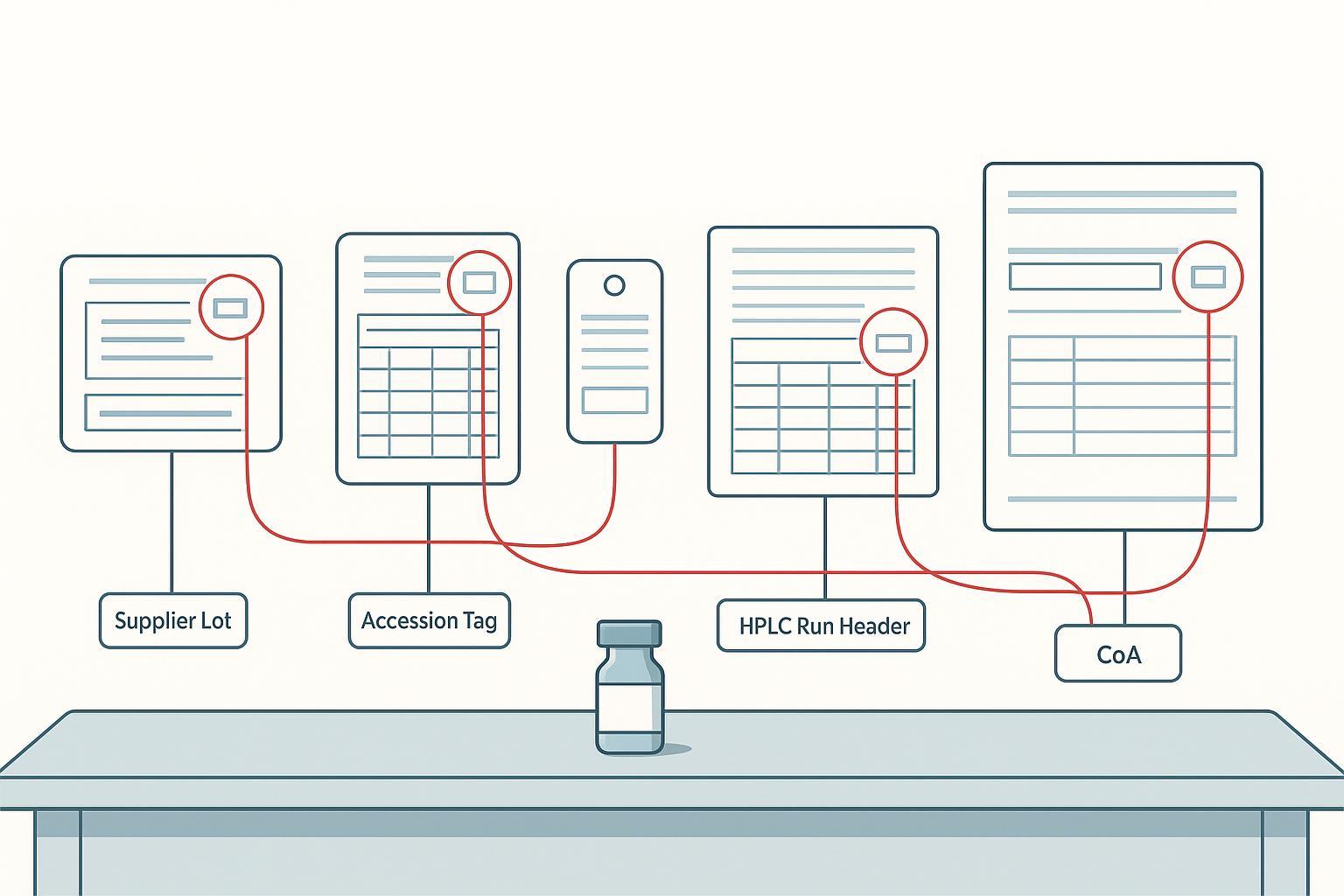
Spårbarhet av peptidpartier bryter den checklista som de flesta labb ärver från generiska LIMS-guider. En peptidfrisättningspanel är inte ett test på ett prov. Det spänner över masspektrometrisk identitet, omvänd fas HPLC-renhet, innehåll av motjon och trifluorättiksyra, endotoxin genom LAL-analys, och sterilitet, och var och en av dessa poster har identifierare som måste överensstämma exakt: leverantörslott, inre parti, anslutningsnummer, sekvenstabell, kromatogramhuvud, och analyscertifikat. Generiska guider testar inget av det avtalet.
De stannar också vid fel gräns. I praktiken, kromatografisk datahantering är uppdelad i två system. CDS styr instrumentet, exekverar sekvensen, förvärvar och integrerar kromatogrammet, utvärderar systemets lämplighet, och äger den ursprungliga råfilen. LIMS äger registreringen, spårbarhetskedjan, provuppgift, batchning, resultataggregation, specifikationskontroll, rapportering, och dispositionsprotokollet. LIMS driver arbetslistan och tar tillbaka godkända resultat, vilket är handoff som en peptidutvärdering måste förhöra snarare än att anta.
Om din aktuella checklista kom från en allmän LIMS-guide, den skrevs för en datamodell som aldrig behövde förena en sekvenstabell med ett kromatogramhuvud.
Fråga 1: Kan systemet bevisa sekvens och spårbarhet från ända till ända?
Peptidpartispårbarhet är endast bevisbar när samma identifierare visas i sekvenstabellen, körhuvudet och CoA, och systemet kan gå den kedjan i en enda fråga. I praktiken, det betyder att tre grupper av fält måste komma överens med varandra istället för att leva i separata moduler.
|
Sekvenstabell |
Kör rubrik |
Referensstandard |
|---|---|---|
|
Sekvens och modifieringar |
Datafilnamn och sökväg |
Standardnamn och parti |
|
Providentifierare |
Instrument-ID |
Tilldelad styrka eller renhet |
|
Peptidsyntes Metodnamn och version |
Utgångs- eller omtestdatum |
|
|
Förvärvsdatum och tid |
Länk till kalibreringskurvan |
|
|
Tjänster Analytiker ID |
||
|
Flaskans position eller arbetslista |
De delade identifierarna är providentifieraren och metodversionen: går av antingen och kedjan stannar. Behandla den här listan som en utövares vägledning för att strukturera ditt eget demomanus, inte som en kontrolllista.
Låt sedan säljaren köra den baklänges. Ge dem ett CoA-lotnummer och be dem producera sekvensposten, löpningen, metodversionen och analytikern i en vy, utan att lämna systemet eller bygga om frågan för hand.
Fråga 2: Hur hanterar LIMS spårbarhetskedjan för alikvoter och stabilitetsdrag?
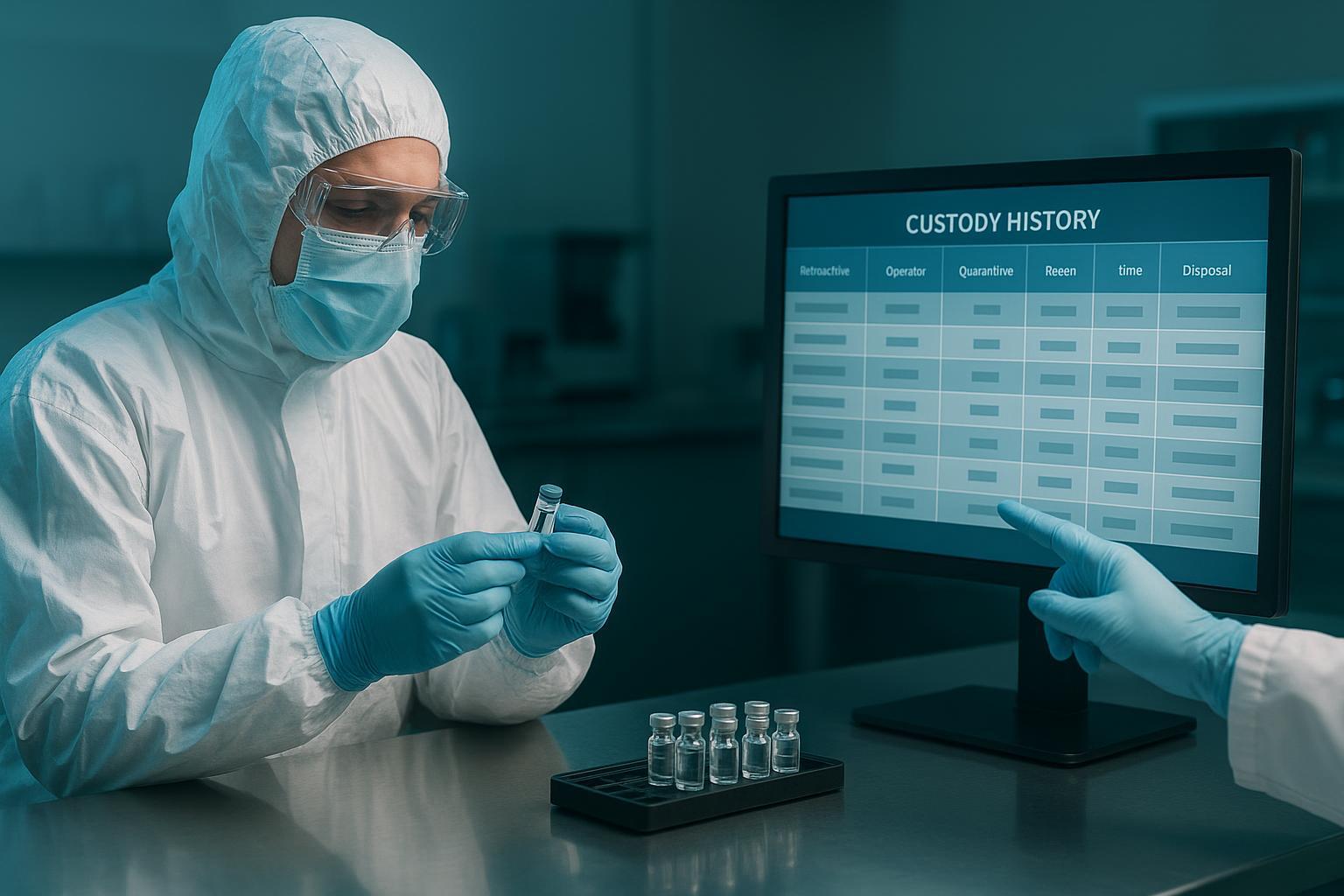
Chain of custody i LIMS är ett register över överföringar och stater, inte ett signaturblock. Kvitto och karantän, varje delmängd, varje frysning/upptiningshändelse, varje stabilitetsdragpunkt och den slutliga deponeringsposten behöver sin egen tidsstämpel, hänförligt rekord. 21 CFR del 11 kräver säker, datorgenererade, tidsstämplade revisionsspår som oberoende fångar datumet, tid och operatör bakom varje handling som skapar, ändrar eller raderar en elektronisk post. Samma förordning säger att dessa register måste vara lätt tillgängliga för FDA-inspektion, vilket är den standard en vårdnadshistorik måste uppfylla utan manuell rekonstruktion.
För en mängd peptider, det betyder att en granskare kan öppna en vy och se kvittot, frisläppande i karantän, tre alikvotdelningar, två stabilitetsdrag och en avfallsingång, var och en bär en tidsstämpel, en operatör och en anledning.
Fråga 3: Kontrollerar LIMS rå kromatografidata och metodversioner?
Kromatografisk datahantering och metodversionskontroll avgör om ett releasebeslut kan rekonstrueras år senare. LIMS måste veta vilken metodversion som producerade varje resultat, och den måste blockera rapportering av ett resultat mot en ersatt version. Om det inte kan lösa den länken, batchposten är ofullständig oavsett hur ren revisionsspåret ser ut.
Här spelar gränsen roll. Kromatografidatasystemet äger instrumentkontroll, sekvensexekvering, förvärv, integration, systemlämplighet och den ursprungliga råfilen. LIMS äger registreringen, vårdnad, provuppgift, batchning, resultataggregation, specifikationskontroll, rapportering och dispositionsprotokollet. En CDS ensam kommer inte att bära sammanhanget på lotnivå; en LIMS ensam kommer inte att hålla den råa signalen.
Map the method lifecycle to a recognised framework. I Q2(R2), the harmonised analytical procedure validation framework issued in March 2024, covers validation principles including the analytical use of spectroscopic data, and supports justified post-approval change management. For the instruments themselves, USP 〈1058〉 frames instrument qualification as fitness for intended use, official as of 1 augusti 2017.
In the demo, ask the vendor to revise a method, then show what happens to results already reported under the prior version.
Fråga 4: Hur dirigeras och bevaras undersökningar utanför specifikationen?
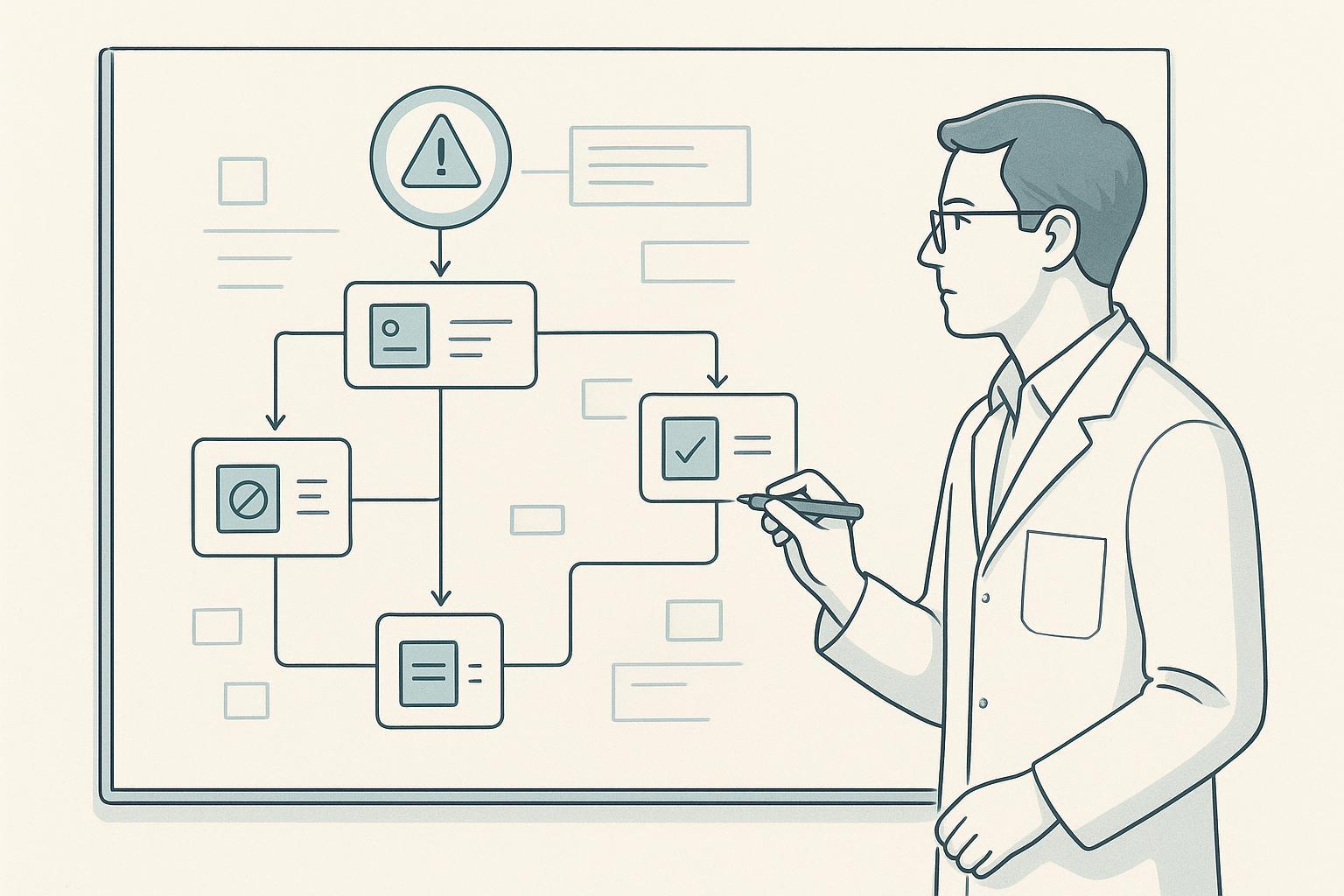
An out-of-specification investigation in a peptide QC lab is a routing and preservation problem before it is a compliance exercise. Industry-standard two-phase practice, framed by the FDA’s guidance on investigating out-of-specification test results, starts with a Phase I laboratory investigation: the lab checks its own work for an assignable cause before the result is treated as a product failure. Only when Phase I finds no assignable laboratory cause does the event escalate to Phase II, where the investigation moves beyond the laboratory.
The routing matters less than what survives it. For any OOS event, the record an auditor must be able to reconstruct includes the original reported result with sample ID, metod, instrument, run sequence, datum och tid, analyst, and batch or lot context; the raw data behind it, including chromatograms, integrations, weights, calculations, and system-suitability and calibration records; an audit trail of every addition, radering, modifiering, reprocessing, and re-integration, with who authorised each one and why; the investigation record itself, with its phase assignment, evidence reviewed, conclusions, CAPA, and disposition; and the full retest history showing why retests were permitted, whether the initial result was invalidated, and which result became reportable (NCI Frederick, Managing Out-of-Specification Test Results or Unexpected Test Results, 2022).
A LIMS that stores only the final disposition cannot reconstruct any of this. Ask the vendor to walk one OOS event through the system end to end, from the first reported value to the reportable result.
Fråga 5: Genereras analyscertifikatet endast från godkända resultat?
Certificate of analysis generation is a controlled-document function, not a reporting template. A CoA is assembled from approved results, and its header fields must agree exactly with the sequence table, run header and reference standard records for that lot. The fields that carry the most weight are product name, partinummer, COA date and testing laboratory, because those four are what a customer checks first and what an auditor reconciles against the batch record.
That is why the release-blocking test belongs in the demo. Ask the vendor to generate a CoA for a lot that still has an open out-of-specification investigation against it, then watch what the system does. A LIMS built for peptide QA refuses, flags, or routes for approval. A reporting tool prints the certificate anyway, and you have just seen how a non-conforming lot reaches a customer.
|
CoA header field |
Source record it must agree with |
|---|---|
|
Product name |
Sekvenstabell |
|
Lot number |
Sequence table and run header |
|
COA date |
Approval record for the released results |
|
Testing laboratory |
Run header and reference standard records |
If the vendor cannot show that agreement in the demo, treat the CoA as unverified until they do.
Hur en försvarbar beviskedja ser ut från slut till slut
A defensible peptide lot traceability chain is a sequence of handoffs, and each handoff needs a named record plus a control that keeps the record honest. Walk it in the demo from the vial label through accession, analytical run, metodversion, analyst, review, disposition, och analyscertifikat. At every one of those steps, ask which record carries the handoff and what stops that record from being edited after the fact. Chain of custody in the LIMS is only as strong as its weakest handoff, so a system that names the record but cannot show the control is showing you a form, not a control.
MOL Changes supports this kind of staged handoff, and can be used to keep method versions and review records attached to the lot they belong to.
Vanliga misstag i LIMS-val för peptid QA

The most common failure in choosing a LIMS for peptide QA is evaluating on a feature checklist instead of asking the vendor to produce a record. Checklists are easy to score and hard Syntetiska peptider to falsify, which is exactly why they survive procurement. The five mistakes below are the ones that cost labs the most, and each has a cheap fix you can apply in the next demo.
Accepting a demo on synthetic data. Vendors demo with clean, pre-built lots because real data exposes gaps. Ask them to start from one of your own CoA lot numbers and walk to the sequence record, löpningen, the method version and the analyst who signed it. If the walk breaks anywhere, you have found your answer.
Treating the CDS/LIMS boundary as an integration detail. It is a data-ownership decision. Whoever holds the raw chromatographic data controls the audit trail, so settle that before you discuss connectors.
Letting method versioning be a free-text field. Free text cannot prove which method produced a result. Require a version history that binds each result to the method revision in force at the time of the run.
Assuming CoA generation is a reporting feature. It is a release control. Ask what the system does when an out-of-specification investigation is still open at the moment someone tries to issue the certificate.
Not asking what happens to an open OOS at release. This is the question that separates a defensible system from a document repository, and it takes thirty seconds to ask.
Hur man poängsätter svaren och bestämmer
Score each of the five questions on three axes, and score the vendor’s behavior, not the feature list. Första: did they demonstrate the record in the system, or only describe it? A traceability claim shown live, with a real lot walked from synthesis through release, is worth more than a slide. Andra: was the evidence exportable? Ask them to export the audit trail, the method-version history, or the OOS record as a file you can open. If the answer lives only inside their interface, you cannot audit it. Tredje: did the answer survive a follow-up? Ask what happens when a stability pull is split across two analysts, or when a method is revised mid-study. Vendors who know their product answer immediately; vendors who do not will offer a call with an engineer.
For a LIMS for peptide QA, the scoring criteria should also include the cost and timeline of validation, because that is often the deciding factor. Regulated LIMS validation is reported at roughly $15,000 till $80,000 for validation alone, with full regulated implementations commonly reported at $150,000 till $500,000 and timelines of 6 till 12 months single-site and 18 till 36 months multi-site (1LIMS, hämtas 2026-08-10). Treat these as indicative only: they come from vendor and consultancy estimates that vary widely, with no stated methodology or sample, so they should not anchor your decision. Use them to frame a budget conversation, not to choose a system.
|
Fråga |
Demonstrated the record |
Evidence exportable |
Survived follow-up |
|---|---|---|---|
|
1. Sequence and lot traceability |
|||
|
2. Chain of custody for aliquots and stability pulls |
|||
|
3. Raw chromatographic data and method versions |
|||
|
4. OOS investigation routing and preservation Om |
|||
|
5. CoA generated from approved results only |
Two limitations deserve a place in the scoring. Instrument-vendor lock-in is real: a system built tightly around one chromatography vendor’s data format can make a second instrument line expensive to onboard later. Migration cost is the other. Moving historical peptide data out of a legacy system, with its audit trails intact, is a project in itself, and vendors rarely quote it upfront. Ask both questions before you sign, and score the answers honestly.
If the scoring leaves you with two viable options, talk to a peptide QC specialist who has run these systems in a regulated lab, not just a sales engineer.
Vanliga frågor
Kan ett kromatografidatasystem ensamt täcka peptid QA-spårbarhet?
Inga. A chromatography data system is the system of record for acquisition, integration, and the native raw file, but registration, vårdnad, batchning, specifikationskontroll, and the disposition record sit in the LIMS. That boundary matters for your evaluation because chromatographic data management and peptide lot traceability are two different record chains, and only one of them ends in a release decision. Ask the vendor to show where the CDS record is referenced by the LIMS record, and what happens to that reference when a result is reprocessed.
Vad händer om leverantören inte kan visa en metodversionshistorik i demon?
Treat it as an unresolved release-blocking control, not a roadmap item. Method version control is what lets you prove which procedure produced a released result, so a demo that cannot display it is an incomplete demo, not a scheduling problem. Ask for the method lifecycle in writing, including how a version is retired and how historical results stay bound to the version that generated them, then ask for a reference lab that has been audited on exactly that. If the vendor cannot supply either, the out-of-specification investigation path downstream is unverifiable too.
Hur mycket validering behöver en peptid QC LIMS?
Scope validation to the records your lab releases on, and map instrument qualification to USP 〈1058〉 “fitness for intended use” rather than treating it as a separate exercise. In practice that means the validated scope covers registration, custody transfer, specification evaluation, och dispositionsprotokollet, with the instruments feeding those records qualified for the purpose they serve. A LIMS for peptide QA does not need to be validated as a whole system beyond what those release decisions depend on.
Ändrar ett ELN någon av dessa fem frågor?
Inga. An ELN changes where the analyst writes, not who owns custody, metodversion, or the disposition record. If an ELN is in the stack, the same five questions apply to whichever system holds those records, and you should confirm in the demo which one that is.
Slutsats
You now have a working evaluation framework: five questions for a LIMS for peptide QA, each paired with a specific record to demand and a specific request to send. Sequence and lot traceability maps to the full analytical record set, which for a typical peptide lot runs to roughly six to eight core documents covering MS identity, RP-HPLC renhet, motjon, endotoxin, sterilitet, och kvarvarande lösningsmedel (Polypeptide QC specifications, odaterad). Chain of custody maps to aliquot and stability-pull logs. Raw chromatographic data and method versions map to the instrument export and version history. OOS routing maps to the investigation record. CoA generation maps to the approved-results gate.
The value of asking this way is that it moves the conversation from a feature list to an audit. A vendor can claim traceability; only the records show whether it holds.
The next step is deliberately small. Request a representative CoA and analytical data package, then run the five questions against it before you book a second demo. If the answers are thin, ask to speak with a peptide QC specialist on the vendor’s team and put the same five questions to them.
Avslöjande: MOL Changes has a commercial interest in peptide quality standards and LIMS evaluation practice.