Vilken juli 2026 Rösten gjorde och ändrades inte
Den juli 23-24, 2026, Pharmacy Compounding Advisory Committee granskade sju ej godkända peptider och rekommenderade sex av dem för 503A-bulklistan (McDermott Will & Smärgel, 2026-07-28). BPC-157, KPV, och TB-500 var och en godkänd 8-6 med en nedlagd röst; MOTs-c godkänd 7-5; Semax passerade 8-5; Epitalon passerade 7-4; Emideltide (DSIP) misslyckades 6-7. RAPPER spelade in Epitalon-sammanställningen som 7-5, så behandla den enskilda figuren som orolig.
⚠️ Varning: Rekommendationen är endast rådgivande. Som Mintz anteckningar, en rådgivande omröstning är inte en byrååtgärd, och alla listor kräver fortfarande regler för meddelanden och kommentarer. Inget har ändrats juridiskt ännu, och att förekomma på listan är en fråga om sammansättningsstatus, inte ett säkerhetsresultat.
Det som redan gäller är oförändrat: enligt 503A §, en bulkläkemedelssubstans behöver ett giltigt analyscertifikat och måste komma från en anläggning som är registrerad hos FDA enligt avsnitt 510 (FDA, 2026-05-14). FDA beskriver också 503A-listan som uppdaterad löpande under en interimspolicy med tre kategorier. Det är därför som checklistan för peptiddokumentation nedan fokuserar på poster du kontrollerar idag.
Hur man använder denna checklista för peptiddokumentation
Denna checklista täcker sex områden: identitet, renhet, analytiska metoder, föroreningsprofiler, inköp, och avsedd användning. De kartlägger fyra faser av arbetet: försyntes, pågår, släppa, och överlämnande. Varje objekt är formulerat som en binär bedömning, så du kan svara ja eller nej och gå vidare.
|
Täckningsområde |
Försyntes |
Pågår |
Släppa |
Hand-Over |
|---|---|---|---|---|
|
Identitet |
Sekvens och mål bekräftade |
Byggstensregister |
Identitetsbekräftelse |
Sekvenspost överförd |
|
Renhet |
Specifikationsuppsättning |
Pågående kontroller loggas |
Renhetsresultat anges |
Refererad renhetsmetod |
|
Analytiska metoder |
Metod vald |
Metoden körs som skriven |
Valideringssammanfattning bifogas |
Metodfil medföljer |
|
Föroreningsprofiler |
Kända föroreningar listade |
Profilen övervakas |
Profil rapporterad |
Profildata ingår |
|
Inköp |
Leverantör och parti registreras |
Tjänster Språkkedjan behålls |
Källa t Handla raceable |
Ursprung dokumenterat |
|
Avsedd användning |
Användningsfall definierat |
Omfattning oförändrad |
Använd påståendematchningar |
Användningsgränser kommunicerade |
Två omfattningsbegränsningar gäller. Detta är dokumentationsvägledning, inte juridisk eller regulatorisk rådgivning; konsultera kvalificerad myndighetsrådgivare innan du fattar beslut om efterlevnad. Och liststatus och säkerhetsstatus är separata frågor: Att visas på eller utanför en lista avgör inte i sig om en peptid är säker.
Arbeta igenom faserna i ordning, använd sedan den konsoliderade tabellen i slutet för att bekräfta att inget missades. Avsnitten som följer definierar vad som räknas som adekvat anpassad dokumentation för peptidsyntes för varje artikel.
Fas 1 — Försyntes- och inköpsskivor

De skivor som är billigast att skapa är svårast att rekonstruera senare. Ett partinummer skrivet på en mottagningslogg vid intag tar sekunder; återfå samma partinummer arton månader senare, när en partner frågar vilka byggstenar som gick in i en sats, kan ta dagar och kan sluta i ett svar som ingen kan försvara.
Fyra artiklar hör hemma i denna fas, och var och en är en binär check:
-
Antalet aminosyrabyggstenar och hartspartier registreras, med leverantörens CoA för varje. Spårbarheten måste överleva på partinivå, inte katalognivån. Ett leverantörskvalifikationspaket bör innehålla ett partispecifikt CoA som registrerar testerna, specifikationer och resultat för det partiet, plus parti- och SKU-spårbarhet tillbaka till en dokumenterad syntesväg (lyochem labbanteckningar, 2026-06-01). FDA:s egen översikt över kraven i avsnitt 503A pekar i samma riktning, förväntar sig en giltig CoA och 510-registrerad tillverkning (FDA, 2026-05-14).
-
Referens standardidentitet, lotnummer och utgångsdatum dokumenteras.
-
Ett skriftligt uttalande om avsedd användning skiljer forskningsanvändning från sammansättning.
-
Vårdkedjan från mottagande till förvaring dokumenteras.
Referensstandardens utgångsdatum är det artikelteam som oftast arkiverar på fel plats. Det hör hemma i batchprotokollet, inte i en labb-anteckningsbok, eftersom batchposten är vad en recensent eller partner faktiskt läser. Om standarden gick ut före körningen, de identitetsuppgifter som genereras mot den har en kvalifikation som posten bör ange på dess framsida, och en notebook-post tre hyllor bort kommer inte att dyka upp det.
Fas 2 — Identitetsdokumentation
Identitet är en separat fråga från renhet, och a 98% renhetssiffran svarar inte på det. Renhetstestning bekräftar hur mycket av materialet som eluerar som huvudtoppen; det bekräftar inte att huvudtoppen är peptiden du beställde. Som Peptra Labs förklarar i sin certifikat för analysguide, renhetstestning är inte identitetsbekräftelse "såvida det inte finns en identitetsanalys för den batchen" (2026-05-22). Den villkorliga formuleringen är hela poängen: identitet måste demonstreras med en metod som kan skilja din sekvens från en nära granne.
Tre metoder bär den specificiteten. Masspektrometri fastställer molekylmassa, med elektrosprayjoniseringstoleranser på ±1 Da nedan 5,000 Da och ±2 Da ovanför, och MALDI-TOF som håller ±0,5 Da på kortare peptider (Lyos Labs, 2026-04-08). Aminosyraanalys rapporterar sammansättning efter hydrolys, and peptide mapping locates the sequence itself. Each produces its own record: the spectrum or composition report, the expected versus observed value, the instrument and acquisition parameters, and the analyst and date.
On validation scope, the reading of ICH Q2(R2) that Peptide Staff applies to peptide methods is that identity methods do not need full validation across every characteristic, but they do need to show specificity (2026-09-11). Read that as a documentation instruction rather than a relaxation: the file still has to prove the method discriminates, which means a specificity rationale, a representative spectrum, and a stated acceptance window. This is where peptide analytical method validation expectations differ most sharply between identity and assay work, and where a thin file is easiest to spot.
Fas 3 — Renhetsdokumentation och vad numret betyder
A CoA purity figure is an area-percent measure, and it systematically reads high. The record has to state what was measured and how, or the number invites a false conclusion about content.
The distinction is not academic. In one cited metrology example, a manufacturer-stated content of 983.72 mg/g sat against a mass-balance determination of 896.36 ± 0.68 mg/g, a gap on the order of seventy-plus milligrams per gram (lineara, 2026-05-01). Treat that as a single-upstream illustration, not a general rule.
Water and counter-ions explain much of the difference. Lyophilized peptides are hygroscopic, and failing to correct for water can bias results by several percent; Karl Fischer reports water as % w/w and feeds the net-content and salt-correction calculation (clarascience, 2026-07-15). Counter-ions such as trifluoroacetate, acetate and chloride contribute to batch mass but are not detected at 214 nm (peptidetrace, 2026-05-23).
So the record must state the reporting convention: as-is, anhydrous, or salt-free. De 95%, 98% och 99%+ bands are marketing conventions rather than validated specifications; a 95% specification may contain up to 5% by weight of related substances, synthesis byproducts, residual protecting groups or counter-ions (peptidetrace, 2026-05-23).
Key Takeaway: An area-percent figure answers “how much of the UV-absorbing material is the main peak”, not “how much peptide is in the vial”.
Fas 4 — Analysmetoder
A method is only reconstructable if the file names the column, the mobile phase, gradienten, the detection wavelength and the integration rules. Everything else is a summary that a receiving lab has to rebuild from scratch.
Conventional peptide practice records a defined parameter set. Column chemistry defaults to C18 for short and mid-length peptides, with C8 for over-retained hydrophobic sequences and 300 Å for longer chains. Dimensions are typically 4.6 × 150 mm for UV purity work and 2.1 × 100 mm for LC-MS, with pore sizes of 100-130 Å and particle sizes of 3.5 eller 2.7 µm, dropping to 1.7-1.8 µm for LC-MS (reversed-phase HPLC method parameters for peptides, 2026-09-15). Mobile phases run 0.1% TFA (ungefär 13 mM) in water and acetonitrile, switching to 0.1% formic acid for LC-MS. Gradients are scouting at 5-65% B over 60 minutes at 1.0 ml/min, or focused at 0.25-0.5% B/min, med en 90-95% B wash of at least 5 minutes and re-equilibration of about 10 column volumes. The measured dwell volume belongs in the method, and detection sits at 214 nm for the peptide bond.
Method status is a separate record from method content. A validated method has been formally demonstrated fit for its intended purpose across the relevant performance characteristics, while a qualified method is a limited demonstration of fitness for a narrower, defined purpose without the full validation evidence (peptide analytical method validation guidelines, 2026-09-11). Which characteristics apply depends on method purpose. Under the adopted I Q2(R2) guideline, effektiv 14 juni 2024, the named characteristics include accuracy, precision, specificitet, detektionsgräns, kvantifieringsgräns, linearity and range. In peptide practice, assay methods carry the full set, with a range of 80-120% of target, recovery of 98-102%, RSD at or below 2% and r² of at least 0.999. Impurity methods lean on specificity and sensitivity instead: a range from the reporting threshold to 120% of the specification limit, a limit of detection well below the reporting threshold, a limit of quantitation at or below it, and forced degradation to establish specificity. Treat those figures as peptide convention rather than as ICH requirements.
|
Method status |
Peptidsyntes What it demonstrates |
Documentation it requires |
|---|---|---|
|
Validated |
Fitness for the intended purpose across the relevant performance characteristics |
Full validation protocol, predefined acceptance criteria, rådata, and a validation report covering each assigned characteristic |
|
Kvalificerad |
Limited fitness for a narrower, defined purpose |
Scope statement naming the defined purpose, the characteristics actually tested, resultat, and an explicit note of what was not assessed |
System suitability criteria and integration settings are records in their own right, not settings buried in the software. Write down the resolution, svansfaktor, retention time repeatability and signal-to-noise thresholds that a run must meet before its result counts, and record Syntetiska peptider the integration rules (baseline mode, smoothing, minimum area threshold, manual intervention and who authorised it). A purity figure produced under unstated integration rules cannot be defended, and a method that cannot be reconstructed cannot be transferred to a larger scale.
Fas 5 — Dokumentation för föroreningsprofiler
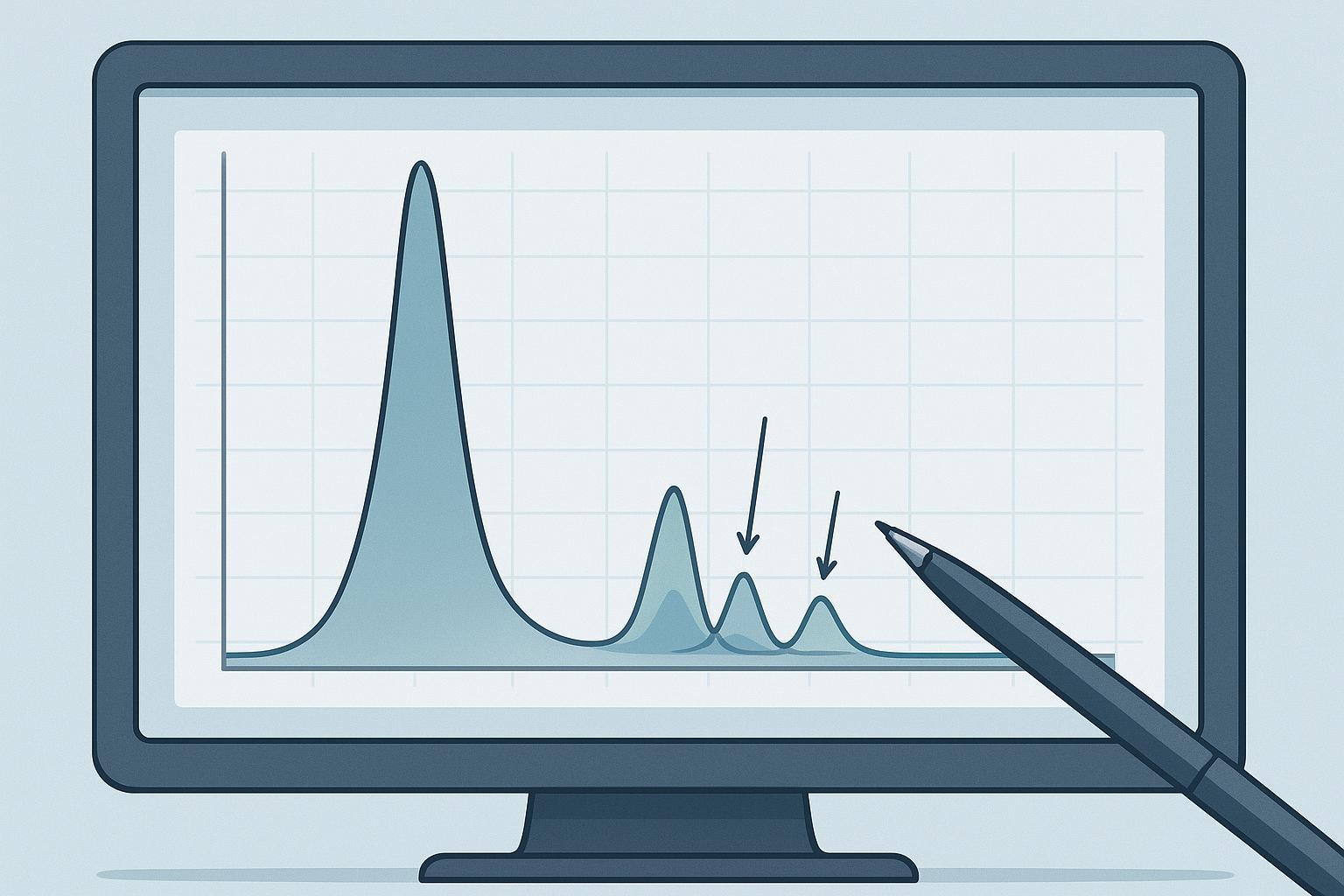
A defensible impurity record lists the classes you looked for and the method that would have found each one. Deletion sequences show as a mass deficit for the absent residue; truncated chains sit at lower mass; oxidised methionine appears as a +16 Da satellite; deamidated Asn or Gln shifts by +1 Da with altered retention; racemisation changes activity without changing mass; TFA adducts show up directly in the chromatogram (lyoslabs, 2026-04-08). Because these species can be close in both mass and retention, a single chromatogram will not separate them all, which is why peptide purity and impurity profile documentation pairs orthogonal methods rather than one run.
Thresholds for reporting, identification and qualification trace to ICH Q3B(R2), which sets identification typically at 0.10% eller 1.0 mg per day intake, vilket som är lägre. That framework does not apply to research-grade material in the same formal sense, so state which threshold basis your record uses.
Fas 6 — Utgivnings- och överlämnande av skivor
Assemble the hand-over as a package, not as a folder of files. The package is the artifact a partner actually reads, and a missing element blocks a program even when the underlying work was sound. Start with the peptide certificate of analysis requirements: the product name must match the vial label, the batch or lot must match both the vial and the order paperwork, and the report must carry the test date, the analytical method, the batch-specific purity result, testlaboratoriet, and a lab-controlled public report URL rather than a supplier-hosted page alone (Peptra Labs, 2026-05-22). Peptidproduktion
Bind every reported value to the raw data behind it, and keep the version and approval trail with the record set. Records should be attributable, läsbar, samtida, original och korrekt, and the set should let a reviewer reconstruct the batch without contacting the lab.
För tips: If a reviewer has to email you to understand a number, the package is incomplete. Om
Documentation packages of this kind are the workflow MOL Ändringar supports.
Konsoliderad peptiddokumentationschecklista
This peptide documentation checklist condenses the six coverage areas into one printable page. Each row is a binary judgment: either the record exists in the lot file or it does not. Hand it to the team before the next campaign starts, and treat any “no” as an open item rather than a formality.
|
Fas |
Checklista objekt |
Record that satisfies it |
Ja / Inga |
|---|---|---|---|
|
1. Pre-synthesis and sourcing |
Is the resin, each amino acid, and each reagent lot identified with supplier and lot number? |
Sourcing log with supplier certificates |
|
|
1. Pre-synthesis and sourcing |
Is the intended sequence, including any non-natural or modified residues, written down before synthesis begins? |
Approved target sequence sheet |
|
|
1. Pre-synthesis and sourcing |
Is the counterion and salt form specified up front? |
Specification sheet |
|
|
2. Identitet |
Is the peptide confirmed by mass spectrometry against the theoretical mass? |
Mass spectrum with calculated versus observed mass |
|
|
2. Identitet |
Is the primary sequence confirmed independently of mass alone? |
Sequencing or MS/MS fragmentation data |
|
|
2. Identitet |
Are the chromatographic identity markers recorded? |
Analytical HPLC retention data |
|
|
3. Renhet |
Is the purity figure stated with its method, kolumn, och detektionsvåglängd? |
HPLC chromatogram and method reference |
|
|
3. Renhet |
Is the purity expressed on a defined basis, with counterion and water content stated separately? |
Purity calculation sheet |
|
|
3. Renhet |
Is the integration method and any peak exclusion rule documented? |
Integration report |
|
|
4. Analytical method records |
Is the method described well enough for another laboratory to reproduce it? |
Method file with column, mobil fas, lutning, flöde, and detection |
|
|
4. Analytical method records |
Is method validation or verification data on file for the intended use? |
Validation or verification report |
|
|
4. Analytical method records |
Are system suitability criteria defined and met on the day of analysis? |
System suitability record |
|
|
5. Föroreningsprofil |
Are related substances reported individually rather than as one lumped figure? |
Impurity table with retention times and relative amounts |
|
|
5. Föroreningsprofil |
Are specified, ospecificerad, and total impurity limits stated? |
Specification with impurity thresholds |
|
|
5. Föroreningsprofil |
Are residual solvents, motjoninnehåll, and water addressed? |
Residual solvent and content data |
|
|
6. Release and hand-over |
Does the certificate of analysis match the batch record values exactly? |
CoA cross-checked against raw data |
|
|
6. Release and hand-over |
Is the stability or retest date supported by data rather than assumed? |
Stability summary or retest justification |
|
|
6. Release and hand-over |
Is the full data package transferable to a partner or regulator without further explanation? |
Complete lot file index |
Two habits keep this page useful. Första, review it at the point each record is generated, not at release, because reconstructing an integration rule or a system suitability result months later is where most gaps appear. Andra, keep the raw data behind every row, since a summary table without the underlying chromatogram or spectrum does not survive scrutiny.
Key Takeaway: A documentation package is only as strong as its weakest row. If any item above cannot be answered with a specific record, that is the item to fix before the next lot is released.
Vanliga frågor om peptiddokumentation
Hur länge ska peptiddokumentation bevaras?
Retain records for as long as the material can be in use or referenced, then add a defined margin on top of that. Because a lot may be held, re-tested, or shipped years after release, the retention period should be set by the longest plausible use window, not by the release date. Where a lot is tied to a sterility or endotoxin claim, the retention clock follows the longest applicable requirement, since those records are the ones most likely to be requested later.
What if a supplier’s certificate of analysis omits a method detail?
Ask the supplier for the missing detail in writing before you accept the lot, and record the request and the response. A certificate that reports a purity figure without naming the method, kolumn, or detection wavelength cannot be independently interpreted, so the gap is a documentation defect rather than a formatting preference. If the supplier will not supply it, treat the lot as unverified for that attribute and say so in your own records.
Är en kvalificerad metod acceptabel för ett givet syfte?
Ja, provided the qualification is documented against the intended use and the limits are stated. A qualified method is acceptable when its fitness for the specific purpose has been demonstrated and recorded; it is not acceptable as a substitute for a validated method where the purpose requires validated performance. The deciding question is what the result will be used to support, not how the method was labeled.
Vad ska vi göra när mycket misslyckas med systemets lämplighet?
Do not release the lot, and do not re-integrate or re-run until the failure is investigated and the cause is identified. A system suitability failure is a signal about the method or the instrument as much as about the sample, so the investigation should establish which before any repeat injection is treated as a valid result. Document the failure, the investigation, and the resolution together, because the failed run is part of the lot’s record.
Key Takeaway: Each answer above stands alone, so you can lift the one you need into a supplier query, an SOP note, or a review meeting without losing its context.
Nästa steg
The regulatory outcome is not yours to control; the record set is. Start tomorrow with the phase that is weakest in your current files, usually Phase 4, and work forward. A peptide documentation checklist only helps if someone can hand the file to a reviewer who was not in the room.
If you would like a worked example, MOL Changes supports teams with a sample documentation package covering method files, impurity tables and lot-level release records, which can be used to benchmark your own template before your next audit cycle.
This article is documentation guidance, inte juridisk eller regulatorisk rådgivning. Consult qualified regulatory counsel before making compliance decisions. Reviewed by the MOL Changes technical documentation team. MOL Changes provides custom peptide synthesis and analytical services; this article is educational and does not constitute a product recommendation.