Cosa fa sì che i peptidi lipidici non canonici rompano i presupposti di sintesi standard
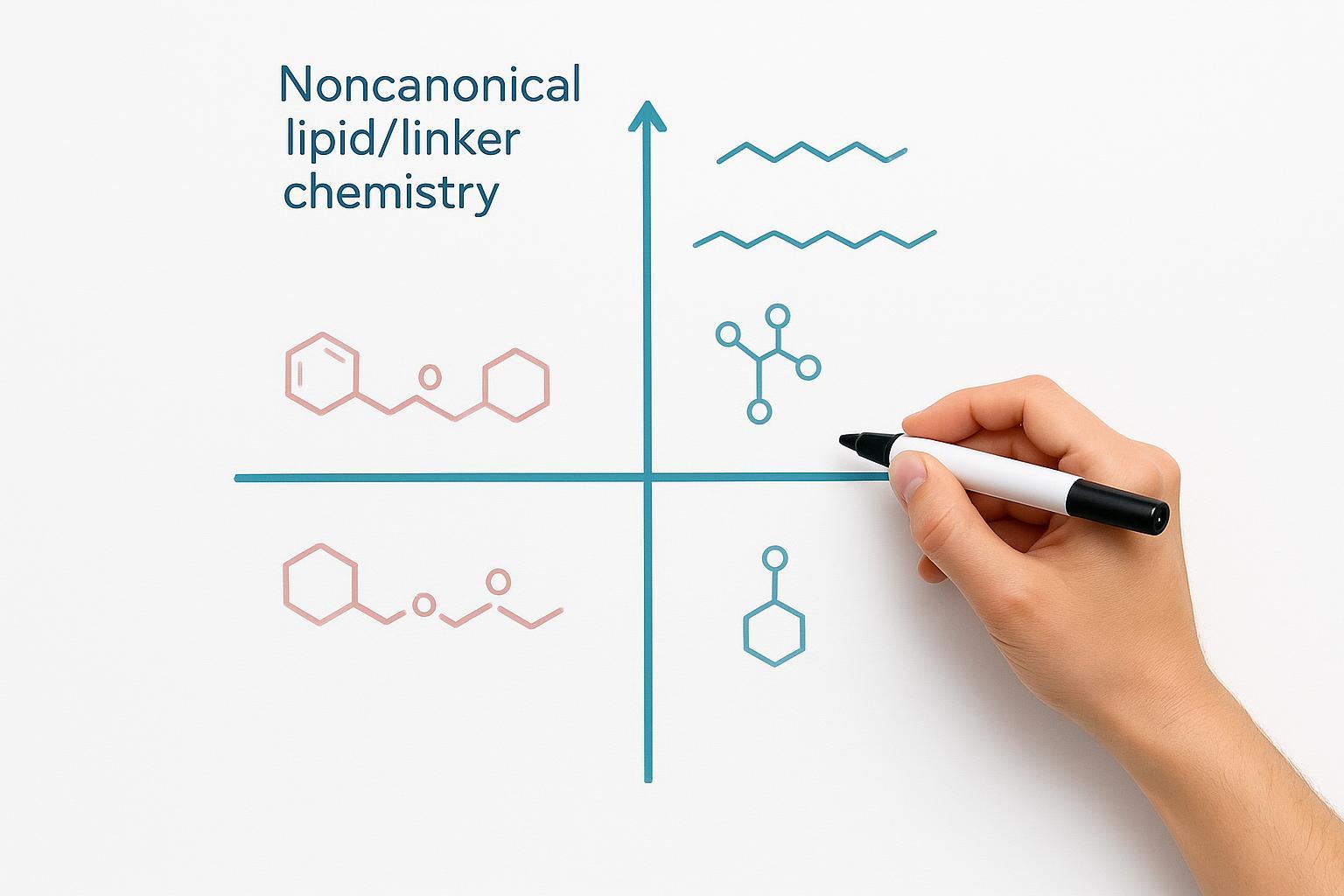
“Non canonico” e “lipidato” descrivono due assi di progettazione separati, e una richiesta che li tratta come tale è sottospecificata prima di lasciare la scrivania. Il primo asse è il residuo non canonico: un elemento costitutivo innaturale o mimetico che sostituisce un amminoacido proteinogenico. La seconda è la chimica non canonica dei lipidi o dei linker, che copre i concetti di lipidi abilitati agli acidi dicarbossilici e scindibili, nonché gli ibridi PEG-lipidi. I fornitori li elencano come menu diversi, quindi una richiesta che nomina solo “un peptide lipidato non canonico” lascia al fornitore il dubbio su entrambi (Peptidi creativi).
Una seconda decisione si trova al di sotto di questa divisione: se il lipide continua sulla resina o dopo la scissione in soluzione. Carico di idrofobicità, La logica del gruppo di protezione e l’impurità rischiano di cambiare con quella scelta, quindi rientra nel capitolato d'oneri o in una esplicita delega al fornitore (Peptidi creativi).

La chimica spiega perché l’ambiguità è costosa. Raggiunge la moderna sintesi in fase solida con reagenti HATU o HBTU 99 A 99.5 percentuale di efficienza per accoppiamento, ma ogni ciclo viene eseguito a 3 A 10 volte l'eccesso di reagente (Peptidi americani, 2026-06-06). Nel corso di una lunga sequenza lipofila, che l'efficienza a livello di residuo si trasforma in un vero e proprio carico di impurità. L'aggregazione su resina è la modalità di fallimento dominante per le sequenze idrofobiche, riducendo silenziosamente l'efficienza di accoppiamento e amplificando le impurità di cancellazione in n-1, Serie n-2 e n-3 (Bio-Sin).
Chiave da asporto: Specificare la chimica dei residui non canonici e la chimica dei lipidi/linker come due requisiti separati, e indicare se la lipidazione avviene sulla resina o dopo la scissione.
Cosa deve essere specificato in una richiesta di sintesi peptidica personalizzata

Una richiesta di sintesi peptidica personalizzata è valida tanto quanto i campi che trasporta. Lasciane uno vuoto e il fornitore lo riempirà con un valore predefinito che non hai scelto. I campi che deve contenere una richiesta di sintesi personalizzata completa sono la sequenza completa da N a C, ogni residuo non canonico nominato esplicitamente con la stereochimica (Forma D, N-metile, β-amminoacido), identità lipidica, punto di attacco, linker o chimica di coniugazione, obiettivo di purezza, scala, e risultati analitici (Bachem; Thermo Fisher Scientific).

|
Campo delle specifiche |
Perché è importante |
Quanto costa un'omissione |
|---|---|---|
|
Sequenza N-C |
Definisce il target sintetico |
Il venditore sostituisce un ordine residuo predefinito |
|
Residui non canonici, con la stereochimica |
Cinetica di accoppiamento della forma D e del cambiamento N-metilico |
Racemizzazione o navi isomeriche errate |
|
Identità lipidica |
C12 contro C18:1 cambia la solubilità e la maneggevolezza |
Classe lipidica sbagliata, lotto inutilizzabile |
|
Punto di attacco |
N-termine, Lys e-ammina, Maniglia Cys, o indice dei residui |
I lipidi si depositano nel sito sbagliato |
|
Chimica dei linker/coniugazioni |
Ammide, estere, tioestere, tioetere, il disolfuro si comporta diversamente |
Collegamento instabile, scollamento prematuro |
|
Servizi Obiettivo di purezza |
Sintesi peptidica Riduce tempi e costi di purificazione |
Sotto- o grado eccessivamente specificato |
|
Scala e aliquotazione |
Imposta la sintesi e il piano di confezionamento |
Materiale insufficiente per le ripetizioni |
|
Risultati analitici |
Definisce il pacchetto dati di rilascio |
Nessuna prova per il lotto |
Chimiche di lipidazione e classi di lipidi un partner di sintesi offre tipicamente la span amide, estere, tioestere, tioetere, e legami disolfuro, con attacco all'N-terminale, Lys e-ammina, un handle Cys, o residui contenenti idrossili, e un pannello rappresentativo di laurico C12, miristico C14, palmitico C16, stearico C18, oleico C18:1, e steroli come il colesterolo (Peptidi creativi).
Due campi meritano numeri espliciti anziché un intervallo che si spera venga interpretato dal fornitore. I pavimenti Purity sono indicizzati in base all'applicazione: Sopra 95% per NMR, cristallografia, ligando-recettore, e test di concorrenza; 90 A 95% per la produzione di anticorpi monoclonali e ELISA quantitativo o RIA; Sopra 80% per Western blotting non quantitativo, all'interno di un complesso 80% A 97% banda per lavori non GMP (Guida alla purezza indicizzata dall'applicazione pubblicata da Bachem). Nota la fonte: questa è una pagina del venditore che vende i gradi più alti, quindi tratta i pavimenti come posizione di partenza, non un punto di riferimento neutrale.
La scala segue la stessa logica. The scale and aliquoting range a custom-synthesis vendor publishes runs from 5 mg a 100 G, with aliquoting from 0.5 mg per vial at ±2% accuracy and standard QC release by HPLC plus MALDI-MS (Bachem). Same vendor, same incentive: confirm the release panel you actually need before you accept the default.
One route decision belongs in writing. State whether the lipid is installed on-resin or after cleavage, or delegate that choice explicitly rather than by omission. Delegating the route decision explicitly rather than by omission is what keeps a vendor from optimizing for their cheapest synthesis path instead of your assay.
Per Suggerimento: Paste this table into your quote request and ask the vendor to confirm or strike each row. A written strike is a documented assumption; silence is not.
[Screenshot: annotated custom-synthesis order form with the specification fields highlighted]
Come verificare la lipidazione specifica del sito e da dove proviene l'ambiguità

Intact mass confirms composition, non posizione. A visible mass shift tells you a conjugate formed and roughly how much lipid was added; non è così, by itself, resolve site specificity, detailed distribution, or low-abundance positional isomers. Localization typically requires peptide-level or subunit-level work by LC-MS/MS or related methods (Proteomica creativa, Intact Mass Analysis for Conjugation Confirmation, 2026-03-12). That single sentence is the whole reason site-specific lipidation verification is harder than it looks: two lots can share an identical mass and differ in where the lipid sits.
The escalation rule for intact-mass data follows from that limit. MALDI-TOF suffices for a clean yes/no dominant-conjugate check. Escalate to ESI-MS or LC-MS when overlapping species, multiple occupancy states, or broadened envelopes appear, and treat a ladder of closely spaced envelopes as a signal of multiple sites or adducts rather than a purity problem (Proteomica creativa, 2026-03-12).
The four-part evidence package for site-specific lipidation is a synthesis of these upstream principles rather than a single quoted source: the exact site specified in the design, an intact LC-MS or HRMS mass match, digest plus LC-MS/MS site mapping showing the lipid on the intended fragment, and evidence that alternative sites are absent or below a justified threshold.
Dove i metodi analitici ortogonali riducono l'ambiguità nelle prime ricerche
The right question is not which single assay is best, but which pair of methods covers the other’s blind spot. Orthogonal characterisation, not a single assay, is what raises confidence when a lipidated peptide could plausibly be several different molecules.
High-resolution mass spectrometry assigns elemental composition and precursor ions before fragmentation, which matters when isobaric species share a nominal mass. NMR remains the structural backstop when MS cannot separate isomeric or regioisomeric ambiguity. Comparing C18 and C4 selectivity adds a second dimension of separation, since the two stationary phases resolve species with subtly different hydrophobicity differently. Treat that as method guidance rather than a verified citation: the source document could not be opened during this run.
Impurity reporting is more informative than a single purity number. The lipidation step generates incomplete acylation, over-acylation, positional isomers and closely related species, and suppliers who report individually track variants that are structurally distinct, process-relevant, or comparability-relevant, following ICH Q3A/Q3B conventions (Peptidi creativi). For lipopeptide characterization, ask which impurity classes the certificate can actually name.
|
Metodo |
Cosa dimostra |
What it cannot prove |
Escalate when |
|---|---|---|---|
|
Massa intatta |
Molecular weight matches the expected construct |
Where the lipid sits, or whether isomers coexist |
Mass matches but activity or retention is unexpected |
|
LC-MS/MS after digest |
Sequence and modification site on the fragments observed |
Modifications on fragments not recovered |
Coverage gaps leave the lipidated residue unobserved |
|
HRMS |
Elemental composition and precursor ions before MS/MS |
Isomeric or regioisomeric distinction |
Isobaric species are plausible |
|
RMN |
Structural assignment where MS cannot resolve isomers |
Routine lot release at scale |
MS data are ambiguous on connectivity |
|
RP-HPLC ortogonale (C18 vs. C4) |
Separation differences from hydrophobicity shifts |
Absolute structural identity |
One method shows a single peak, the other does not |
Impostazione di criteri di accettazione basati sul rischio per un lotto lipidato
Release criteria for a lipidated lot should be built from what the material has to do next, not from a purity target copied off a catalogue page. For most early research use, the acceptance criteria beyond a purity number are the identity of the correctly lipidated species, a known peptide content measured by a quantitative assay such as amino acid analysis, an explicit salt form and counterion identity with its amount, and a disclosed water content. Senza quelli, the mass you weigh out includes material that is not peptide.
That is why the analytical line items a vendor quotes separately matter: net peptide content by AAA or CHN, water and acid content, contenuto di controione, ESI-MS/MS and endotoxin testing are each reportable and each priced on their own. Thermo Fisher’s standard custom-peptide QC illustrates the same tiering: MS plus HPLC for standard peptides, MS plus analytical HPLC plus AAA for heavy peptides, with material shipped as a lyophilized TFA salt unless another form is requested. Both are vendor pages with an incentive to sell add-ons, so treat them as a menu, non un punto di riferimento.
The framework for choosing limits is ICH Q6A’s acceptance-criteria structure, efficace 1 Maggio 2000, which addresses how acceptance criteria and test procedures are set and justified. In practice this is phase-appropriate specification setting: a QbD risk process that maps variability to product risk rather than a single numeric rule.
⚠️ Attenzione: A lot-tied CoA binds results to a specific batch, carrying the lot number, sequenza, Purezza dell'HPLC, Identità della SM, method details and the chromatogram or spectrum, often with net peptide content, testing date and laboratory. A “typical” specification sheet binds nothing. If the document does not name your lot, it is not release evidence for your material.
Errori comuni che affondano un progetto di peptidi lipidici non canonici
The most expensive failures in this workflow are not synthesis failures. They are specification and release failures: the lot meets its stated criteria and still cannot support the experiment it was ordered for. Each mistake below is written as an evaluation criterion, so you can check your own request against it before the vendor starts.
Treating intact mass as proof of site selectivity. Intact mass confirms composition, non posizione. The mass-matched lot that still fails is the archetypal case: the lipid is present, the molecular weight is correct, and the modification sits on the wrong residue, so the lot passes release and fails in the assay. Ask what evidence localizes the lipid, not what evidence weighs it.
Reporting a single purity number. A purity number that hides positional isomers and over-acylated species tells you the main peak is large, not that it is the right molecule. Purity and site selectivity are separate measurements, and a high purity figure can coexist with a heterogeneous product.
Leaving the route decision unstated. An unstated route decision the vendor resolves for yield is a silent transfer of control over your impurity profile. State whether lipidation happens on-resin or post-cleavage, and say which species you need suppressed.
Omitting stereochemistry for noncanonical residues. Stereochemistry left out of the request makes the diastereomer you wanted unverifiable on receipt, because nothing in the specification distinguishes it from the one you received.
Accepting a CoA that is not tied to the lot. A CoA that is not tied to the lot cannot be traced to the material in your freezer, which removes your ability to investigate later.
Aggregation-driven failures show a recognizable pattern: broad or split HPLC peaks, the same mass at multiple retention times, hard-to-separate near-neighbour impurities, batch-to-batch variability, and insoluble crude after cleavage (Bio-Sin, read 2026). These are vendor troubleshooting heuristics rather than published failure rates, but they are the classic failure signature of a lipophilic sequence and worth checking against any chromatogram you receive.
|
Mistake |
Perché succede |
La soluzione |
|---|---|---|
|
Intact mass read as proof of site selectivity |
Mass is the easiest measurement to report and looks conclusive |
Require localization evidence, non solo composizione |
|
One purity number for the whole lot |
Purity is the familiar release metric |
Report purity and site selectivity as separate results |
|
Route decision left to the vendor |
The request never states an impurity priority |
Specify on-resin or post-cleavage, and the species to suppress |
|
Stereochemistry unspecified |
Noncanonical residues are assumed to be unambiguous |
State the diastereomer and the method that distinguishes it |
|
CoA not lot-tied |
Documentation is treated as a formality |
Reject any CoA that does Peptidi sintetici not identify the lot |
Che aspetto ha il successo e come leggere il pacchetto dati
A finished lot is not a purity number. It is a four-part evidence package for site-specific lipidation: a certificate of analysis tied to that specific batch, an intact mass that matches the expected conjugate, a digest-and-LC-MS/MS mapping that places the lipid on the intended fragment with alternative sites absent or below a stated threshold, and a disclosure of net peptide content, counterion identity and water content. That last part is what a lot-tied CoA actually binds to. Senza di esso, the reader is accepting assumptions about acceptance criteria beyond a purity number.
Read the package in that order. Identity first, because a mass match alone cannot localize a modification. Site mapping second, because it is the only element that distinguishes the intended positional isomer from a mass-matched alternative. Content and counterion third, because they determine how much material is actually in the vial.
For the first lot of a new construct, treat orthogonal characterisation, not a single assay, as the working standard: run an orthogonal separation such as C18 against C4, and add an NMR backstop where the construct warrants it. Negozio Once lot-to-lot consistency is demonstrated, the routine panel can carry the release. Note that the orthogonal-panel guidance rests on partial verification, so treat it as a risk-reduction step rather than a validated protocol.
Chiave da asporto: Release decisions should follow a defined sequence: purity and identity met, then site mapping met, then content and counterion disclosed. A branch that fails routes to escalation and review, not automatic rejection. Di
A process-level illustration: an analytical workflow that supports batch-tied reporting and can be used to keep the digest mapping, content and counterion data in one release record helps reviewers trace each claim back to the lot it came from. Modifiche MOL works in this space as a custom peptide synthesis partner.
Domande frequenti
Quanto tempo impiega una sintesi personalizzata di peptidi lipidati non canonici?
Plan for longer than the standard peptide timeline. A conventional custom peptide order is often quoted at roughly two to three weeks for delivery, and that baseline assumes routine residues and straightforward purification. Lipidation chemistry, sourcing of noncanonical residues, and the extra chromatographic effort a hydrophobic chain demands each push the schedule out. Ask your supplier for a milestone schedule that separates synthesis, lipidazione, e purificazione, so a slip in one stage is visible before it becomes a delivery delay.
La massa intatta è sufficiente per confermare la lipidazione sito-specifica?
NO. Intact mass tells you the construct’s total molecular weight, not where the lipid sits. A mass-matched lot can still carry the chain on the wrong residue, and that positional isomer will behave differently in a binding or stability assay. Treat intact mass as a release gate for identity only, then escalate to peptide-level mapping when the site matters. The escalation rule is straightforward: MALDI-TOF is adequate for a quick mass check, but site-specific lipidation verification needs ESI or LC-MS with fragmentation, because only the tandem experiment localizes the modification.
Cosa succede se la massa corrisponde ma la mappatura del digest no??
That is the positional-isomer case, and the lot is not releasable for site-sensitive work. Request peptide-level mapping data before accepting it, and compare the C18 and C4 separations side by side, since the two chemistries resolve lipopeptide species differently. If isomeric ambiguity persists after orthogonal separation, consider NMR to localize the modification directly. Produzione di peptidi
Un grado di purezza più elevato sostituisce l’evidenza della selettività del sito?
NO. Purity and site identity are orthogonal attributes. A single purity number, even one reported at 98%, can hide positional isomers and over-acylated species that co-elute with the target. Ask for the chromatogram and the mapping data behind the number, non solo la percentuale.
Cosa devo fare se il peptide lipidato coeluisce con una specie troncata?
Change the separation rather than the acceptance threshold. A truncated sequence that lacks part of the lipid chain can track closely with the full-length product on a standard C18 gradient, so a method that resolves them is the practical fix. Try a shallower gradient or a different stationary phase, and confirm the resolved peaks by mass before you release the lot.
Conclusione
You now have three working instruments for noncanonical lipidated peptides: a specification checklist that forces the request to state the residue, the lipid, and the attachment chemistry; a verification matrix that separates what each method proves from what it cannot; and risk-based acceptance criteria that scale the evidence to the consequence of being wrong. The highest-value habit tying them together is simple: never let intact mass alone stand in for site selectivity. A mass-matched, high-purity lot can still carry the lipid on the wrong residue.
If you want a second read on a construct before committing to a route, request a construct review and we will walk the specification and acceptance criteria with you.
MOL Changes works with research teams on custom peptide synthesis and characterization, so we have a commercial interest in peptide quality standards. The workflow above stands on its own regardless of supplier.