Cosa stabilisce e cosa non stabilisce la progettazione peptidica guidata dalla fisica
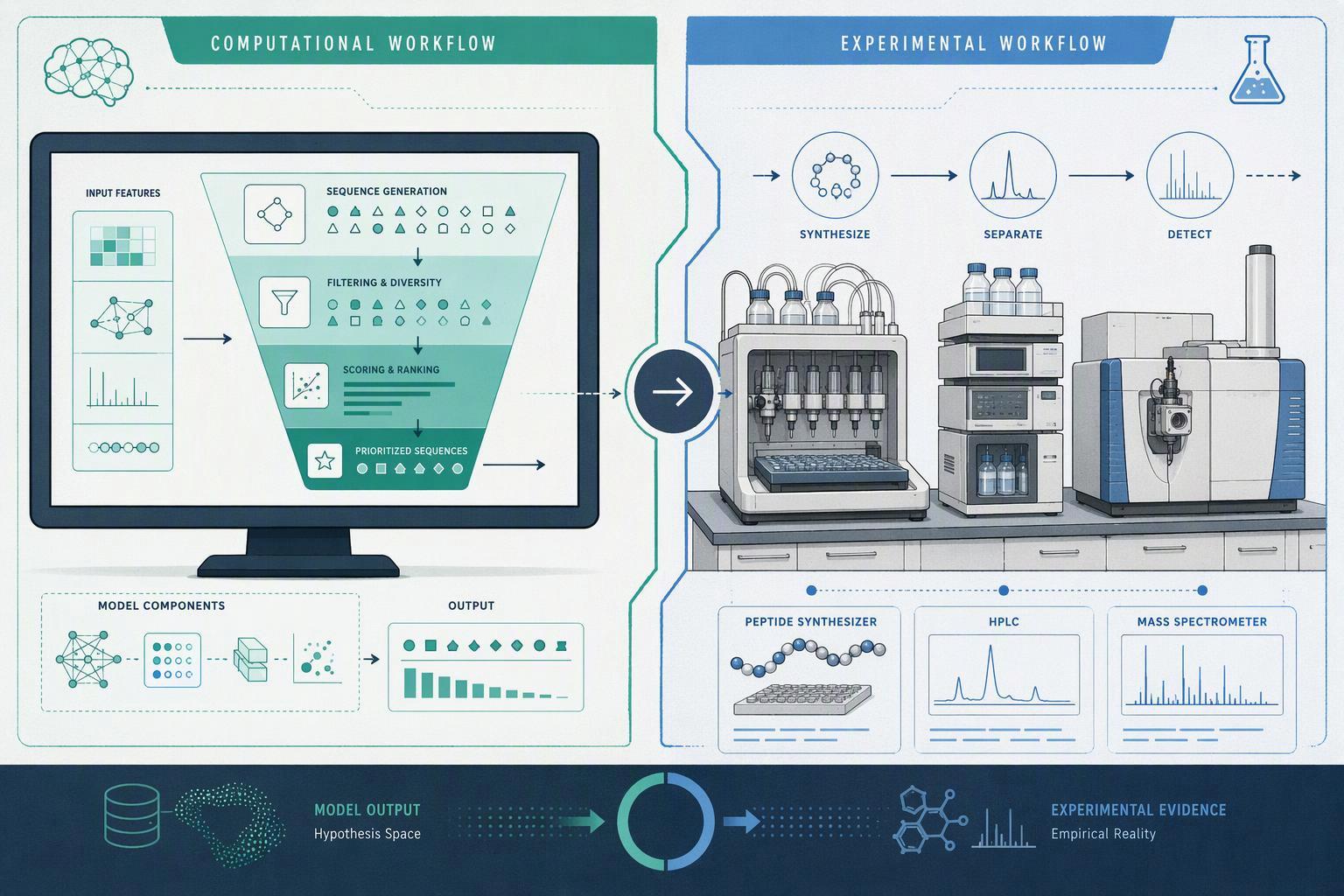
Un punteggio computazionale è un'ipotesi su una proprietà modellata. Convalidarlo con l'endpoint sperimentale pertinente e valutare separatamente la fattibilità della sintesi, rischio di impurità e producibilità. Non trasferire un tasso di successo del legante pubblicato a una classe di peptidi o a un bersaglio diverso senza prove.
I tassi di successo della progettazione computazionale sono comparabili solo quando sono target, classe di molecole, il processo di selezione e i criteri di successo sperimentale coincidono. Gli studi più vecchi basati sulla fisica e le pipeline di leganti più recenti utilizzano impostazioni diverse; nessuno dei due stabilisce un tasso di successo per il costrutto ordinato.
Chiave da asporto: Un punteggio modello stabilisce la plausibilità, non identità. Solo sintesi, la purificazione e la conferma analitica stabiliscono che una molecola esiste come specificato.
Perché la fattibilità della sequenza viene prima di qualsiasi punteggio
Una valutazione di fattibilità di una sequenza peptidica pone una domanda diversa da quella a cui ha risposto il modello di progettazione. L'affinità prevista non dice nulla sul fatto che la catena si assemblerà sulla resina, e le due proprietà sono in gran parte indipendenti: un raccoglitore con un punteggio elevato può essere la sequenza più difficile da realizzare nel set.

L'aggregazione su resina è la spiegazione classica della variabilità specifica della sequenza nell'efficienza sintetica, secondo L’articolo tecnico di Merck sul superamento dell’aggregazione in SPPS (recuperato 2026-02-27). La stessa fonte individua i colpevoli ricorrenti: tratti contigui di Ala, Val e Ile, e residui in grado di formare legami idrogeno intracatena come Gln, Ser e Thr. Ala-Gly ricorre nei peptidi transmembrana idrofobici e amiloidogenici, ecco perché i progetti tratti da bersagli a membrana o inclini all'aggregazione meritano una seconda occhiata prima di essere citati.
L'errore è visibile prima che il batch venga perso. Una grave aggregazione si manifesta come un ritiro della resina nella sintesi discontinua e un profilo di deprotezione appiattito o ampliato nel flusso, e una volta collassata la resina, I test di accoppiamento ninidrina e TNBS possono restituire falsi negativi: il test risulta completo mentre la catena viene troncata. Per sequenze più lunghe di 20 amminoacidi, tracciare l'assemblaggio mediante clivaggio TFA su piccola scala anziché affidarsi esclusivamente al test del colore.
|
Schermo |
Cosa registrare |
Lettura che espone una cancellazione o un troncamento |
|---|---|---|
|
Lunghezza della corsa idrofobica |
Tratto contiguo Ala/Val/Ile più lungo |
Massa LC-MS corta di uno o più residui |
|
Motivi inclini all'aggregazione |
Gln, Essere, I tre cluster; ripete Ala-Gly |
Picco principale HPLC allargato o diviso |
|
Lunghezza della catena |
Residui totali; posizione del percorso più lungo |
Profilo di clivaggio TFA su piccola scala su ciascun segmento |
|
Prestazioni di accoppiamento |
Sintesi della libreria peptidica Forma del profilo di deprotezione nel flusso |
Traccia di deprotezione appiattita; test di Kaiser falso negativo |
La conseguenza pratica del passaggio dalla progettazione alla sintesi è che la fattibilità è una proprietà della sequenza, non del suo punteggio. Schermare le quattro righe Sintesi di termopeptidi sopra prima che la sequenza inserisca una virgoletta, e contrassegnare qualsiasi progetto che ne fallisce due o più per una discussione sul percorso piuttosto che per un ordine diretto.
Compatibilità delle modifiche: Cosa può effettivamente trasportare il percorso
La compatibilità della modifica del peptide è una questione di percorso, non è una domanda da catalogo. La maggior parte delle modifiche non canoniche lasciano intatto il ciclo Fmoc-SPPS di base, ma ognuno aggiunge un vincolo che il percorso deve assorbire: stapling through Alloc/allyl or Mtt/Mmt/Dmt handles installed during assembly and reacted on-resin or late-stage, head-to-tail cyclization needing an orthogonal C-terminal anchor or a cleavable linker, D-amino acids needing milder coupling for racemization control, and N-methylated residues needing stronger activation, higher equivalents or double coupling.
Asp-containing motifs can be vulnerable to aspartimide formation during base exposure, with severity depending on sequence, protecting groups and deprotection conditions. Screen the actual construct and quantify relevant variants rather than using a per-cycle literature range as the process specification.
Screen every proposed modification against the route before you approve it: which handle it needs, whether that handle survives every subsequent deprotection, and what the final cleavage does to it.
Impostazione di obiettivi di purezza per applicazione, Non per abitudine
Peptide purity targets by application should be set at order stage, because the grade you specify drives the synthesis route, the purification effort and the yield you can realistically recover. A standard vendor mapping such as GenScript’s recommended peptide purity guidelines places crude material at first-pass non-sensitive screening, >75% for ELISA, peptide arrays and polyclonal antibody antigen, >85% for in-vitro bioassays, epitope mapping and semi-quantitative enzyme-substrate work, >95% for quantitative receptor-ligand work, blocking or competitive inhibition, NMR and quantitative phosphorylation or proteolysis, E >98% for crystallography, GMP peptides, clinical trials and SAR. Crude peptides are typically around 50–60% pure, though that figure still needs batch verification before it goes into a publication.
|
Destinazione d'uso |
Typical purity target |
|---|---|
|
First-pass, non-sensitive screening |
Greggio |
|
The Synthesis Of Aspirin ELISA, peptide arrays, polyclonal antibody antigen |
>75% |
|
In-vitro bioassays, epitope mapping, semi-quantitative enzyme-substrate work |
>85% |
|
Quantitative receptor-ligand work, blocking/competitive inhibition, RMN, quantitative phosphorylation or proteolysis Large Scale Peptide Synthesis |
>95% |
|
Crystallography, GMP peptides, clinical trials, SAR |
> Peptidi ;98% |
Two cautions belong with that ladder. Primo, purity is an HPLC area-percent of peptide-related material, while net peptide content is a separate quantity that accounts for counterion and water (Bachem, Quality Control of Amino Acids & Peptidi, 2026). Secondo, the vendor tables agree in band but are commercial sources with an interest in selling higher grades, so treat them as a starting framework rather than a specification.
Conferma analitica: Perché un numero HPLC non è un'identità
Peptide analytical confirmation by LC-MS starts from a hard limit: a single HPLC purity number cannot tell an isomeric modification apart from the intended one, because isomers and isobars share mass while differing in site or arrangement. HPLC measures chromatographic homogeneity, not exact chemical identity (Navigating Challenges in Mass Spectrometry Analysis of Endogenous and Synthetic Protein Modifications, PMC, 2026). A clean main peak that is not the intended molecule is a real failure mode, non teorico.
Sample handling compounds the problem. Ossidazione, deamidazione, formylation and acetylation can arise during processing and mimic genuine modifications, confounding identification (same PMC review, 2026). Process control changes the size of that burden: for methionine-containing sequences, the oxidation side reaction fell from roughly 20% a circa 5% under optimised conditions (Methionine-Containing Peptides: Avoiding Secondary Reactions, PMC, 2023). Peptide
Expect a defined impurity spectrum rather than a single contaminant: cancellazione, troncamento, inserimento, stereoisomer or racemization, cleavage-related and degradation products, plus high-molecular-weight species such as dimers and aggregates (Linee guida EMA sullo sviluppo e la produzione di peptidi sintetici, 2022).
Per Suggerimento: Pair a chromatographic purity figure with an orthogonal identity method before releasing a lot. One number describes how much material elutes together, not what that material is.
Nota sull'ambito: this article covers synthesis and analytical practice. It is not clinical or therapeutic guidance.
Dall'output del progetto a una specifica pronta per la sintesi
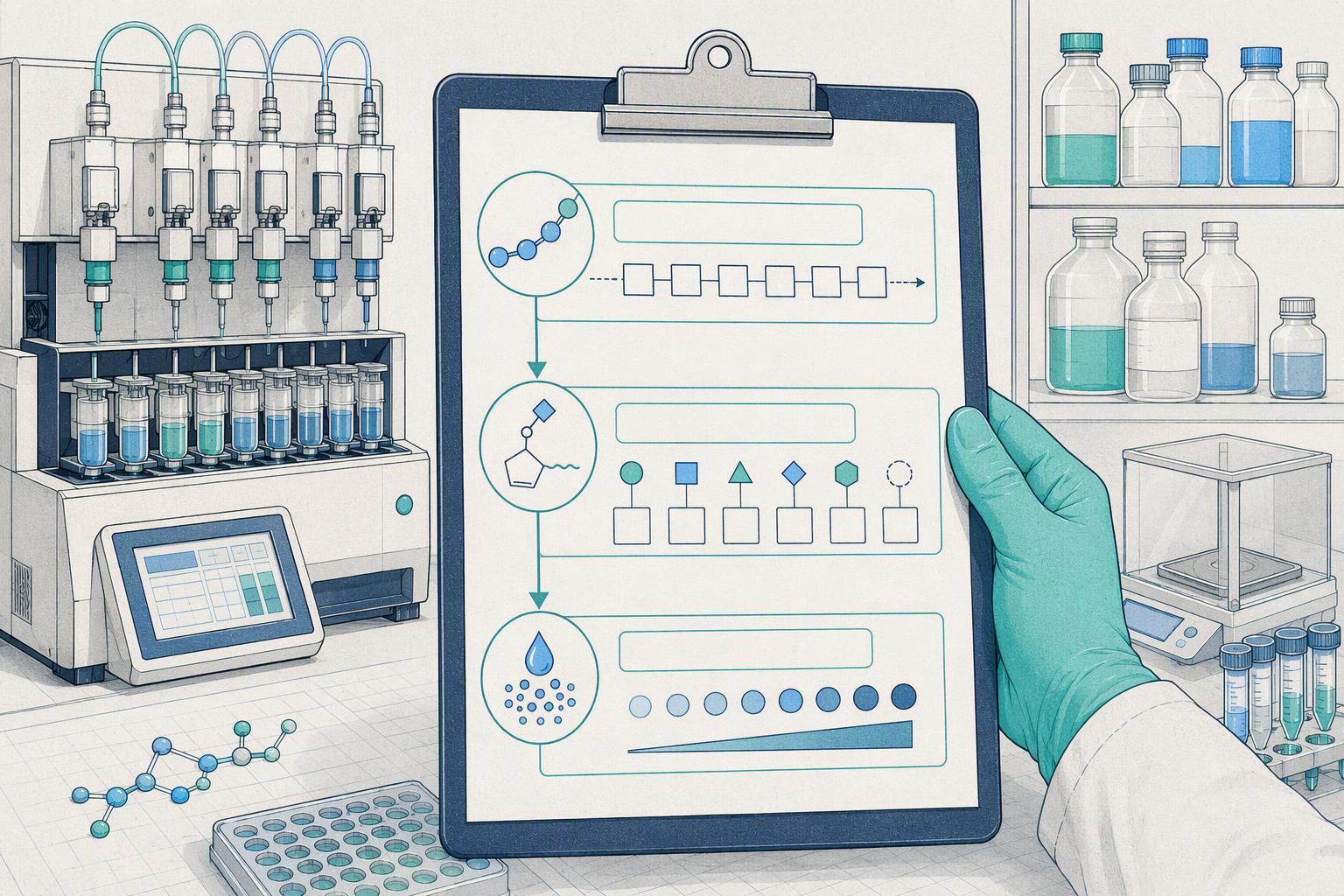
The physics-driven peptide design to synthesis handoff works when the specification, not the structure file, carries the design intent. A synthesis team should be able to start from the specification alone, without re-deriving why a residue or a modification was chosen.
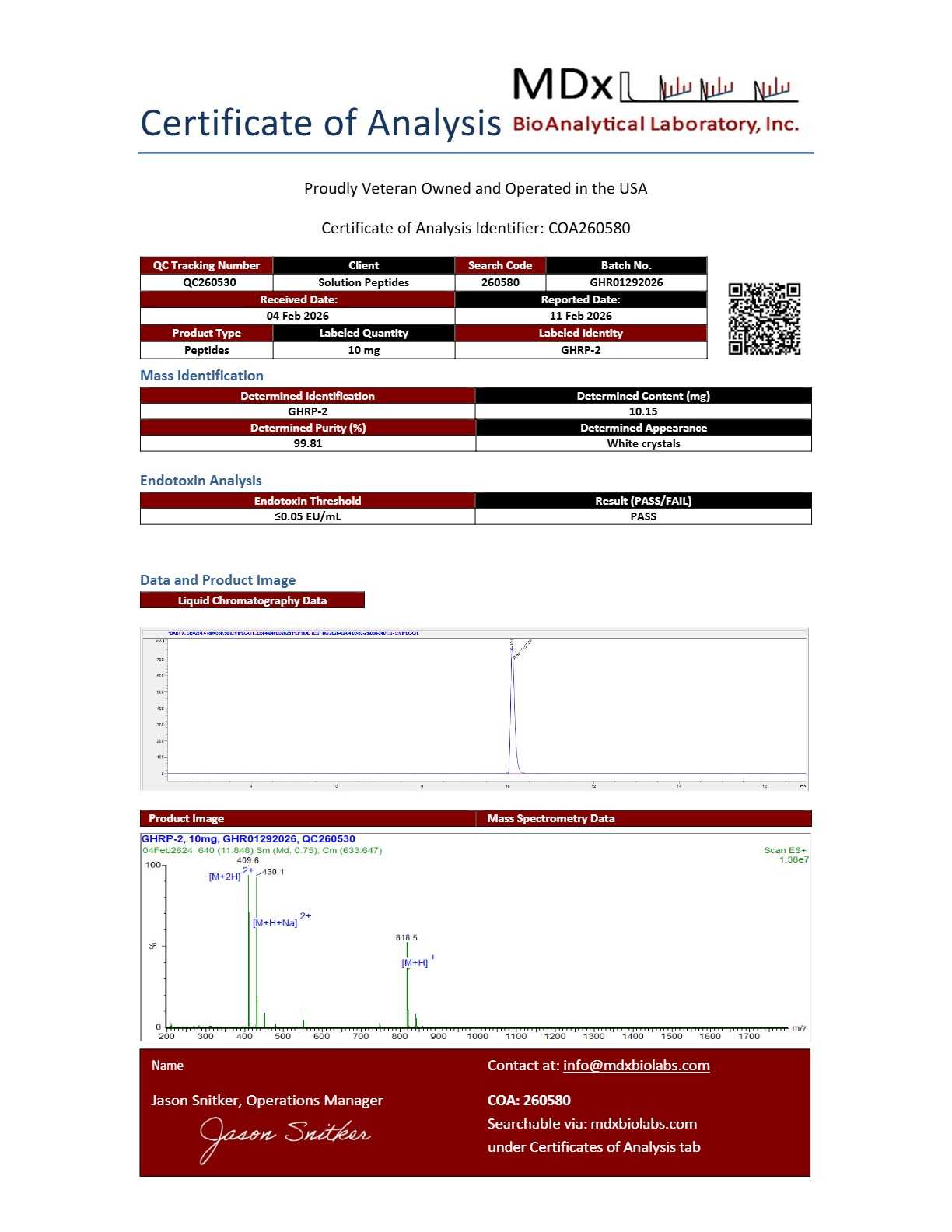
A peptide certificate of analysis typically carries HPLC purity as area percent, Identità della SM, net peptide content or amino acid analysis, controione, contenuto di acqua, E, for higher grades, endotossina, bioburden and residual solvent (Peptidi americani). Endotoxin limits are commonly specified by intended use rather than by a single fixed number: sotto 1 EU/mg for routine cell-based work, sotto 0.1 EU/mg for sensitive immune-cell assays, E 0.1 A 0.5 EU/mg for preclinical in vivo material (Proteomica creativa).
Chiave da asporto: The handoff package is the specification: sequence and modifications, route constraints, grado di purezza, and the analytical package that will release the lot.
La linea guida EMA sullo sviluppo e la produzione di peptidi sintetici, first published 9 Dicembre 2025 and legally effective from 1 Giugno 2026, copre il processo di produzione, caratterizzazione, specifiche e controllo analitico (EMA). An integrated platform such as MOL Changes shows the same contract in practice: sequence and intended use assessed at intake, then HPLC, MS and sterility testing reported with the lot.
Errori comuni che trasformano un buon progetto in un lotto fallito
The most consequential mistake is treating an in silico score as experimental validation. UN 2023 Nature Portfolio study of de novo designed protein interfaces reported 93.5% failure across heterodimeric interfaces and 96.4% across homodimeric interfaces (Communications Chemistry, 2023). That is one study, not a corroborated benchmark, but it makes the point: a favorable computational score predicts plausibility, not a synthesizable, molecola pronta per il test.
The recurring bench mistakes follow the same pattern. Teams skip a feasibility screen on hydrophobic or aggregation-prone stretches, because the design output looked clean. They assume a modification is route-compatible without checking the protecting-group strategy it demands. They specify purity by habit rather than by application. And they accept a single HPLC purity number as identity confirmation, when purity and identity are separate questions.
Verify feasibility, route compatibility and the analytical acceptance criteria before committing a batch. Estimate rework time and cost from the actual sequence and supplier proposal; no universal resynthesis duration follows from these risks.
Domande frequenti
È possibile utilizzare un punteggio di progettazione basato sulla fisica come prova dell'attività??
NO. A score from a physics-driven design tool is a hypothesis about structure, not a measurement of function. BindCraft’s own reported success rates for de novo binder design range from roughly 10% A 100% depending on the target and the campaign (BindCraft), which is precisely why the score cannot stand in for an assay. Treat the computational result as a reason to synthesize and test, never as a substitute for the test.
Quanto tempo richiede una valutazione di fattibilità della sequenza peptidica, e cosa lo spinge?
Most of the time goes to the sequence itself rather than to queue position. Difficult stretches, aggregation-prone regions, and unusual modifications each add review time, because the assessment has to check coupling efficiency and route viability before anything is committed. A straightforward sequence with a standard purity target moves quickly; a heavily modified or long construct takes longer, and the honest answer is that the timeline follows the chemistry, not a fixed calendar.
È possibile realizzare una struttura pesantemente modificata o pinzata con Fmoc SPPS standard?
Spesso sì, but not automatically. Staples, macrociclizzazione, and unnatural residues each impose their own constraints on coupling and deprotection, and the route has to be chosen per sequence rather than assumed. This is exactly the kind of question a feasibility review exists to answer: whether the modification is compatible with standard Fmoc chemistry, or whether the route needs to change.
Cosa devo fare quando il picco principale non corrisponde alla massa prevista?
Do not accept the peak on the basis of retention time alone. A mismatched mass means the identity is unconfirmed, and the correct response is to hold the lot and investigate rather than proceed. Purity by HPLC and identity by mass spectrometry answer different questions, and a clean chromatogram does not resolve a mass discrepancy.
Un grado di purezza più elevato vale sempre il costo??
NO. The right purity target follows the application, not a default preference for the highest number. A grade chosen for a demanding assay is money well spent; the same grade applied to a screening use may buy nothing the experiment needs. Set the target from what the downstream work actually requires.
Conclusione
You can now screen a physics-driven peptide design to synthesis handoff in four moves: check sequence feasibility before you trust any score, confirm the route can carry each modification, set purity from the application rather than from habit, and require orthogonal analytical confirmation instead of a single HPLC number. The mechanism underneath all four is the same. A physics-driven design output is a hypothesis; sintesi, purification and analytical confirmation are what turn it into evidence.
MOL Changes offers custom peptide synthesis and analytical services. This article is educational and describes general synthesis and analytical practice; it is not medical advice.