Steg 1: Separera identitetstestning från renhetsdata
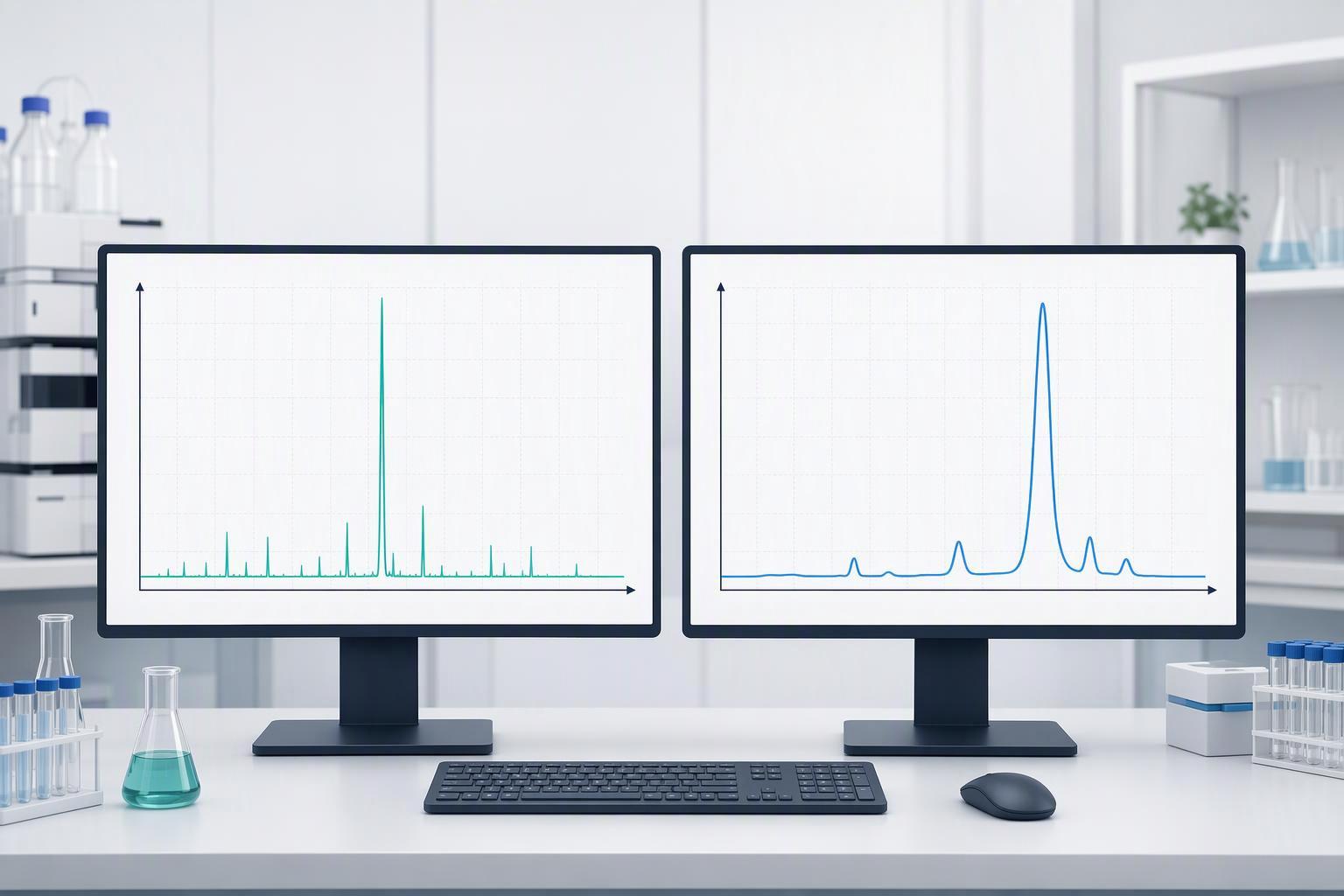
Identitet och renhet är separata analytiska frågor, och en leverantör som bara svarar på en av dem har inte svarat på någotdera. Identitet frågar vad materialet är: det kräver specifika, ortogonal bekräftelse såsom masspektrometri, LC-MS/MS, aminosyraanalys, NMR, peptidkartläggning, eller HPLC-retention mot en referensstandard (USP referens standardarbete, 2023). Masspektrometri separerar molekyler genom mass-till-laddning-förhållande och rapporterar en molekylvikt; LC-MS/MS lägger till ett fragmenteringssteg som läser sekvensinformation. Renhet är ett helt annat mått: den kvantifierar målpeptiden i förhållande till föroreningar och relaterade ämnen, och säger ingenting om huruvida målet är rätt molekyl.
Det gapet är felläget värt att namnge. En förening kan läsa 99% ren genom HPLC och fortfarande vara fel peptid, eftersom en hög renhetssiffra inte är bevis på identitet. I BPC-157 renhetstestning, ett rent kromatogram bekräftar att en art dominerar provet, inte att arten är BPC-157.

Renhet beräknas från den integrerade topparean: måltopparea dividerat med total integrerad topparea, multiplicerat med 100. Konventionen antar omvänd fas HPLC på en C18-kolonn med UV-detektion vid 220 nm, våglängden där peptidbindningar absorberas (Dokumentation för GenScript-peptidkvalitet).
Vad ska man kontrollera: innehåller dokumentationspaketet en identitetsmetod (MS, LC-MS/MS, eller motsvarande) rapporteras separat från renhetsmetoden, eller presenterar det en enda renhetsprocent som hela den analytiska historien?
Handla ="https://molchanges.com/wp-content/uploads/2026/10/pub_20261002_013927_165_11203be2c7974a76b7f4d56fce8c9749.png">
Steg 2: Läs ett renhetspåstående för dess metod, Massa, Labb, och datum
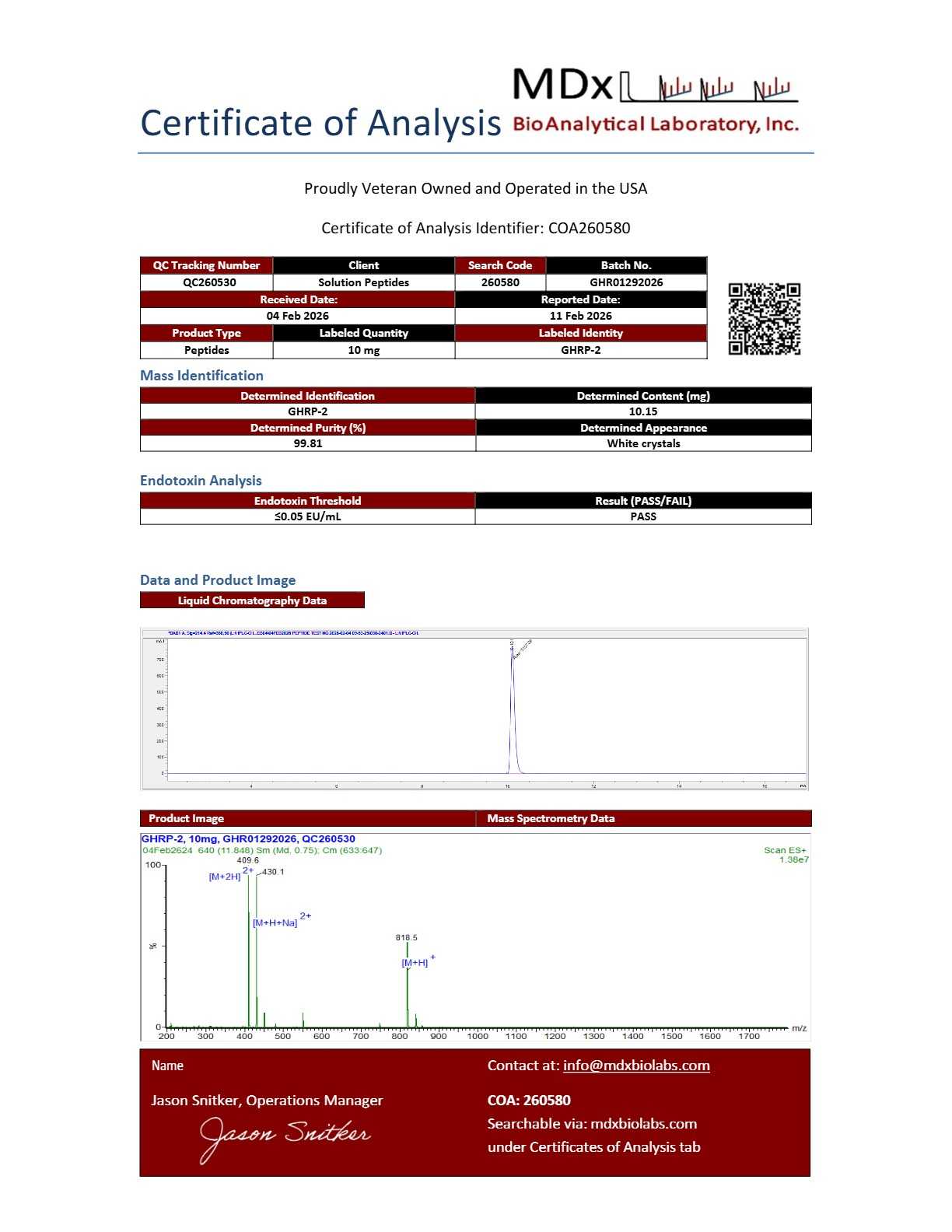
Eftersom identitet och renhet är separata frågor, en renhetsprocent blir bevis först när metoden, partinummer, testlaboratoriet, och analysdatum resa med det. Dessa fält är kärnan i de flesta krav på peptidcertifikat för analys.
Peptidsyntes Börja med metoden. Ett försvarbart HPLC-UV-resultat med omvänd fas namnger dess detektionsvåglängd, kolumn, och gradient, och anger den standard den validerades mot. Ett kontraktslaboratories publicerade metod använder en C18 5 µm, 4.6 × 250 mm kolonn med en vatten/acetonitrilgradient innehållande 0.1% TFA eller myrsyra, läser i första hand kl 214 nm med en 280 nm sekundär kanal, rapporterar föroreningar ner till 0.1% av den totala topparean, och är validerad till ICH Q2(R1) och USP <621> (ACS labbtest, hämtas 2026-01-01). Det är en dokumenterad HPLC-metod, inte bara en procentsats. Om ett CoA säger "≥98% (HPLC)” och stannar där, du kan inte avgöra om siffran kom från en validerad metod eller en enda injektion på ett okalibrerat system.
Den andra distinktionen är viktigare än de flesta köpare förväntar sig: en UV-area i procent är inte nettohalten av peptider i vikt. USP tilldelar peptidrenhet genom massbalans, mäter varje detekterbar föroreningsklass, inklusive peptidrelaterade föroreningar, motjon, vatten, kvarvarande lösningsmedel, och obrännbara rester, och subtrahera summan från 100% (USP referens standardarbete, 2023). Eftersom UV-area-procent renhet inte mäter motjoner, TFA eller acetatsalter, vattenhalt, eller kvarvarande lösningsmedel, en hög areaprocent kan samexistera med en väsentligt lägre nettohalt av peptider i vikt.
Kontrollera sedan varan och datumet mot din egen beställning. En renhetssiffra tillhör ett parti som testats på ett datum, inte till en produktlinje. När du skalar från milligram till gram, be om CoA för Syntetiska peptider mycket du faktiskt får, och jämför dess analysdatum med leveransdatumet. Ett CoA daterat arton månader före leverans beskriver en annan sats av material än den i kartongen.
Hur ett misslyckande ser ut: ett CoA med en renhetsprocent, ingen metodrad, inget partispecifikt analysdatum, och inget kromatogram. Du har inget sätt att avgöra om siffran mättes, uppskattas, eller kopieras från en tidigare batch.
Steg 3: Begär dokumentationspaketet och kontrollera det mot ALCOA+
När du vet vilka fält ett renhetskrav behöver, nästa steg är att begära hela paketet, eftersom ett CoA inte är ett enda dokument. Det är ett paket, och paketet är vad du inspekterar.
Fråga efter dessa fält innan du utvärderar något annat: partinummer, tillverkningsdatum, analysdatum, testlaboratoriet, analytisk metod, kromatogram eller spårreferens, masspektrometrisk identitetsresultat, lagringsförhållanden, och ett uttryckligt uttalande om vad som var inte testat. That last field is the one most suppliers omit, and its absence tells you more than its presence would. These are the core peptide certificate of analysis requirements a qualification reviewer works through.
Judge the package against the ALCOA+ data-integrity attributes, which require records to be attributable, läsbar, samtida, original och korrekt, plus komplett, konsekvent, enduring and available. The five original attributes trace to FDA CGMP guidance finalized in December 2018; MHRA’s GxP data-integrity guidance, Revision 1 (mars 2018), added the remaining four. Contemporaneous is the test that catches most weak packages: an analysis date reconstructed months after synthesis fails it.
A lot-specific package from MOL Changes illustrates the inspectable form: an analytical report tied to a named lot, with traceable quality data for research and industrial use. MOL Changes operates Class 100 ultra-sterile cleanroom production with in-house HPLC, MS och sterilitetstestning, and manufactures custom and catalog peptides from milligrams to kilograms.
⚠️ Varning: a CoA is produced by a party with an interest in the result; independent third-party testing is what raises its evidentiary weight.
Steg 4: Tillämpa kontroller för avsedd användning som ett kvalificeringskriterium
Documentation tells you what was tested; intended-use controls tell you what the supplier believes the product is for. Research use only peptide labelling is not boilerplate, and treating it as boilerplate is how buyers end up qualifying a consumer-facing seller. RUO designates a product manufactured and sold for laboratory research, whether that is in vitro studies, animal testing, analytisk kemi, or preclinical investigation. Such products are not made under pharmaceutical GMP, have not undergone the testing required for human use, and carry no regulatory approval (Peptide Journal, 2025).
The label alone decides nothing. Under the FD&C Act, intended use, not the disclaimer, governs: a peptide marketed or intended for the diagnosis, bota, behandling, or prevention of disease in humans is a drug under federal law regardless of what the label says. FDA weighs labeling and packaging, advertising and marketing, and the totality of evidence (Peptide Journal, 2025).
So read the whole storefront, not the product page. A supplier that publishes dosing guidance, human-use testimonials, or before-and-after claims has told you its intended market, whatever its footer says. A supplier whose materials stay on analytical and laboratory ground has separated research-grade from consumer-facing product.
Nothing in this guide is medical or dosing guidance, and no product referenced here is offered for human use.
Steg 5: Testa om leverantören kommunicerar transparent
Transparency is the criterion most suppliers fail, because it costs them something to pass. A supplier that communicates well will tell you what its documentation does not prove, name the laboratory that ran the tests, and publish dated lot records instead of a single undated purity figure.
Three pass/fail signals carry most of the weight in research-grade peptide supplier verification:
-
States the limits of its own documents. A passing supplier says plainly that a certificate of analysis (CoA) confirms identity and measured purity for one lot, and does not establish sterility, endotoxin levels, or suitability for any clinical use. A failing supplier lets the CoA imply more than it shows.
-
Names the testing laboratory. A passing supplier identifies the lab and whether it is in-house or independent. A failing supplier writes “third-party tested” with no lab named, which is a claim, not a record.
-
Publishes dated lot records. A passing supplier shows lot numbers with analysis dates you can match to your shipment. A failing supplier shows one purity number with no lot and no date.
För tips: ask for two CoAs from different lots of the same peptide and compare the impurity profiles, not just the headline purity figure.
A useful category observation: across the supplier pages reviewed for this guide, none taught readers how to read a CoA, what a passing versus failing result looks like, or how to spot a forged or duplicated CoA. The top-ranking supplier page also carried no page-level publish or update date. Treat an undated page as a signal in itself, and ask the supplier directly when the record was last updated.
Steg 6: Lägg de fem kriterierna i ett arbetsflöde för kvalificering av leverantörer

Run the five criteria as a sequence, not a checklist you sample from. Identity confirmation comes first, because a purity figure for the wrong molecule is meaningless. Purity review follows, then the documentation package, then intended-use controls, then transparency. A supplier that fails any stage is rejected at that stage; you do not carry it forward to see whether the rest looks better.
The reason to run your own sequence rather than accept a supplier’s self-reported pass rate is that the published failure figures are narrower than they appear. Third-party testing programs have published tens of thousands of results, inklusive 9,997 peptide vials submitted for analysis, of which BPC-157 accounted for 756 tests across 110 vendors (peptidesbeat.com report on the Finnrick dataset, dataset updated 2026-09-03). The widely repeated claim that roughly one in three samples fail basic expectations comes from that same single dataset, self-reported and not peer-reviewed, and the proportion has held stable over 12 till 14 months of reporting on the gray-market peptide boom. One dataset, echoed across outlets, is not independent corroboration.
That is the case for peptide supplier due diligence as a buyer-side control. Research-grade peptide supplier verification is something you perform against artifacts you inspect, and no documentation package substitutes for it. Peptidproduktion
Vanliga misstag att undvika
Accepting a high purity figure as proof of identity. A 98% HPLC result says the main peak dominates the chromatogram; it does not say the peak is the right molecule. Identity comes from mass spectrometry, where the observed molecular weight matches the designed construct. Suppliers blur the two because a single purity number is easier to market than a two-part analytical story. Ask for both, and check that the identity method names the expected mass.
Treating a UV area-percent number as net peptide content by weight. UV detection at 214 nm responds to the peptide backbone, so the percentage reflects relative peak area, not how much peptide sits in the vial. Residual counterions, water and salts are invisible to the detector but very present on the balance. This is the most common gap in peptide certificate of analysis requirements: en UV-area i procent är inte nettohalten av peptider i vikt, and a supplier who presents it as such has either misunderstood the assay or is counting on you to.
Listing assays without showing what a pass or fail looks like. Across the supplier pages reviewed for this guide, chromatograms and spectra appear as decoration rather than as results with stated acceptance criteria. A specification you cannot compare against a reported value is not a specification.
Leaving pages undated. An undated CoA or specification page cannot be tied to a lot, a method revision or a testing laboratory, which undermines the traceability the document exists to provide.
Key Takeaway: a purity figure without a method, massa, laboratory and date is a claim, not a measurement.
Vanliga frågor
Hur kan jag skilja ett förfalskat eller duplicerat CoA från ett äkta?
Check that the lot number on the certificate matches the lot on the vial label and packing slip, then look for a chromatogram or spectrum specific to that lot rather than a figure reused across products. A document that names no testing laboratory and no analysis date, or whose chromatogram reappears under a second lot number, is unverified. Requesting the raw data file behind the report is the strongest check available. Om
Can I verify a supplier’s claim that a third party tested its peptides?
Partly. You can confirm the named laboratory exists, offers the cited method, and issues reports in that format. What the document cannot show is that the sample submitted came from the lot you received. That gap is not hypothetical: reporting on the gray-market peptide boom found that about a third of the thousands of products analysed failed basic quality checks, a proportion broadly unchanged over the 12 till 14 months of data gathering. Independent testing of a retained sample from your own receipt is the only way to close it.
Vad ska jag göra om en CoA rapporterar renhet utan kromatogram eller lotmatchning?
Ask for the missing artifacts before evaluating the number. A purity figure without a method, a lot identifier, and a supporting chromatogram cannot be traced to anything, so it functions as a marketing statement rather than analytical evidence. Note also what a purity figure is not: the FDA’s peptide dossier guidance sets at least one peptide-related impurity threshold of 0.10% of drug substance for impurity characterization, a characterization requirement and not an identity proof. Meeting your peptide certificate of analysis requirements means holding identity, renhet, and lot traceability as separate records, not one headline percentage.
Does a research-use-only label change a supplier’s legal position?
It shifts the framing rather than settling the question. A research-use-only label states the product’s intended application, and regulators assess the supplier’s conduct against that intent. As one legal analysis of the gray area puts it, intended use, not the disclaimer, governs. I praktiken, research use only peptide labelling is a qualification signal: a supplier that consistently separates research-grade material from consumer-facing product, and publishes no dosing or human-use guidance, is easier to qualify than one whose marketing contradicts its own label. This is not legal advice; consult counsel for your jurisdiction.
Slutsats
The five criteria are one habit: separate identity from purity, read every purity claim for its method, massa, lab and date, check the documentation package against ALCOA+, treat intended-use controls as a qualification gate, and watch how the supplier answers an awkward question. Peptide supplier due diligence is not a one-time audit but the practice of preferring a supplier whose artifacts can be inspected over one whose claims can only be believed. A lot-specific CoA that names the testing laboratory, the analytical method and the analysis date gives you something to file, compare across batches and hand to a colleague; a purity percentage with none of that context gives you nothing to check.
If you want to run the framework against a real package, request a sample CoA package or talk to a technical specialist. Both are low-commitment steps that let you test the documentation before any purchasing decision.
Avslöjande: MOL Changes has a commercial interest in peptide quality standards and supplies research-grade peptides with lot-specific analytical documentation. Nothing in this guide is medical or dosing guidance, and all products discussed are for research use only.
Reviewed by the MOL Changes technical team. Consult a qualified professional before making decisions about research materials.