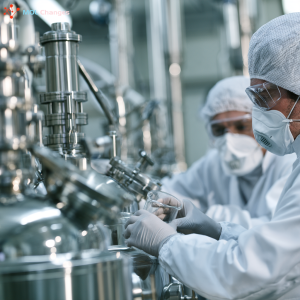
Varför flaskhalsen flyttade från modellen till bänken
En AI-medforskare är ett multiagentsystem som genererar och rangordnar forskningshypoteser; gränssnittet på bänksidan är allt mellan en rankad kandidat och en flaska med karakteriserat material. Modellförmågan har överskridit det gränssnittet, och gapet är där vinsterna går förlorade.
Googles egna rapporterade valideringar är den tydligaste illustrationen. Dess multiagent Gemini-medforskare föreslog akut myeloid leukemi som återanvänder kandidater som hämmade KG-1-viabilitet vid kliniskt relevanta koncentrationer, epigenetiska mål som visade aktivitet i mänskliga leverorganoider (sid < 0.01), och en cf-PICI/fagsvansmekanism för antimikrobiell resistens (Google Research, 2025-02-19). Läs det finstilta: systemet producerade hypoteser, inte material. Vart och ett av dessa påståenden blev ett anspråk först efter våtlabbarbete, och när de första peer-reviewed co-scientist resultaten dök upp i Nature, täckning var tydlig att labvalideringarna, inte modellen, bära bevistyngden (IEEE spektrum, 2026).

Mönstret upprepas över hela fältet. En utvärdering av sex agentiska upptäcktsramverk visade att ingen helt stödde någon av 15 verkliga uppgiftsklasser, och peptidspecifika uppgifter hade noll täckning, med system som är partiska mot representationer av små molekyler (granska täckning, 2026-02-13).
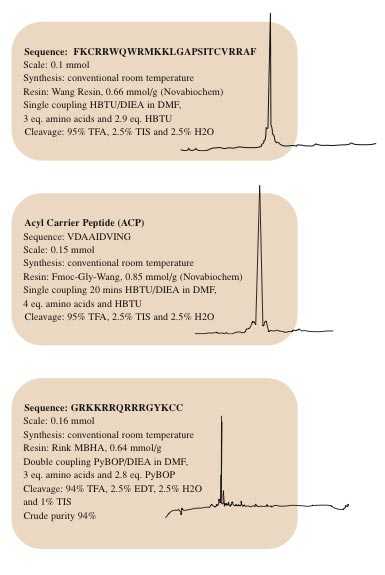
Det fysiska lagret är inte ett avrundningsfel. Samma 16-mer, sex hartser, en femfaldig spridning i rå renhet: barstjärna[75–90] sträckte sig från 20% till 52% utan en solubiliserande tagg och 41% till 72% med en ArgTag (SPPS-hartsstudie, 2025-11-21). Effektivitet per steg kombinerar på samma sätt: 99% över 30 rester ger ungefär 74% total avkastning, 98% ger om 55%, och 95% ger om 21% (tillverkningsförklaring, 2026-07-24). Den sista uppsättningen är aritmetisk illustration, ej uppmätt kampanjdata, och siffror av denna typ varierar beroende på källa.
Key Takeaway: En modell som rankar kandidaterna väl ger fortfarande bänken en molekyl vars syntes genomförbarhet, modifieringskompatibilitet och analytisk bekräftelse är osäkra. AI-designad peptidsyntes genomförbarhet är begränsningen som anger vad loopen faktiskt kan leverera.
Peptidsyntes över sex synteshartser plus PS-2CTC i pilotskala, två serier per harts (utan ArgTag / med ArgTag). Värden utan/med: 20/41, spår/24, 45/72, 52/58, 51/64, 34/64, 27/50. Källa: PMC12645436, 2025.]
Synthesis Feasibility är ett designfilter, Inte en post-hoc-kontroll
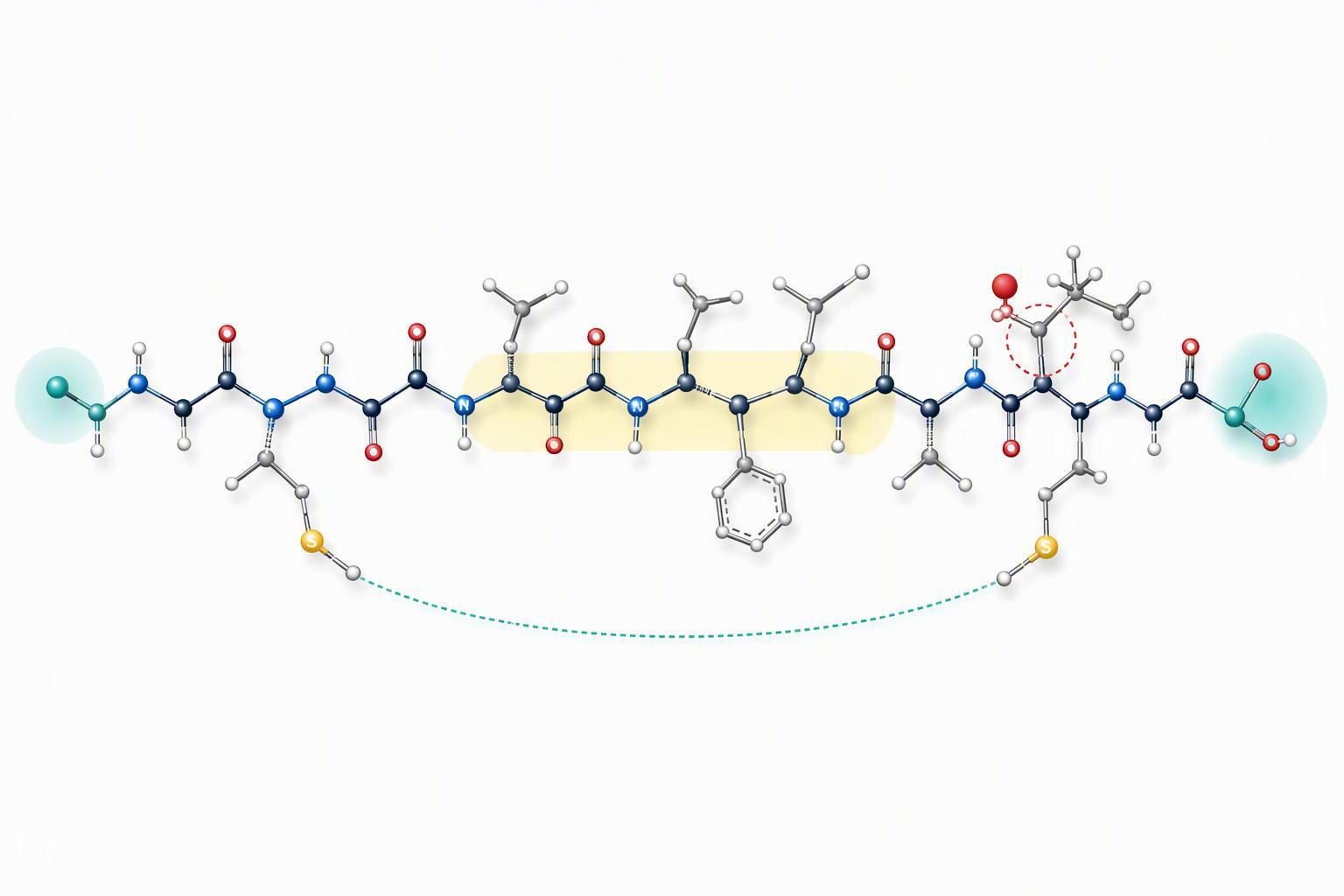
AI-designad peptidsyntes genomförbarhet måste gate en kandidat innan någon lägger en beställning, inte förklara misslyckandet i efterhand. Behandla det som ett designfilter: en skärm på sekvensnivå som körs på modellutgången, i samma slinga som poängfunktionen.
Det praktiska taket som de flesta synteskemister arbetar mot är kort. Ovan ungefär 15 aminosyror, fastfas råprodukt bär ett stort antal lågaktiva biprodukter, och dessa biprodukter överstiger ofta målpeptiden i råoljan (SPPS praktisk granskning, 2025). Över 35–40 rester, stegvis slutar SPPS att vara den rätta vägen och konvergent kondensation eller naturlig kemisk ligering tar över (samma recension, 2025).
Aritmetiken förklarar varför. På 95% per steg, en kedja med 30 rester ger ungefär en femtedel av teorin; över 100 rester, a 1% förlust per steg lämnar ungefär en åttondel av teorin (Förklaring av peptidsyntes, 2026). Båda figurerna är aritmetiska illustrationer, ej uppmätt kampanjdata.
Syntetiserbarhetspoäng hjälper här, med gränser. SAscore validerades mot kemistbedömningar vid r² = 0.89 på fyrtio molekyler, ett litet set (RSC Chemical Science, 2025), och litteraturen ramar in sådana poäng som tidigvarningsfullmakter, inte bevis på tillverkningsbarhet (Syntetiserbarhetsfiltreringsstudie, 2026).
Key Takeaway: Separata sekvensinneboende genomförbarhetsproblem (aggregeringsbenägenhet, hydrofob sträckning, multi-disulfid topologi, steriskt hindrad koppling) från ruttberoende (skyddsstrategi, val av harts, klyvnings- och reningsförhållanden). Den första är en designbegränsning; det andra är ett processval.
Modifieringsbegränsningar hör till generationssteget
Restriktioner för peptidmodifiering är en indata från generationstid, inte en överraskning vid reningstiden. Den avsedda kemin och den verkliga syntesvägen måste kontrolleras mot varandra innan en modell förbinder sig till en kandidat, eftersom en poäng som endast består av struktur inte kan se rutten. Modellerna är fortfarande passande mönster, inte fysik: peer-reviewed reviews of multi-agent peptide-design frameworks report that these systems are limited by sparse high-quality experimental data, weak handling of flexible and disordered peptides, and reliance on statistical patterns rather than physical chemistry (Briefings in Bioinformatics, 2024; Kemisk kommunikation, 2026).
That gap is where a compatibility check earns its place. A candidate carrying lipidation, cyclization or a fluorescent tag should be run against a modification menu that covers the intended chemistry before an order is placed, not after a failed Syntetiska peptider massa. In practice this is a short exchange: sequence in, intended modification named, route and feasibility read back. Where the menu stops, a capable CDMO or specialist supplier is the honest answer, and the arbiter is still the experiment.
En avläsning är inte bekräftelse
Orthogonal analytical confirmation of peptides means using methods whose physical basis for separating or identifying a molecule is genuinely independent, not two runs of the same principle. A single reverse-phase HPLC trace tells you the lot elutes as one peak; it does not tell you what that peak is. The FDA’s own list of deficiencies in comparative peptide filings expects orthogonal chromatographic methods with different separation principles alongside UHPLC-HRMS/MS to confirm peak identity (FDA comparative-peptide-analysis guidance, 2022-09-20). I Q2(R2) sets the validation characteristics per procedure type and allows specificity to be demonstrated against a second, well-characterized procedure, including an orthogonal one (I Q2(R2), 2023-11-30). Q6B sets specifications from manufacturing-consistency lots, which is why acceptance criteria belong to the lot, not to the assay (Jag Q6B).
|
Impurity level |
Tjänster Action required |
|---|---|
|
≥0.10% |
Report |
|
≥0.5% |
Identify |
|
≥1.0% |
Qualify |
|
>0.5% new impurity vs. reference product |
Not acc Handla eptable |
Thresholds per the FDA guidance (2022-09-20) och den EMA synthetic-peptide guideline (2025-12-04).
The recurring bench pattern: a candidate ranks well in silico, synthesizes as a low-recovery crude, purifies poorly, and yields a lot whose single-method readout looks acceptable while the orthogonal method disagrees.
Identity and purity documentation should be traceable to raw data files per lot, and a CoA without the underlying chromatogram and mass spectrum is not verifiable. Peptidproduktion
Batchjämförbarhet är en designingång
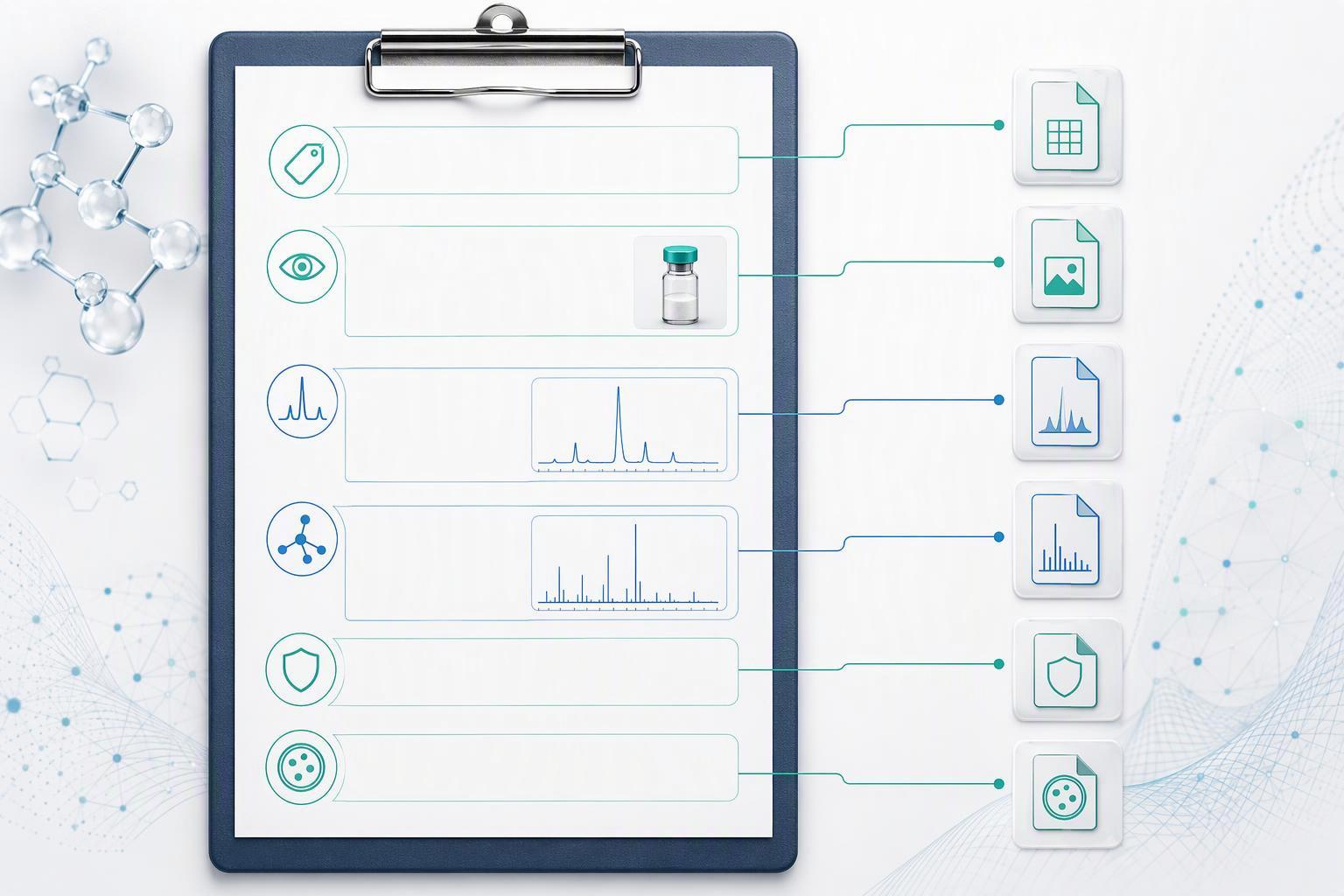
Peptide batch-to-batch comparability is the ability to show that two lots of the same sequence meet the same specification, and it is decided long before QC opens a vial. A specification is not a purity number; it is tests, procedures and criteria, and the same thresholds apply lot to lot (FDA guidance on endotoxin limits). Route and resin choices are comparability variables: in a 2025 SPPS study, one sequence gave 27% crude purity on high-loading PS-2CTC resin at 0.75 mmol/g, stiger till 50% på 0.69 mmol/g with the tag, while apolar PSAM-RAM gave roughly 20% and MBHA-RAM only trace product (same SPPS resin study). By-products fall into deletions, terminations and chemical modifications, and their profile shifts with the route.
No published 2025–2026 dataset gives a numeric lot-to-lot purity distribution for complex modified peptides versus simple linear peptides. What the record does fix is the release layer: sterility takes 14 days in two media at two temperatures before a sterility result exists, with no growth in either medium required (FDA Pharmaceutical Microbiology Manual), and endotoxin is judged against the 5 EU/kg parenteral limit, calculated as K/M (FDA guidance on endotoxin limits). A per-lot documentation set records lot number, utseende, purity by HPLC with chromatogram, identity by MS with spectrum, and endotoxin and sterility results, each traceable to its raw data file.
Loop-hastigheten bestäms av analytisk vändning, Inte inferenshastighet
The design-test-learn cycle for peptide discovery, the loop where a candidate is designed, synthesized, tested and fed back into the next round, is gated by calendar time on the bench, not by inference speed. In AI-driven small-molecule discovery, a design-make-test-analyze iteration commonly runs 4 till 8 veckor, while peptide service quotes put standard synthesis at 1 till 3 weeks and modified or longer peptides at 2 till 6 veckor, with primary assay turnaround of 3 till 5 dagar, 5 days with ADME, and under 10 days with in vivo PK (BioIndustry Association, hämtas 2026-09-12). Those are vendor and service-level statements, not a controlled benchmark. AstraZeneca’s under-5-day design-to-test-data target and sub-2-hour prototype cycle show what the same loop looks like when the wet-lab steps are engineered for speed (IRBM, hämtas 2026-09-11).
The calendar time a synthesis request actually consumes follows the same shape: standard peptides of 2 till 30 amino acids at above 80% purity typically arrive in 10 till 15 arbetsdagar, express orders in 5 till 7 dagar, and complex or multiply modified sequences in 3 till 4 veckor. Shortening the loop means buying back those weeks, not shaving milliseconds off a model run.
Men modeller kommer att designa kring kemi - gör de inte redan?
Partly, and the concession matters. SAscore-class synthesizability filters are standard practice, and the 2025–2026 literature treats accessibility scores as useful early-warning proxies. But the same literature is explicit that they are proxies, inte bevis på tillverkningsbarhet, with the physical experiment remaining the arbiter. The proxy is also thinner than its reputation: SAscore was validated on forty molecules, and it is structure-only rather than route-based. On the model side, a review of six agentic frameworks found zero peptide-task coverage across six frameworks, with a bias toward small-molecule representations, and the underlying scoring is largely fitting patterns, inte fysik. Better filters raise the hit rate. They do not remove feasibility, modification compatibility, orthogonal confirmation and comparability as design inputs.
Nästa steg: Behandla gränssnittet som designytan
AI-designed peptide synthesis feasibility, modification compatibility, orthogonal confirmation and batch comparability are design inputs, not downstream checks, and the loop rate is set by analytical turnaround rather than inference speed. The starting sequence is short. Screen candidates against sequence-intrinsic feasibility rules before you order anything. Check the intended modification against the route that will actually run it. Require orthogonal confirmation with per-lot raw-data traceability. Specify comparability criteria in the order itself, not in a follow-up email after the first lot arrives.
MOL Changes is a specialized peptide R&D organization integrating organic chemistry and biology, offering custom synthesis from sequence design to large-scale production, with production in Class 100 ultra-sterile cleanroom environments and QC by MS, HPLC, AAA, endotoxin, motjon, optical rotation and UV content. MOL Changes har ett kommersiellt intresse av peptidkvalitetsstandarder. Development-stage material characterization is not a clinical claim, and formulation or dosing decisions belong with qualified professionals.
Send a sequence for a feasibility read. You get a route assessment and a realistic timeline before you commit to an order, which is the cheapest way to find out whether a candidate can exist in a vial. Om
Vanliga frågor
Don’t synthesizability filters already solve this?
Partly, and that is the honest answer. Filters are useful proxies, not certificates. A 40-molecule validation set showed that predicted synthesizability and bench outcomes diverge often enough that a filter can rank candidates but cannot clear one. Treat a passing score as permission to try, never as evidence the molecule exists.
Vårt program är redan engagerat för kandidater som inte är genomförbara. Vad nu?
Re-sequence the route before you re-design the molecule. By-product accumulation becomes the dominant constraint above roughly 15 rester, and the route itself changes above 35 till 40 rester, where convergent ligation starts to pay. Many “infeasible” sequences are feasible on a different assembly strategy.
Won’t models simply get better and design around chemistry?
Capability is improving; coverage is not. Six major evaluation frameworks contained zero peptide coverage, so the frameworks were not evaluated on peptides. Better models help, but peptide modification constraints are physical, not informational, and no benchmark currently measures them.
Har batchjämförbarhet betydelse i forskningsskala, eller endast vid tillverkning?
It matters as soon as two lots feed one experiment. Comparability is a specification question: define impurity thresholds and the analytical methods that measure them before you compare results across lots, not after a replicate disagrees.