Vad IND Clearance gör och inte certifierar för ett peptidprogram
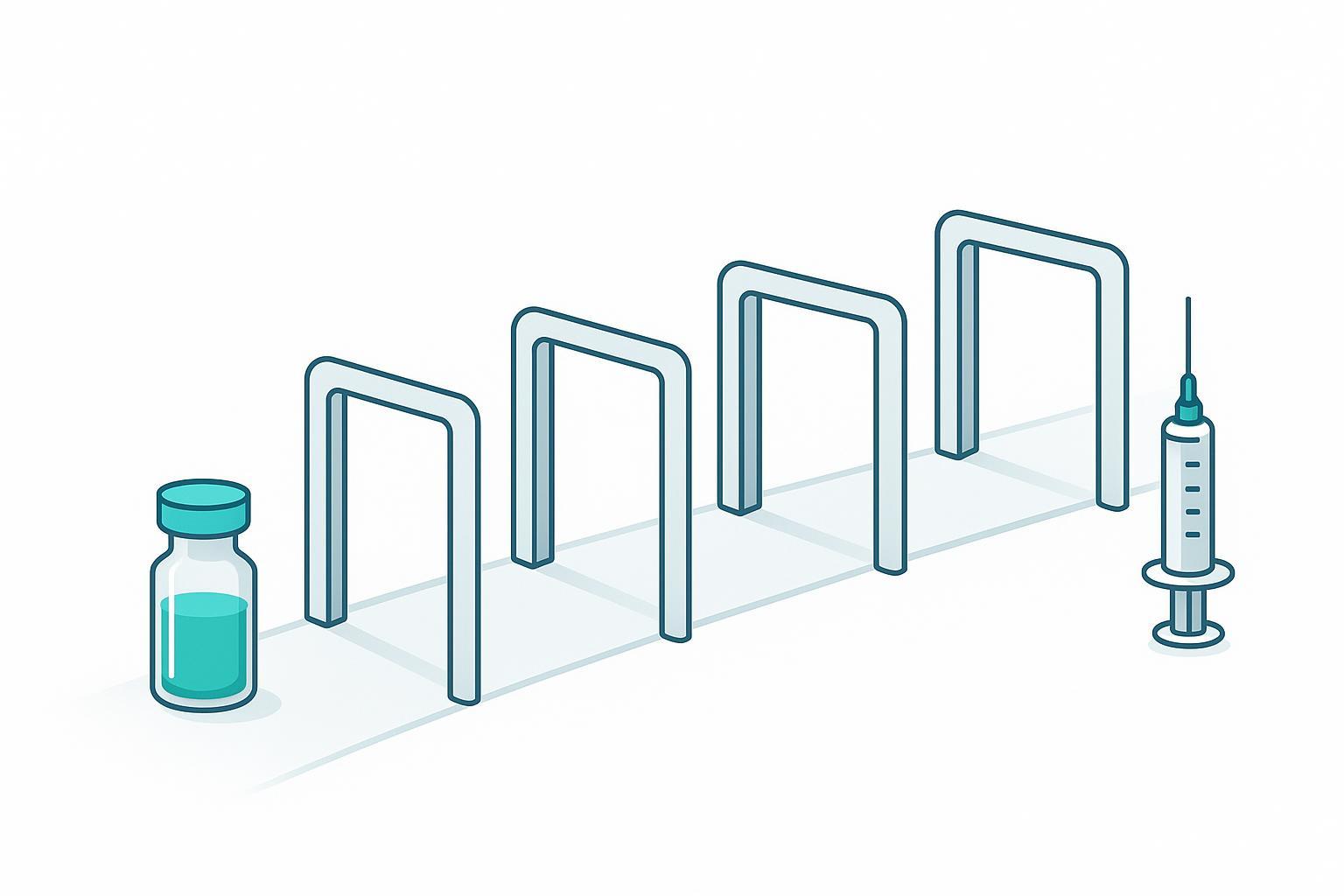
Peptid IND-godkännande är ett tillståndskort, inte ett kvalitetscertifikat. När FDA godkände ENDO-205:s IND på 23 mars 2026, det tillät en första mänsklig prövning i friska pre-menopausala kvinnor att börja (peptideinsider.org ENDO-205-fil, hämtas 2026-09-11). Det validerade inte CMC-paketet, lås specifikationerna, eller fastställa att peptiden fungerar.
Den skillnaden är lätt att tappa i det interna tillkännagivandet. Som samma dossier uttrycker det tydligt, "IND-godkännande är inte ett godkännande. Det är den första av flera portar... Den har inte granskat några bevis för att ENDO-205 fungerar i en person, eftersom inga sådana bevis finns ännu” (peptideinsider.org ENDO-205-fil, hämtas 2026-09-11).
Key Takeaway: "Klarat att fortsätta" och "visas säkert eller effektivt" är olika påståenden. Endast den första har gjorts.

FDA:s egna CMC-förväntningar på en första-i-mänsklig IND bekräftar hur snäv granskningen är: inga analytiska metodvalideringsdata förväntas, och stabilitetsdata från det specifika kliniska partiet "krävs kanske inte" (FDA, IND-applikationer: CMC-information, hämtas 2026-06-22).
Det som fyller det utrymmet är bevispaketet efter IND, och fem kravområden bär det: sekvens och föroreningskontroll, ortogonal karakterisering, stabilitetsindikerande metoder, märkning och förslutning av behållare, och ändamålsenlig testning avpassad till fasen.
Bevispaketet efter IND: Fem kravområden som bär den första dosen
Utvecklingskrav för peptider efter IND är inte en enda checklista. De är fem bevisområden som var och en måste vara tillräckligt stark för att stödja dosering av en människa, och var och en mognar i olika takt över de kliniska stadierna.
|
Peptidsyntes Kravområde |
Vad den måste fastställa före första dosen |
Vilken fas 1 inte kräver |
Hur ett misslyckande ser ut |
|---|---|---|---|
|
Sekvens- och föroreningskontroll |
Den avsedda sekvensen bekräftas och föroreningsutbredning förstås från byggstensnivån och uppåt |
Fullständigt kvalificerade processer i kommersiell skala |
En oidentifierad trunkerings- eller raderingsart visas över rapporteringsgränsen |
|
Ortogonal karakterisering |
Mer än en oberoende metod kommer överens om identitet, renhet, och struktur |
En låst, validerad releasepanel för varje attribut |
En enda analys bär hela identitetsanspråket, och en andra metod motsäger det |
|
Stabilitetsindikerande metoder |
Nedbrytningsvägar är kända Syntetiska peptider och metoden upptäcker dem |
ICH-kompatibel långtidsdata vid alla lagringsförhållanden |
En metod klarar frisättning men missar en nedbrytningsprodukt som bildas vid lagring |
|
Märkning och behållareförslutning |
Etiketten, behållaren, och stängningen överensstämmer med bevispaketet |
Slutlig kommersiell förpackningskonfiguration |
Extraherbart material eller en förslutningsinteraktion dyker upp efter att doseringen påbörjats |
|
Analytisk testning för ändamålsenlig användning |
Varje metod är kvalificerad för den fråga som fasen faktiskt ställer |
Fullständig validering enligt kommersiella standarder |
En metod är överbyggd för Phase 1 och fördröjer tidslinjen utan att lägga till beslutsvärde |
Mognadskurvan bakom den tabellen är den användbara mentala modellen: fas-lämplig CMC-mognad över de kliniska stadierna löper från först i människa till fas 2, Fas 3, and commercial lock, with method maturity rising from exploratory (0) through qualified (1) to validated (2). The five areas below are ordered by how early they become load-bearing, not by how much documentation they generate.
Hur peptidutvecklingskraven efter IND skiljer sig från förväntningarna före IND

Peptide post-IND development requirements shift the central question from “is this molecule defensible” to “is this lot reproducible, and is this method fit for its purpose.” Before clearance, the work is largely about identity, rutt, and feasibility. After it, the same data set has to support lot-to-lot control, trending, and tech-transfer documentation that a pre-IND package was never asked to carry.
That shift is deliberate, not a loophole. FDA’s own CMC expectations for a first-in-human IND state that sponsors can reduce application development time by up to 12 months by not over-building the initial CMC section, which means the pre-IND question set does not simply carry forward. What replaces it is phase-appropriate rigor: methods that are qualified rather than validated, specifications that are justified rather than locked, and a stability program that distinguishes the retest-period versus shelf-life distinction for drug substance and drug product respectively.
Öva 1: Kontrollsekvens och föroreningsutbredning på byggblocksnivå
Peptide impurity control is decided long before final release. For a synthetic peptide, the impurity profile of the finished lot is largely set upstream, at the building-block and coupling stages, which means post-IND control has to reach back into those stages rather than wait for the release panel.
Tjänster The thresholds worth applying come from a specific regulatory upstream. FDA’s synthetic-peptide impurity thresholds, reported in 2026, require that peptide-related impurities at or above 0.10% be individually identified, with a categorical upper limit of 0.5% for new peptide-related impurities not present in the reference listed drug.
|
Development stage |
Purity by RP-HPLC area |
Individual impurities |
Total impurities |
|---|---|---|---|
|
Fas 1 mål |
~95–98% |
NMT 0.5% |
NMT 2–5% |
|
Commercial expectation |
~98–99% |
NMT 0.1% |
NMT 1.0% |
The Phase 1 versus commercial purity bands are illustrative development targets, inte en specifikation. Define your own reporting, identifiering, and qualification thresholds, then trend them from the first clinical lot forward.
Omfattningsanmärkning: De 0.10% och 0.5% figures trace to a single regulatory upstream, FDA 2021 ANDA guidance for highly purified synthetic peptide products referencing rDNA-origin reference listed drugs. They are not a universal IND requirement.
Felläget är förutsägbart: impurities that appear only at scale, or that were never individually identified because they sat below the threshold at small scale.
Öva 2: Bygg ett Ortogonal Characterization Package, Inte en enda analys
Peptide characterization fails when one technique is asked to answer every identity question. No single assay establishes that a synthetic peptide is the intended molecule, so the post-IND package pairs methods that each resolve a different ambiguity.
Reverse-phase HPLC monitored at 220 nm establishes purity and main-peak content, while LC-MS/MS confirms monoisotopic mass and full amino-acid sequence coverage. In a published leuprolide acetate example, the theoretical monoisotopic mass of m/z 1209.6533 matched an experimental 1209.6515, and MS/MS delivered complete sequence coverage (Reference Standards to Support Quality of Synthetic Peptide Therapeutics, 2023). The same source notes that multiple orthogonal techniques are typically used to verify peptide identity, including HPLC retention time, NMR, MS, and chiral testing.
The failure mode is a mass-confirmed but sequence-ambiguous peptide. A deletion sequence can share nominal mass behavior with the parent while differing by a single residue, and a purity method alone will not separate them. Pairing mass confirmation with sequence coverage, and adding chiral or NMR testing where the reference standard demands it, closes that gap and keeps the package defensible across a lot or supplier change.
ENDO-205’s amino-acid sequence, rutt, and dose remain undisclosed, so this package is described generically rather than for that molecule (the program’s disclosed status as of September 2026).
Öva 3: Designstabilitetsindikerande metoder innan du behöver dem
Peptide stability testing earns its place in the post-IND package by converting a degradation observation into a specification you Handla can control. That only works if the method resolves degradants from the parent peak before the first clinical lot goes on study.
Run forced degradation first, under acid, bas, oxidative, thermal, and photolytic stress, and confirm the method separates every degradant it generates from the main peak. Then place the clinical lot on long-term, mellanliggande, and accelerated conditions in the same container-closure system you propose for storage and distribution. The storage statement on the label is derived from that evaluation, which is why “room temperature” or “ambient conditions” cannot appear in place of a defined condition.
|
Parameter |
Drug substance |
Drug product |
|---|---|---|
|
Long-term |
25°C/60% RH or 30°C/65% RH Peptidproduktion |
25°C/60% RH or 30°C/65% RH |
|
Intermediate |
30°C/65% RH |
30°C/65% RH |
|
Accelerated |
40°C/75% RH Om |
40°C/75% RH |
|
Commitment derived |
Retest period |
Shelf life |
Pending confirmation: The numeric conditions above follow ICH Q1A(R2) stability conditions, but the ICH Q1A(R2) PDF was not machine-readable in this run. Treat the figures as corroborated by secondary summaries only until the primary text is checked.
Felläget är tyst. A method that co-elutes a degradant with the parent peak produces a stability table that looks clean while the product is not, and the problem surfaces after the clinical lot is already on study.
Öva 4: Behandla märkning och behållareförslutning som en del av bevispaketet
Peptide labeling requirements are a regulated control, not a design afterthought, and the storage statement printed on the label is an output of the stability program rather than a marketing decision. Under 21 CFR 312.6, the immediate package of an investigational drug must bear the caution statement “Caution: New Drug, Limited by Federal (or United States) law to investigational use,” and the labeling may not carry any statement that is false or misleading or represent that the investigational drug is safe or effective for the purposes under investigation.
That second clause is the one that catches teams. A storage statement that overstates stability, or label copy that implies a clinical benefit the program has not demonstrated, breaches 312.6(b) even when the underlying data are sound.
Sequence container-closure selection ahead of the stability study, inte efter det. Extractables and leachables findings, moisture transmission, and light protection all feed the storage statement, so a closure chosen late forces the stability protocol to be rewritten. No efficacy or safety claim is made here for ENDO-205; the labeling requirement is procedural, and the caution statement is the only claim the immediate package carries.
Öva 5: Omfattning lämpliga analytiska tester till fasen, Inte till destinationen

Fit-for-purpose analytical testing in the post-IND window means matching each method’s rigor to what Phase 1 actually needs, not to what a commercial filing will eventually demand. The FDA’s own CMC expectations for a first-in-human IND do not include analytical method validation data, and process controls unrelated to product safety are not expected at this stage. That is a deliberate allowance, not a loophole: it lets a program defer validation until the process is locked, when the validation will still describe the process it was written against.
The practical split is per method, not per program. A release assay that supports a safety decision needs qualification now; a method whose only job is to trend a parameter you have not fixed yet can wait.
[TABLE] Method-to-phase expectation matrix: columns for method, Fas 1 expectation (not expected / kvalificerad / validerad), and documented rationale.
Sterility and endotoxin testing are the exception to any deferral logic, because they run on compendial mechanics rather than on your process. The 14-day USP <71> sterility test incubates membrane-filtered or directly inoculated samples in fluid thioglycollate at 30–35°C and soybean-casein digest at 20–25°C, filtering the contents of at least 10 containers through 0.45-µm cellulose acetate membranes (FormBlends, Sterility Testing for Peptides, reviewed 2026-05-14). Endotoxin limits come from the USP <85> endotoxin limit calculation, K/M, där K är 5 EU/kg/hour for non-intrathecal routes and 0.2 EU/kg/hour for intrathecal. Because the limit is dose-based, no universal EU/mL value exists. Note that this formula is compendial arithmetic; the primary FDA PDF could not be opened in this run, so treat the threshold values as USP-derived rather than FDA-confirmed.
The failure mode runs in both directions. A team that validates a stability-indicating method to commercial rigor before the process is locked will repeat that validation after every process change, paying twice for the same assurance. A team that leaves a safety-critical method unqualified creates a data gap that surfaces at the Phase 2 transition, when the agency asks what supported the release decision in the first place. The fix is documentation: for every method you deliberately leave unvalidated, write down why, what substitutes for it in the interim, and what trigger will force validation. That rationale is the artifact a reviewer reads.
Ett fungerade exempel: Sekvensering av Post-IND-paketet i ett neutralt utvecklingsarbetsflöde
The five practices form a sequence, not a checklist. Impurity thresholds and the characterization package come first, because the release panel you set at that stage determines what later work has to measure. Stability-indicating methods and container-closure follow, since both depend on knowing which degradants and leachables the panel can detect. Labeling and fit-for-purpose testing close the sequence, because both describe a control strategy that only exists once the earlier steps are fixed.
A peptide synthesis and analytical workflow such as MOL Changes supports this ordering by keeping building-block control, rening, and characterization inside one traceable chain, which helps teams avoid re-qualifying methods after a late process change.
Key Takeaway: This sequence is illustrative, not prescriptive. Fas 1 programs deliberately leave some methods unlocked while the process is still moving, and locking them early can cost more than it protects.
Vanliga misstag i Post-IND-fönstret
The five errors below are the ones that survive a careful review of the obvious ones. Each has a specific fix.
Treating IND clearance as validation of the CMC package. An accepted IND means FDA found the submitted package adequate to proceed, not that the package is complete or final. Fixningen: keep the CMC section under active revision through Phase 1 and log every open item with an owner and a target date.
Applying the 0.10% och 0.5% thresholds as if they were IND requirements. Those figures come from FDA’s synthetic-peptide impurity thresholds, which govern ANDA submissions, not investigational new drug applications. Fixningen: set your own reporting and qualification thresholds from toxicology and clinical exposure, then document the rationale.
Validating analytical methods before the process is locked. Method validation against a moving process produces data you will repeat. Fixningen: qualify methods for the intended use first, and reserve full validation for a frozen process.
Selecting container-closure after the stability study has started. Extractables and leachables interact with the formulation, so the study design depends on the closure. Fixningen: choose the primary container before the first stability lot is placed.
Writing label copy that implies clinical benefit. 21 CFR 312.6 requires the caution statement on investigational drug labeling, and the regulation bars any representation that the drug is safe or effective for the purposes under investigation. Fixningen: describe the dosage form and route only, and route all promotional language through regulatory review.
Hur framgången ser ut före den första dosen
A complete post-IND package is one you can hand to a reviewer and defend line by line. Konkret, that means five things are in place before the first dose: orthogonal identity confirmation of the peptide sequence, a stability-indicating method demonstrated by forced degradation, a clinical lot on stability in its proposed container-closure, investigational labeling that meets the applicable requirements, and a written rationale for every method you deliberately have not validated yet.
That last item is the one teams skip, and it is the one that most often turns a routine review into a rebuild. FDA’s own CMC expectations for a first-in-human IND are phase-appropriate rather than exhaustive, so an unvalidated method is not automatically a gap. An unvalidated method with no documented justification is.
The stretch goal is a lot-to-lot trending plan. Build it now and the Phase 2 transition becomes a data review instead of a redevelopment project. The retest-period versus shelf-life distinction is the practical lever here: a retest period supported by trending data is a far easier position to extend than one assembled retroactively.
Vanliga frågor
Gäller FDA-trösklarna för peptidföroreningar för en IND?
Inga. De 0.10% identification threshold and the 0.5% cap on new peptide-related impurities come from FDA’s 2021 ANDA guidance for certain highly purified synthetic peptide drug products. Those thresholds are written for abbreviated applications referencing an rDNA-origin reference listed drug, not for an investigational new drug application. Importing a commercial impurity ceiling into a Phase 1 setting misreads the scope of the document.
Gör Fas 1 kräver validerade analysmetoder?
FDA states that it does not expect analytical method validation data for a first-in-human Phase 1 IND, and stability data from the specific clinical lot may not be required either. Treat that as a floor rather than a ceiling: a method that supports a safety decision still has to be fit for its purpose, and the retest-period versus shelf-life distinction governs how far the supporting data can be stretched.
What is ENDO-205’s current development status?
As of September 2026, the disclosed picture is narrow. The IND cleared on 23 mars 2026 and permits a first human trial in healthy pre-menopausal women of reproductive age. Fas 1 status reads “Planning,” with no ClinicalTrials.gov record, no peer-reviewed data, and the sequence and route undisclosed. That is the program’s disclosed status as of September 2026, and nothing beyond it should be assumed.
Slutsats
You can now sequence the five peptide post-IND development requirements that carry a program to first dose: sequence and impurity control at the building-block level, an orthogonal characterization package, stability-indicating methods designed before they are needed, labeling and container-closure treated as evidence, och ändamålsenlig testning avpassad till fasen. The end state is concrete: a characterized peptide with orthogonal identity confirmation, a stability-indicating method demonstrated by forced degradation, a clinical lot on stability in its proposed container-closure, compliant investigational labeling, and a documented rationale for every method deliberately left unvalidated.
That last item matters as much as the others. Peptide IND clearance does not obligate commercial-grade validation at Phase 1, and treating it as though it does is the most common way sponsors spend time they did not need to spend.
Planning the evidence package for your own post-IND window?
Review how a phase-appropriate analytical package is assembled, covering characterization, stabilitetsindikerande metoder, and fit-for-purpose testing, before the first clinical lot goes on study. Talk to an expert or review the analytical package with the team that supports peptide quality standards.
Avslöjande: MOL Changes has a commercial interest in peptide quality standards and analytical services.