Mohato 1: Hlalosa Hore na Lipalo tsa Hao Li Tlamang tsa GLP-1R li Neng li Bolela'ng
Linomoro tse tharo tse fapaneng li tsoa ka mokhoa o tloaelehileng oa ho etsa mohlala, mme ha di bolele ntho e le nngwe. A lintlha tsa ho emisa ke boleng ba ts'ebetso ea lintlha bakeng sa boemo bo le bong ba peptide sebopehong se le seng sa receptor; e beha maemo, ha e lekanye kamano. A e boletse esale pele Kd ke hore lintlha li sutumetsoa ka mokhoa o koetlisitsoeng ho shebahala joalo ka mokhoa o tsitsitseng oa ho arohana. A khakanyo ea matla a sa lefelloeng (MM-PBSA, MM-GBSA, alchemical FEP) ke lipalo tse thehiloeng ho fisiks holim'a sehlopha sa liforeimi, 'me e na le phapang e tloaelehileng eo u lokelang ho e bala e le karolo ea nomoro.

Ha ho le e 'ngoe ea tsena e lekantsoeng e tlamang kamehla.
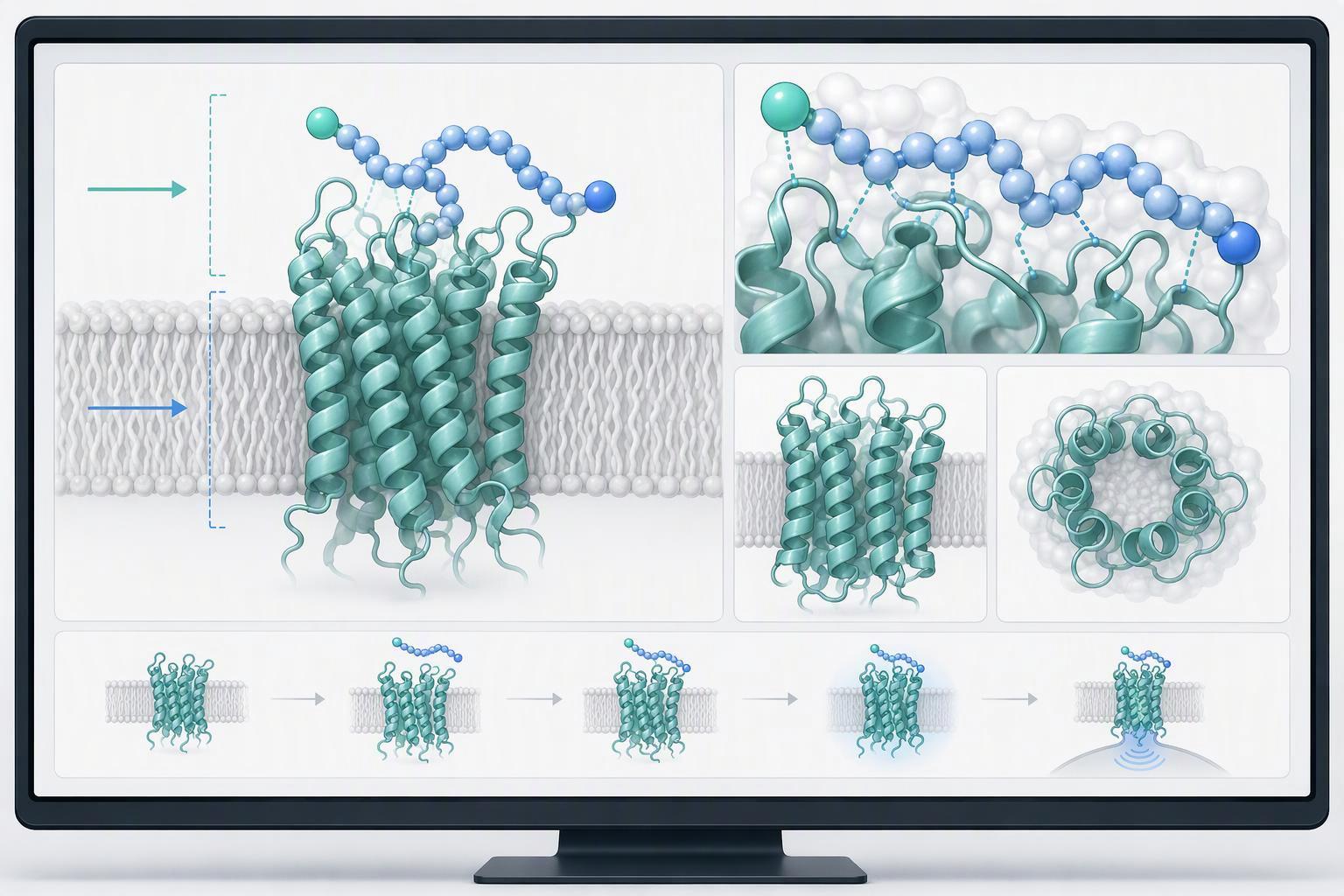
Lebaka leo ka lona ho ata ha GLP-1R ho pharaletseng haholo ke sebopeho. Tlhokomeliso ea peptide ea Sehlopha sa B1 GPCR ke bothata ba li-domain tse peli: peptide C-terminus e sebelisa sebaka sa extracellular ha N-terminus e tlameha ho fihla mokokotlong oa 7TM bakeng sa ts'ebetso., kahoo sebaka se le seng sa receptor se thata se ke ke sa emela boemo bo tlanngoeng, 'me docking e na le maikutlo a hore na u entse mohlala ofe oa li-receptor (Tlhaho Puisano, 2022).

Boikutlo boo ha se thuto. Ho a 2026 Frontiers thutong ea Pharmacology, agonist e tšoanang ea masala a 18 a fumane lintlha 55 nM khahlano le moamoheli a le mong le 360 nM kgahlanong le emong (SR18; PRODIGY khahlanong le 0 ns conformer khahlano le MD central conformer). MM-PBSA e felile 1 μs ea MD e fane ka −98.79 ± 8.77 kcal/mol bakeng sa SR18 khahlano le −167.22 ± 16.20 kcal / mol bakeng sa GLP-1. Ha ho na tlhahlobo ea lisele tse entsoeng.
Key Takeaway: Lintlha ke khopolo-taba e nang le nako ea ho itšepa, eseng sephetho. Pele o beha eng kapa eng, ngola hore na ke boemo bofe ba receptor, mokhoa ofe, le hore na ke bar efe ea phoso e hlahisitseng nomoro ka 'ngoe.
Mohato 2: Hlahloba Maikutlo a Mohlala Pele U Tšepa Boemo
Boemo bo botle feela joalo ka menahano e ka tlase ho eona, mme dikakanyo tseo hangata ha di bonahale tafoleng ya tlhahiso. Pele o nka khato ka taelo e boletsoeng esale pele, botsa lipotso tse tharo: hore na ke matla afe le puso ea sampole e hlahisitseng poketso, ketsiso e tsamaile nako e kae, le hore na mohlala o ne o hlile o bapiloe khahlanong le eng.
Sampling ke sebaka sa pele sa khefu ea maemo. Sehlopha sa B GPCR MD hangata se tsitsa feela kamora 200-500 ns, ka ho phomola ho tsoelang pele bakeng sa 1.5-2.5 μs e eketsehileng, le lits'ebetso tse ngata tsa ts'ebetso li feta linako tse tloaelehileng tsa MD ka ho felletseng (Tekolo ea Liphetoho tsa Naha tsa Conformational tsa Sehlopha sa B GPCRs, 2019). A 100 ns run e shebahalang e kopane e kanna ea se be mohlala oa boemo bo loketseng.
Pose accuracy e boetse e na le siling. Ho a 2025 GPCR-peptide benchmark, AlphaFold2 e hlahisitse mekhoa e nepahetseng ea ho tlama 94% ea li-post-cutoff complexes (63/67), ka kopanelo-karolo AUC ea 0.86 bakeng sa AF2 khahlano le 0.76 bakeng sa Chai-1, ha ESMFold le NeuralPLexer li hlolehile ho ruisa li-binder ho hang (GPCR-peptide e tlamang sehlopha sa benchmark, 2025-04-26). Bala seo 94% joalo ka sephetho sa mohloli o le mong, eseng tiiso bakeng sa sepheo sa hau.
|
Sehlopha sa mohlala |
Tshebetso e tlalehiloeng |
Maikutlo a ka 'nang a robeha |
|---|---|---|
|
MD / mahala-matla |
E tsitsisa ka mor'a 200-500 ns |
Sampling e telele ho lekana |
|
AF2 / AF3 |
94% mekhoa e nepahetseng; AUC 0.86 / 0.82 |
Benchmark e fetisetsoa ho peptide ea hau |
|
Chai-1, ESMFold, NeuralPLexer |
AUC 0.76; ha ho na molemo oa ho tlama |
Lintlha tsa lipina tse amanang |
Mokhoa oa ho hloleha o ngotsoe: ho khutlisa li-RMSD tse ka bang 5–5.5 Å li tlalehiloe bakeng sa li-ligands tse tsejoang hore lia sebetsa. (Litlhaloso tsa sebopeho sa GLP-1R, 2016-04-08).
Mohato 3: Rala Phanele e Nyenyane e Fetang e ka Fokotsang Boprofeta
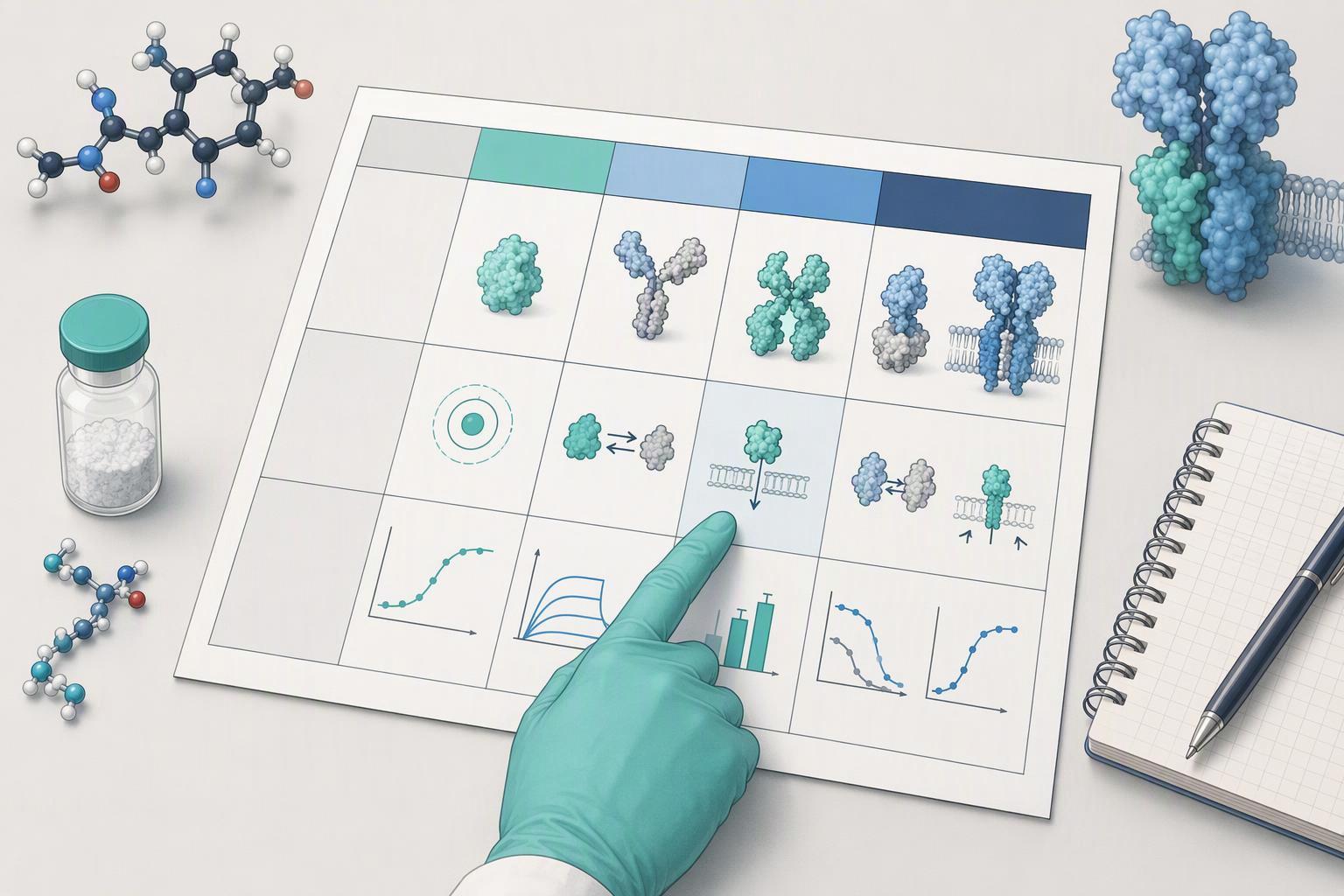
Phanele e fumana litšenyehelo tsa eona ha mofuta o mong le o mong o ka paka hore boemo bo fosahetse. E lekane le kutloisiso ea mohlala, eseng ho budget ea synthesis: haeba palo e bolela hore e arola mefuta e 'meli, at least one member of the panel has to sit on that boundary.
Three groups do most of the work. Single-position substitutions at residues the model flags as contact points test whether those contacts carry the predicted weight. An N-terminal truncation or substitution series tests the region the model treats as decisive, and it is the group most often left out: the SR18 authors noted cell-signaling studies remained to be performed, so the N-terminal behavior their modeling implies is still an open question rather than a settled input. One modification class that changes chemistry rather than sequence, stapling, lipidation, or a D-amino acid scan, tests whether the prediction survives a change the sequence-based model was never trained on.
Mokhoa o Tloaelehileng oa Peptide Synthesis Treat the result as discriminating variants, not a library. Every member should map to one assumption and one readout that would falsify it.
|
Variant class |
Assumption tested |
Falsifying readout |
|---|---|---|
|
Contact-point substitution |
Flagged residue drives affinity |
Shift in measured binding |
|
Synthetic Peptide Synthesis N-terminal series |
N-terminus dominates recognition |
Loss or retention Spps Solid Phase Peptide Synthesis of binding |
|
Chemistry-changing modification |
Sequence alone predicts behavior |
Divergence from predicted rank |
Mohato 4: Kopanya 'malo o mong le o mong o tlamang le o sebetsang
A binding constant tells you how tightly a peptide occupies the receptor. It does not tell you how strongly that occupancy activates it. Receptor occupancy is the fraction of GLP-1R molecules with a peptide bound; cAMP accumulation is the downstream second-messenger readout that reports activation; biased agonism describes ligands that favor one signaling pathway over another, such as cAMP over β-arrestin-2 recruitment. Because these are separate measurements, a ranking built only on affinity can invert once you measure function.
Tirzepatide illustrates the gap. It binds GLP-1R with roughly 5-fold weaker affinity than native GLP-1 but is 20-fold less potent in cAMP accumulation, and in the presence of human serum albumin that potency shift reaches 81-fold while GLP-1(7-36) potency stays unaltered (JCI Insight, 2020). Potency and affinity are not interchangeable, and the assay medium changes the number.
Biased agonists widen the gap further. Native GLP-1 has a cAMP EC50 of 3 pM, kgahlanong le 29 pM for liraglutide and 343 pM for the biased dual agonist CT-859, which produces under 5% β-arrestin-2 recruitment versus 99% for GLP-1 (PMC, 2025). A predicted affinity gain that leaves cAMP flat is a different result from one that shifts it, 'me phanele ea hau e tlameha ho khetholla tse peli.
Kamano e tlamang, matla a kAMP, leeme la tsela le mofuta oa AUC ke liphetho tse fapaneng. Tlaleha tsamaiso ea li-receptor, maemo a teko le papiso ka boleng bo bong le bo bong; bapisa matla a lipalo ka har'a teko e tsamaellanang. Litekanyetso tsa chefo e khahlanong le peptide e 'ngoe ha li thehe moeli o ikhethileng oa GLP-1R..
Bakeng sa Keletso: Etsa tlhahlobo ea ts'ebetso ka mokhoa o ts'oanang oo u rerileng ho o bapisa ka bophara, kaha phetoho ea matla e itšetlehileng ka albumin ka holimo ke thepa ea maemo a teko, eseng ea peptide feela.
Mohato 5: Tšoara Boleng ba Reference-Material e le Ntho e Fetohang Papisong
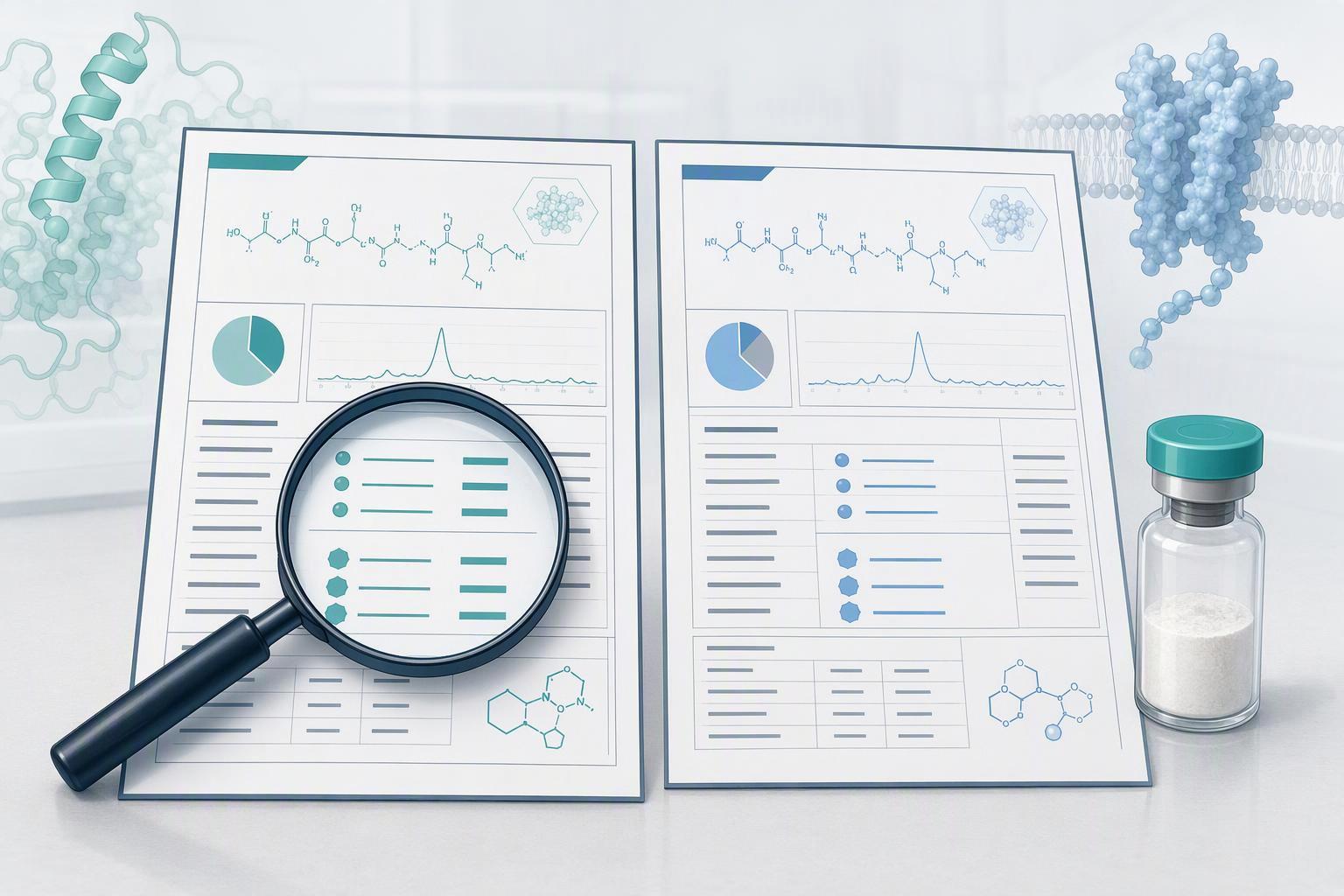
Sebapi sa hau ke tekanyo, mme e jara phoso ya yona. Pele tekanyetso ea litšupiso e kena papisong ea GLP-1R, confirm what it actually is. Counterion form is the most common hidden variable: the TFA salt of the tetra-branched peptide M33 showed 5–30% greater cytotoxicity toward normal bronchial epithelial cells than its acetate counterpart, and MOG formulated with TFA accelerated encephalomyelitis onset by roughly 5 days at comparable incidence and severity (Liphello tsa li-Counter-Ions ho Sebopeho sa Peptide, Ketsahalo, and Functionality, Li-biomolecules, 2025). The mechanism is routine chemistry: Fmoc/tBu SPPS followed by RP-HPLC yields trifluoroacetate salts, with TFA either bonded to basic residues or adsorbed in the lyophilizate, and USP and EP treat the acetate anion in peptide drugs as an impurity whose level must be measured (Karolo ea li-Counter-ion ho Peptides, An Overview, Meriana ea meriana, 2020).
|
QC attribute |
What to verify |
Assay it can shift |
|---|---|---|
|
Bohloeki ka HPLC |
Reported method and integration threshold |
Matla, apparent affinity |
|
Counterion identity |
Acetate vs. TFA, stated on the CoA |
Cell viability, functional readouts Artificial Synthetic Polypeptide Peptide Synthesis |
|
TFA e setseng |
Measured level, not assumed absent Synthesis ea Polypeptide |
Cytotoxicity, proliferation assays |
|
Nomoro ea lotho |
Traceable to a single synthesis batch |
Lot-to-lot comparability |
Mohato 6: Kopanya ho se lumellane 'me u behe Phanele e latelang
When a measured affinity and a predicted ranking disagree, the first question is not which model to revise. It is whether the assay reached equilibrium. A worked GnRH receptor case shows how far this can go: a 2 h incubation gave an apparent Kd of 200 pM while kinetic analysis gave 29 pM, because the radioligand dissociation half-time was 4 h and full equilibrium required at least 20 h (Ligand binding assays at equilibrium: validation and interpretation, Br J Pharmacol, 2010). The non-equilibrium read overestimated Kd roughly 7-fold, and the model was never the problem.
That single case also disposes of a common shortcut. Tekanyetso ea tumellano e phetoang haholo "ka hare ho makhetlo a mabeli" ha e tšehetsoe ke mohloli oo, kahoo ha ea lokela ho sebelisoa e le letšoao la ho feta bakeng sa lipalo tse tlamang tsa GLP-1R.
Beha ho se lumellane pele u ama mohlala. Haeba lekhalo le latela nako ea ho qhoqhoa, sethibelo, kapa sebaka sa litšupiso, fetola phanele kapa protocol. Haeba e pholoha tekanyo e hloekileng ea tekano 'me e pheta-pheta mefuta e fapaneng, fetola mohlala.
Lipotso Tse Botsoang Khafetsa
Na lintlha tsa docking li ka nkela sebaka se lekantsoeng se tlamang?
Che. Lintlha tsa docking ke khakanyo e hlahisoang ke ts'ebetso ea lintlha, 'me phoso ea khakanyo eo ha e tlalehoe haufi le eona. Karohano e lekantsoeng kamehla (Kd) ke paramethara e kentsoeng ka nako ea ho itšepa, eleng sona se etsang hore se sebedisoe joalo ka papiso ya motheo.
Nyeoe ea SR18 e bontša hore na hobaneng phapang e le ea bohlokoa ts'ebetsong. Thutong eo, the same peptide scored differently against two receptor conformers, a 55 nM result against one and 360 nM kgahlanong le emong, and no cell-based assay was performed to adjudicate between them. A score that moves by nearly an order of magnitude with the starting structure is a hypothesis about binding, not a measurement of it. Use docking to rank candidates for synthesis, then let the assay decide.
Ke mofuta ofe oa tlhahlobo oo ke lokelang ho o sebelisa ho bapisa GLP-1R?
Choose on what the format actually reports. HTRF and Tag-lite competition assays give equilibrium affinity in a plate format and suit larger variant panels. Radioligand competition does the same with a different detection principle, and carries the handling overhead that comes with radioisotopes. SPR reports kinetics, association and dissociation rates, which tells you whether a potency difference comes from faster off-rate or slower on-rate.
Lintlha tseo tsa kinetic ke lebaka la ho lefa SPR lethathamong le lekhuts'oane ho fapana le phanele e felletseng. Tlhokomeliso e le 'ngoe mabapi le papiso e phatlalalitsoeng: sengoloa sa kopo ea tlholisano se tlaleha litekanyetso tsa Kd tsa 0.816 nM le 2.347 nM lisebelisoa tse peli tse se nang mekoallo ea liphoso, pheta-pheto kapa n-nomoro, kahoo tšoara linomoro tsa liletsa tse fapaneng e le sesupo ho fihlela u li hlahisa tlas'a maemo a hau.
Ho thoe'ng haeba maemo a ka a mangata a fetoha bohareng ba thuto?
Lokisetsa hape lotho e ncha khahlano le ea khale ka teko e le 'ngoe pele e kena papisong. Matha lotho ka bobeli ka lehlakore holim'a poleiti e le 'ngoe, letsatsi lona leo, protocol e tšoanang, 'me u tlalehe karo-karolelano ea potency.
Sheba setifikeiti sa tlhahlobo bakeng sa bohloeki, counterion le TFA e setseng, kaha e 'ngoe ea tsena e ka fetola matla a bonahalang ntle le tatellano ea peptide. Haeba phetoho ea potency e latela phetoho ea lotho, e nke e le phello e bonahalang papisong ea hau ho e-na le phoso ea mohlala. Liphetoho tse ngata ke phetoho eo u ka e laolang; mosebetsi oa ho hlaba ha o.
Qetello
Loop ke mokhoa. Hlalosa hore na lipalo tsa hau tse tlamang tsa GLP-1R li bolela esale pele eng, hlahloba maikutlo a ka morao ho boemo, etsa phanele e fapaneng e ka e qhekellang, kopanya 'malo o mong le o mong o tlamang le o sebetsang, laola boleng ba papiso, le ho boelanya ho se lumellane pele o laela phanele e latelang. Ha ho le e 'ngoe ea mehato eo e ka ikhethelang, hobane ketsiso e fetoha bopaki bo sebetsang feela ka nako eo palo e lekantsoeng e ka e hanyetsang. Ho fihlela ka nako eo ke khopolo-taba e nang le tafole e shebahalang e itšepa e khomaretsoeng.
Ke ka lebaka leo motšoantšisi a tšoaneloang ke ho hlahlobisisoa joalo ka mohlala. Haeba lisebelisoa tsa hau tsa litšupiso li fapana haholo ho ea ho tse ngata, ho se lumellane hoo u ho boelanang ho ka 'na ha e-ba teng ho latela maemo ho e-na le ho bolela esale pele. Boitsebiso bo ngotsoeng bo ngotsoeng le QC workflow e tšehetsa taolo eo: setifikeiti sa tlhahlobo, bohloeki le data counterion, le ho lateloa ha lotho ho tlalehiloeng hammoho le sephetho sa tlhahlobo, kahoo papiso e latelang e qala ho tloha motheong o tsebahalang. E ka sebelisoa ho boloka lehlakore le lekantsoeng la loop e le e utloahalang joaloka lehlakore la computational.