Snabb jämförelse: peptidleverantörs skala vs specialisering i en överblick
|
Peptidsyntes Kategori |
Stor plattform |
Specialist |
|---|---|---|
|
Bäst för |
Program i sena stadier som behöver hundratals kilo till ungefär ett metriskt ton per år från en enda kvalificerad plats |
Komplexa sekvenser, svåra ändringar, och konjugationsarbete där kemin, inte tonnaget, är begränsningen |
|
Anpassat sekvensintervall |
Bred katalog plus anpassade, men anpassad peptidsynteskapacitet allokeras mot engagerade luckor med stora volymer |
Snävare genomströmning, bredare kemi: icke-standardiserade rester, svåra peptidmodifieringar, och korta undersökningsturer |
|
Svåra modifieringar |
Accepteras när rutten redan är bevisad i skala |
Vinner på namngiven, icke-standard kemi, där specialisten kan beskriva rutten innan citat |
|
Märkning och konjugering |
Tillgänglig, vanligtvis som en definierad servicelinje |
Vinner om att hålla konjugatet i omfattning genom karakterisering och kontroll |
|
Analytiskt stöd och dokumentation |
Strukturerad, revisionsfärdiga paket kopplade till GMP-release |
Vinner om metodutveckling för icke-standardiserade föroreningar, anpassat till dokumentationsfältet som EMA-riktlinjerna anger för processen, karakterisering, specifikationer och analytisk kontroll |
|
Teknisk kommunikation |
Konto- och projektledningsskikt; långsammare för att nå bänken |
Vinner om direkt tillgång till forskarna som driver syntesen |
|
Projektkontinuitet och tekniköverföring |
Vinner när du behöver en andra plats eller en validerad storskalig rutt |
Stark tidigt, men lämnar över projektet när volymen växer ur bänken |
|
Minsta livskraftiga skala |
Hundratals kilo per år per plats, enligt vad köpvågen faktiskt säkrar |
Milligram till låga kilo, inklusive enstaka undersökande partier |
|
Vår dom |
Vinner för volym i sent skede och kontinuitet i regleringsgrad |
Vinner för kemi i tidigt skede och icke-standardiserad kemi |
Notera: Denna tabell jämför leverantör typer, inte två namngivna försäljare. Bachems egen kapacitetssida beskriver Vistas inriktning på upp till nästan ett ton per år, och specialist-/storvolymuppdelningen i en leverantörs eget nätverk visar att båda modellerna kan samexistera under ett tak. Ingen enskild leverantör är enhetligt bättre; den högra kolumnen beror på var din molekyl sitter idag.

Anpassade sekvenser: hur långt sträcker sig varje modell egentligen?
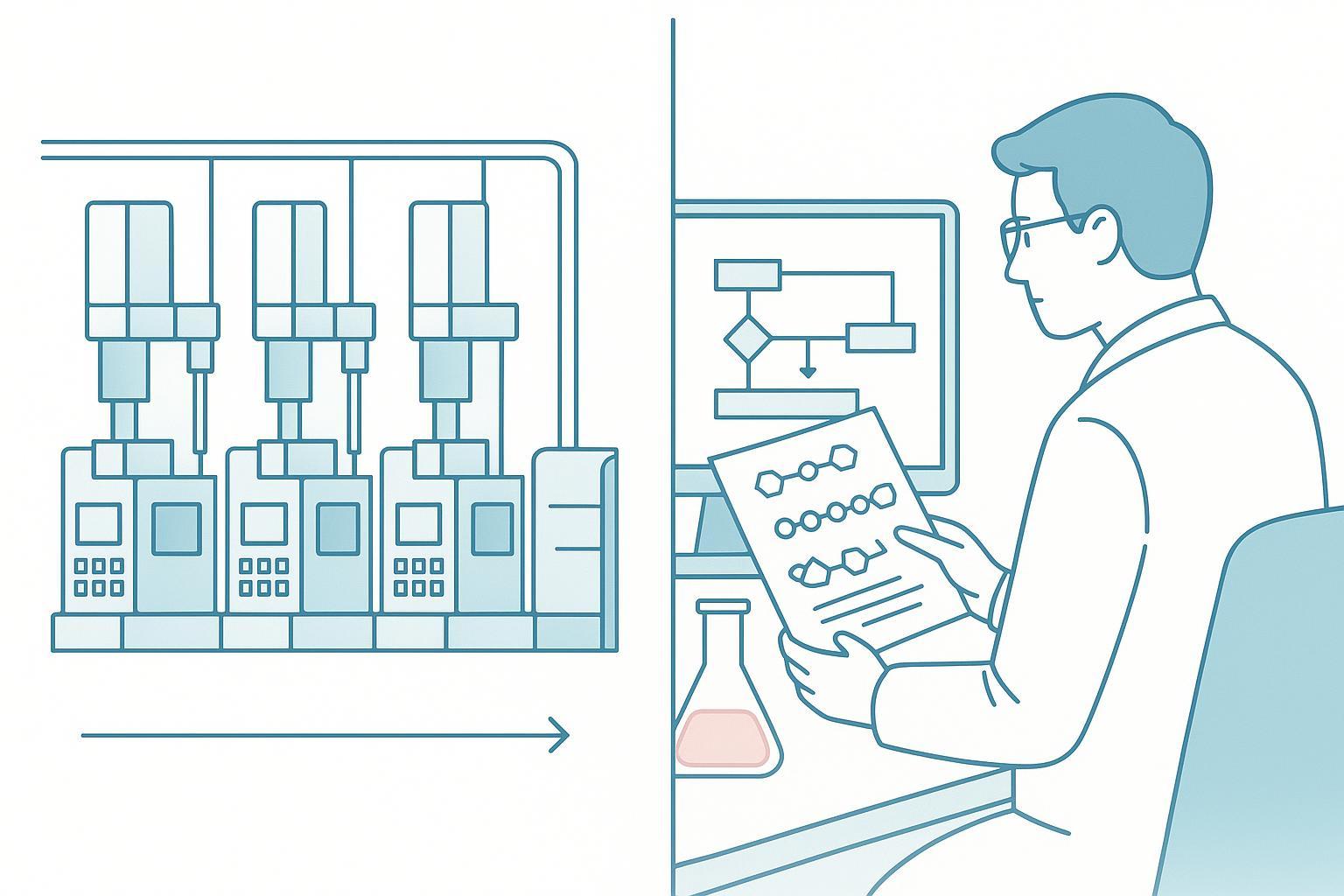
En stor plattform vinner på anpassad peptidsynteskapacitet för sekvenser som den redan har skalat; en specialist vinner på sekvenser som faller utanför en plattforms standardoperativa enveloppe. Begränsningen är kemisk, inte kommersiellt. Enligt den tekniska litteraturen om fastfassyntes, aggregering i SPPS är inte troligt före den femte eller sjätte resten eller efter den tjugoförsta, och peptid-hartsaggregation orsakar långsam eller ofullständig avskyddning och koppling. Långa eller hydrofoba sekvenser är därför där en standardiserad väg når sin gräns, och där en specialists vilja att byta lösningsmedel, hartsladdning eller temperatur har betydelse. En specialist som MOL Changes stöder anpassad sekvensdesign över ett mg-till-kg-intervall, vilket är hur det extra steget för sekvensgranskning och ruttval kan användas för att hantera ett svårt fall. Nyansen: för en sekvens som redan finns i en plattforms validerade katalog, den flexibiliteten köper ingenting.
Svåra modifieringar: vem kan namnge kemin, inte bara acceptera beställningen?
The differentiator on difficult peptide modifications is not willingness to take the order but the ability to name specific tactics on request. A specialist should be able to produce, unprompted, the tactic catalogue in the technical literature: DBU for incomplete Fmoc deprotection, NMP or DMSO as solvent, chaotropic salts, nonionic detergents or ethylene carbonate, sonication, elevated temperature, microwave, low-substitution resin, and TentaGel or SURE resin (peptide.com, 2019-10-14).
For long or aggregation-prone sequences, the same test applies to backbone-protection strategies for long sequences: pseudoprolines, depsipeptides via esterification on Ser or Thr, and Hmb/Dmb protection (peptide.com, 2019-10-14). The six-to-seven-residue Hmb spacing matters because it disrupts aggregation and also prevents aspartimide formation, and racemization control for His and Cys depends on HOBt, 6-Cl-HOBt or HOAt (peptide.com, 2019-10-14).

Use this as a buyer test: ask which of these the supplier proposes for your sequence, and why. A large platform may hold every one of these capabilities internally yet route your request through a standardized intake that never surfaces them.
Märkning och konjugering: vilken modell håller konjugatet i omfånget?
The supplier that keeps the linker and the payload inside the scope of work carries the characterisation burden with you; the supplier that treats the peptide as the finished deliverable hands it back to you. That boundary, not catalogue size, decides how much analytical work lands on your desk.
The EMA guideline on the development and manufacture of synthetic peptides sets the frame. It covers process, karakterisering, specifications and analytical control for synthetic peptides, conjugation included, and it names stereoisomer and deletion, truncated or insertion sequences as defined impurity classes. Those classes do not disappear because the peptide is now attached to something.
Tjänster So ask a direct question before you order: if the conjugate is the product, does your supplier’s specification cover the conjugated species, or only the peptide intermediate? A large platform may decline the linker chemistry as outside its validated scope. A specialist may accept it but subcontract the payload work. Either answer is workable, provided you learn it before the batch, not after the certificate of analysis arrives.
Analytiskt stöd och dokumentation: hur ser ett bra svar ut?

Analytical depth is verifiable, so ask for the method rather than the adjective. A supplier claiming peptide analytical support and documentation should be able to point to the ICH references the EMA guideline points to: I Q3A(R2) for impurities in new drug substances, ICH Q6A for specifications, and ICH M7 for mutagenic impurities.
A real impurity-troubleshooting exchange looks like this. You send the chromatogram and the failing specification. The supplier proposes a method change, returns the supporting data, and amends the CoA to match. Expect HPLC and MS data, a stated TFA counterion exchange step, an endotoxin LAL assay result, and lot-to-lot consistency figures. A non-answer is a purity percentage with no method behind it.
Nyansen: a large platform’s documentation is often more standardized, which makes it easier to audit even when a specialist’s method development runs deeper.
Teknisk kommunikation: vem svarar, och hur snabbt?
The observable difference between the two models is who is on the other end of the question. A large platform typically routes technical communication through an account or project-management layer, with escalation to a scientist when the query clears a defined threshold. A specialist supplier often answers with the person who ran the synthesis, because there may be no layer in between.
That difference is testable before you commit. Ask three questions and watch how the answers come back:
-
What changed between the last two lots?
-
What was the failure mode on the first synthesis attempt?
-
What mitigation is proposed, and what would trigger it?
A substantive answer to the second question is the strongest single signal of real bench experience. A supplier who cannot describe a first-attempt failure mode either never had one worth describing or never saw the record.
Projektkontinuitet och tekniköverföring: vad händer när ditt projekt växer ur bänken?
Continuity risk is highest exactly where the two models hand off to each other. A large platform can absorb a scale-up internally, and Bachem’s own network is the clearest worked example: de six-site distribution of announced capacity covers Bubendorf (Building K), Sisslerfeld, Vionnaz, Perspektiv, Torrance och St. Helens, with Torrance positioned on the right scale equipment for smaller volumes while Vista takes large-volume capacity.
The timing matters more than the headline number. Building K was inaugurated in April 2026 and already manufactures commercial GMP products, but Phase II is expected to contribute to sales only in 2027, and Sisslerfeld commercial production only by 2030. That is the announced timeline for usable capacity, and it sits behind the Sisslerfeld phase-one investment of more than CHF 500M, part of a programme that could exceed CHF 1.2B with partners.
⚠️ Varning: Announced capex is not usable capacity. If your launch depends on 2027 eller 2028 volumes, plan the transfer before you need it, not after your current supplier’s slot is already committed.
Industry veterans quoted on CDMO capacity put the practitioner estimate on construction overruns på 12 till 18 months beyond initial projections. Treat that as a quote-based estimate rather than measured data, but it points the same way as the published dates: build slack into your timeline.
Which brings peptide project continuity and tech transfer back to ownership. When you move, who holds the process knowledge: the analytical methods, the purification route, the deviation history? A specialist that has run your sequence for three years holds tacit knowledge that does not travel in a tech-transfer package. A large platform holds the capacity but not your history. Whichever direction you move, the party that can document the process is the party that can hand it over, so ask for that documentation before you sign, not when you leave.
Prissättning och kommersiella villkor: vad kostar varje modell dig egentligen?
Neither model publishes a price list, so the honest comparison is cost structure rather than quoted pricing. A large platform’s commercial case rests on cost per gram at volume: fixed setup is spread across large campaigns, and the more grams you commit to, the lower the unit price falls. A specialist’s case rests on the cost of the project, including the failed first attempt you do not pay for twice.
The inflection points sit where the two structures diverge. Scale-up is the first: below a few grams, the platform’s setup and slot allocation dominate the invoice, while a specialist absorbs that work into a single project. Dedicated equipment and qualification batches are the second: a platform slot is a capacity reservation Syntetiska peptider with its own commercial terms, so you are buying a place in a queue as much as a synthesis. Hidden costs sit on both sides. Moving a validated route means method redevelopment and requalification, and once a route is validated on one supplier’s equipment, switching carries a real lock-in cost that rarely appears in the quote.
For small research quantities, the specialist is frequently cheaper once rework is counted.
Marknadssammanhang: varför kapaciteten är trång 2026
Demand for peptide manufacturing capacity is arriving faster than the industry can build it. Grand View Research’s peptide and oligonucleotide CDMO market model projects the market growing from USD 3.1B in 2025 to USD 3.5B in 2026, then to USD 8.1B by 2033, a 12.9% CAGR, with North America holding 36.3% av 2025 revenue.
The demand-side driver is the launch pipeline CDMO operators point to: multiple late-phase GLP-1 and obesity peptides expected to reach commercial launch through 2027–2028. Industry capacity trackers put GMP synthesis utilization at roughly 78–85% against total GMP synthetic peptide capacity of about 50,000–70,000 kg per year, up around 20% since 2022, with announced projects adding 12,000–18,000 kg by 2028. Treat that capacity figure as an industry estimate, not audited data, and note it comes from a single source.
Announced peptide-manufacturing CDMO capex has exceeded USD 1.2B since 2024, concentrated in Europe, Asia and the US Southeast. That is the backdrop for the peptide supplier scale vs specialization question: capacity is being added, but not yet at the rate demand is compounding.
Vem ska välja vilken
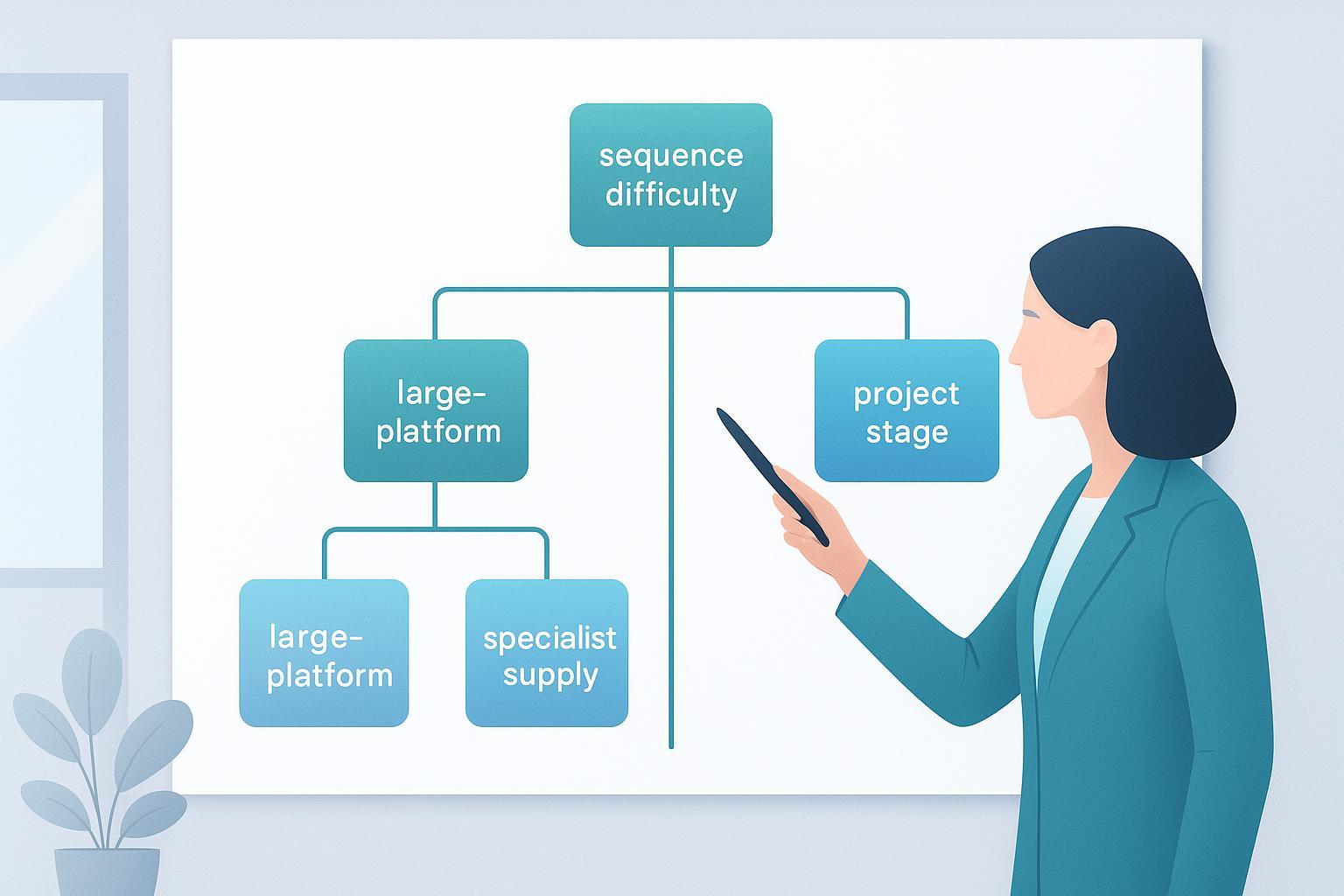
If your sequence is validated and your constraint is capacity, choose a large platform. If your sequence is still fighting you, choose a specialist. Everything else follows from sequence difficulty, project stage, and who owns the process knowledge.
Late-phase scale-up on a validated sequence: A large platform, so you can reserve capacity early and hand auditors documentation that already meets the format they expect.
Lång, hydrofobisk, or heavily modified sequences: A specialist, because route flexibility matters more than throughput when the synthesis itself is the risk.
Conjugation or labelling, where the peptide is one component of a larger construct: Whichever supplier will keep the conjugate in scope. Verify that in writing rather than assuming it from a catalogue page.
Neither fits cleanly: Programmes that need a specialist’s early route work and a platform’s later capacity are common. Plan the tech transfer before you need it, not after the first scale-up batch fails.
“It depends” is the honest answer, and what it depends on is sequence difficulty, project stage, and who owns the process knowledge.
Vanliga frågor
Är en stor peptidleverantör alltid bättre än en specialist?
Inga. A large platform wins on repeat-batch consistency, audit-ready documentation and cost per gram at volume; a specialist wins on sequences that fall outside a standard operating envelope and on direct access to the person who ran the synthesis. The useful question is not which model is better in the abstract, but which one fits the sequence, the phase and the timeline you are working to. That is the whole of the peptide supplier scale vs specialization decision.
Kan jag flytta ett projekt från en specialist till en stor plattform senare?
It is technically feasible and common, but the effort depends on the transfer package: syntetisk väg, analytiska metoder, impurity profile and specifications. Ask who owns that documentation before the project starts, not when you decide to leave. A supplier who cannot hand over a complete method package has effectively locked you in.
Kan jag använda båda leverantörerna på samma program?
Ja, and it is often the rational choice: a specialist for early route development and difficult analogues, a platform for late-phase and commercial volume. The risk sits at the handoff, where knowledge quietly falls through the gap. Define the transfer package contractually at the point you split the work, not afterwards.
Vilken modell ger bättre analytiskt stöd?
Judge the documentation, not the company size. Ask both suppliers to map their release testing and impurity control to the ICH references the EMA synthetic-peptide guideline points to, namely ICH Q3A(R2), Q6A and M7. The supplier that can do this without preparation is the one with real analytical depth.
Är en specialist fortfarande värd att använda sig av 2026?
Ja. Capacity is tight and new large-scale capacity is slow to arrive: the announced timelines put Building K Phase II into sales only in 2027 and Sisslerfeld only by 2030 (Läkemedelstillverkning, hämtas 2026-06-11). A specialist can start difficult work sooner while a platform slot is reserved for scale-up.
Dom: matcha leverantörsmodellen till ditt projekt
|
Kriterium |
Winning model |
|---|---|
|
Standard or catalogue sequences |
Large-scale supplier |
|
Difficult or non-standard sequences |
Specialist |
|
Complex modifications Handla and conjugates |
Specialist |
|
Analytiskt stöd och dokumentation |
Depends on the individual supplier, not its size Om |
|
Technical communication speed |
Specialist, for named-chemistry questions |
|
Projektkontinuitet och tekniköverföring Peptidproduktion |
Large-scale supplier, once the route is fixed |
|
Pricing on routine volume |
Large-scale supplier |
|
Total |
Matched to sequence difficulty, project stage and who owns the process knowledge |
Supplier size does not decide this. Sequence difficulty, project stage and where the process knowledge sits decide it, and a programme can legitimately move from one model to the other as those change.
For transparency: MOL Changes is a peptide vendor, so weigh our specialist column as a set of demands to verify rather than a neutral scorecard.
If you want to test those demands against a supplier, request a capability matrix or analytical documentation, or speak to a technical lead.