



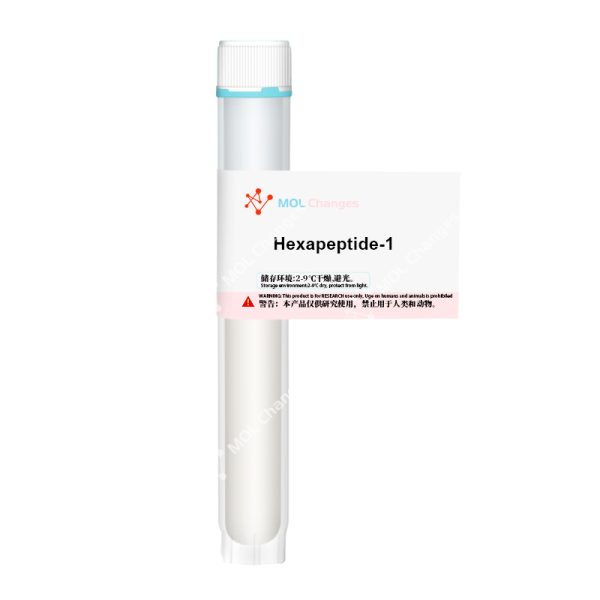
Hexapeptide-1 is a synthetic short chain peptide designed through structural optimization of the core fragment of the endogenous α-melanocyte-stimulating hormone (α-MSH).
It preserves the biological activity of α-MSH, but increases its stability and receptor selectivity with amino acid substitutions (eg, substituting methionine with Nle and introducing a D-configuration at the Phe position).
序列
Nle-Ala-His-DPhe-Arg-Trp-NH2
化学文摘社编号
/
分子式
C41H57N13O6
分子量
828.0
Hexapeptide-1 Related Research
α-MSH is an important regulatory peptide in vivo, and the minimal active sequence of “His-Phe-Arg-Trp” required for activation of melanocortin receptors (MCRs) has been defined 1.
Hexapeptide-1 is an extension of the above core sequence in which Nle and Ala are added to its NH(₂)-terminus, resulting in a hexapeptide structure of the following: Nle-Ala-His-DPhe-Arg-Trp-NH₂.
This design not only retains the critical signalling sequences but also increases hydrophobicity with Nle and enhances enzymatic stability by D-Phe, thus exhibiting enhanced activity and a longer half-life both in vitro and in vivo compared to that of native fragment.
As a result, Hexapeptide-1 is the essential tool molecule for investigating MCR function and associated therapeutic indications.
Hexapeptide-1 acts mainly on the family of melanocortin receptors (MC1R, MC3R, MC4R, MC5R).
Of these, MC1R is abundantly expressed in skin melanocytes, keratinocytes and immune cells and is a central receptor controlling skin pigmentation, inflammation and barrier.
(1).Melanin production control
As an MC1R agonist, Hexapeptide-1 attaches to MC1R to activate the adenylate cyclase-cAMP-PKA signalling pathway.
This in turn increases the activity of tyrosinase, which speeds up the synthesis and transportation of melanin.
This dual mechanism enables its application in two seemingly opposing cosmetic objectives: skin lightening and artificial tanning.
In pigmentation suppressed areas only, it can be used to reduce the risk of spots, when combined with other lightening agents at specific concentrations (arbutin and vitamin c).
Moderate use, on the other hand, helps you have smooth sun-kissed look during tanning.
(2)Anti-inflammatory and Immune Modulation
MC1R activation also inhibits NF-κB associated inflammatory signaling pathways which, in turn, decreases the production of pro-inflammatory factors (e.g., TNF-α, IL-6) to improve redness and irritation induced by UV or chemical irritants on the skin.
In addition, Hexapeptide-1 adjusts the function of immune cells residing on the skin so as to help with restoring damaged skin barriers.
It is therefore appropriate for sensitive skin and post procedure repair products.
(3).Recovery and Anti-Wrinkle
The Hexapeptide-1 has been shown to upregulate E-cadherin expression in recent research, which promotes adhesion between keratinocytes, and speeds the recovery of the skin.
At the same time, it also activates fibroblasts indirectly through cAMP signaling pathway to stimulate collagen and elastin generation.
This enhances skin elasticity and minimise fine lines, sagging to achieve other anti-ageing effect.
Hexapeptide-1 is a fusion of structural biology and dermatology at work.
By the rational modification of the core sequence of natural α-MSH, this short peptide with brightening, anti-inflammation repair and anti-aging multifunctions.
Its discovery provides an alternative to the cosmetic ingredients currently available and introduces new strategies for treatment of pigmentary disorders, photoaging, and skin sensitivity.
COA
高效液相色谱法
MS

评价
目前还没有评价