肽数据管理框架: 它必须生存什么

肽数据管理框架是一种文档模型,它将六个记录层保存在一个持久批次 ID 下, 从原材料接收到合成, 修改, 纯化, 质谱分析, 并发布测试. 其目的很狭隘: 做出三个合理的决定, 发布, 隔离, 或重新测试, 使用审计员可以跟踪的记录,而无需询问您发生了什么.
设计测试是 MHRA 的 ALCOA+ 定义: 九个属性 (可归因的, 清晰易读, 同时期的, 原来的, 准确的, 完全的, 持续的, 持久, 可用的) 应用于原始数据, 元数据, 加工步骤, 和审计追踪, 不仅仅是打印输出. 仪器生成的原始文件是原始记录.
第二个测试是范围. FDA 解释部分 11 狭隘地: 当谓词规则所需的记录以电子方式代替纸质保存时适用. 您依赖的打印输出通常不会触发它, 这就是为什么框架必须同时存在.

使发布调用可审核的机制是 测量→解释→发布决策链: 原始数据, 处理后的数据, 和决策数据分开保存, 链接记录类型.
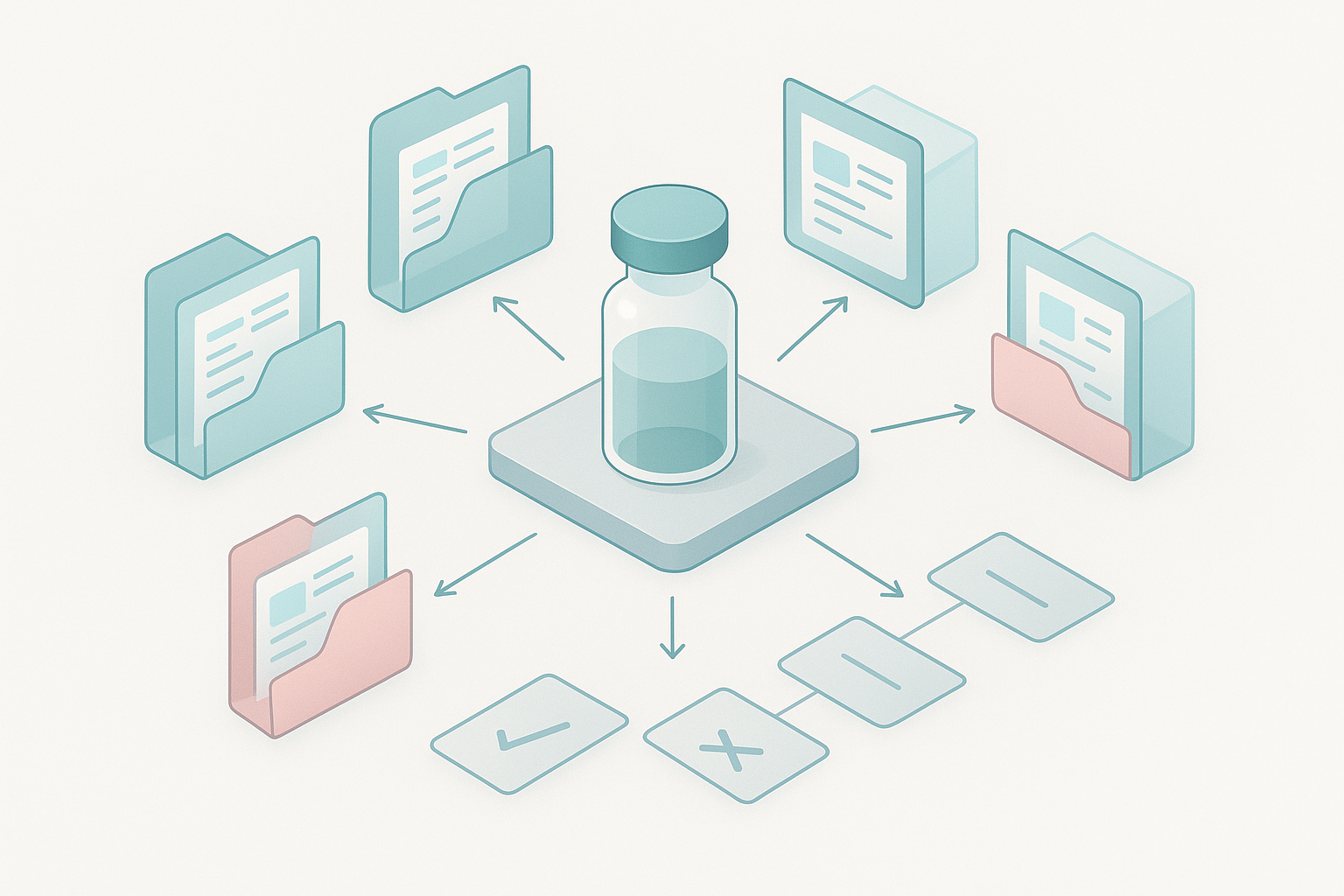
[图表: 一个批次 ID 位于中心,六个记录层从其分支 (收据, 合成, 修改, 纯化, 质谱分析, 测试结果) 以及基地的三个决策结果 (发布, 隔离, 重新测试)]
⚠️警告: 该框架是一个文档模型, 不是监管提交,也不能替代您网站经过验证的 SOP. 将其应用于您自己的质量体系,并与您的监管事务职能部门确认要求.
最小可行数据模型: 一批 ID, 亲子链接, 所需元数据
肽数据管理框架的强度取决于其与单个批次 ID 的最薄弱环节. 如果有任何神器, 是否有色谱图, 质谱, 或签署的授权书, 无法追溯到一个批次及其亲子关系, 框架在第一次审核时失败.
最小可行模型取决于三个要素: 每种材料一个批次 ID, 批次与源自该批次的任何批次之间的显式父子链接, 以及附加到每条记录的必需元数据块. 该区块应带有批次 ID, 父批次 ID, 材料, 方法版本, 乐器, 操作员, 时间戳, 和校验和. 校验和很重要,因为它证明文件自写入以来没有更改, 这是记录和索赔之间的区别.
服务 这方面的现场证据来自可靠的 MS 记录保留的内容. 根据 CAASS 质谱圆桌会议记录了在监管备案中报告 MS 数据的最佳实践, 完整的记录必须包含原始供应商文件, 获取方法文件及其版本, 处理和反卷积参数, 整合方法及其编辑历史, 软件名称和版本号, 理论和观测质量值, 以及带有时间戳的审计跟踪, 用户, 以及变更原因. 单独打印的色谱图或汇总表并不是完整的记录.
|
元数据字段 |
满足 ALCOA+ 属性 |
|---|---|
|
批次号 |
可归因, 完全的 |
|
父批次 ID |
可归因, 完全的 |
|
伴侣 店铺 里亚尔 |
可归因 |
|
方法版本 |
原来的, 持续的 |
|
乐器 |
可归因 |
|
操作员 |
可归因 |
|
时间戳 |
同期 |
|
校验和 |
多肽合成 持久, 原来的 |
每个领域都通过缩小特定差距来赢得自己的位置. 方法版本和校验和一起构成原始和持久的记录, 因为他们让审阅者确认该文件是已编写的文件并且该方法没有漂移. 时间戳和运算符使其具有同时性和可归属性. 父批次 ID 使其完整, 因为没有父项的派生批次是孤儿记录.
电子表格就足够的反对意见通常在这里会崩溃. 电子表格可以保存这些字段, 但它不能强制父子链接或保留校验和以防止静默编辑, 这就是批次间一致性容易被破坏的地方.
层 1: 收据和原材料记录

内部批次 ID 在收货时分配, 第一次使用时不, 并且每个下游记录都会继承第一个条目出错的任何内容. A receipt record needs six fields: supplier, catalogue number, supplier lot number, 分析证书, storage condition, and receipt date. The internal lot ID is then created and linked to the supplier lot in the same record.
That link is the whole point. ICH Q7’s batch-traceability requirement covers the full history from incoming raw materials through intermediates, final API, testing and disposition, with laboratory raw data tied back to the batch record under document control. The supplier lot is the only external anchor if a raw-material failure surfaces months later, and it cannot be reconstructed after the fact.
The failure mode is quiet. A resin or amino acid gets consumed across three internal lots with no supplier-lot link recorded, and when one of those lots later fails, there is no path back to the vendor batch that caused it. Retrospective trace stops at the internal ID.
A synthetic receipt record for an Fmoc-protected amino acid looks like this: supplier, catalogue number, 供应商批次, CoA attached, storage at 2-8 ℃, receipt date, and an internal lot ID minted on the same day. Assign it once, at the dock.
层 2: 综合记录
Synthesis records have to reconstruct the run, not narrate it. That means recording conditions per cycle rather than per run: resin loading and substitution level, coupling reagent and activator, number of cycles, deprotection conditions (reagent, 专注, 时间, 温度), cleavage cocktail and scavengers, and the synthesizer method version. The last field is the one most often missing, and it is the one that makes a deviation interpretable months later.
The reason is that impurity formation is cycle-dependent, not run-dependent. VialHelp’s review of impurity classes that survive into the final lot reports aspartimide formation of roughly 1.65% per cycle in a model peptide, with a test peptide reaching 44% total impurities under standard deprotection conditions and falling to 15% when an additive was used. The same source records cysteine epimerization of 8.0% at room temperature, 10.9% 在 50 ℃, 和 26.6% 在 80 °C with Trt protection, against 0.4–1.3% with a different protecting group.
Those figures are only actionable if the cycle conditions that produced them are on the record. A purity deviation logged against final run parameters alone cannot be attributed to a cycle, a temperature excursion, or a protecting-group choice, so the investigation restarts from the beginning.
层 3: 修改子记录
A modification is its own record with its own identifier, not a sentence inside the synthesis note. The sub-record should carry the modification type, the modified position, the protecting group used, the reaction conditions, the parent synthesis lot ID, and the resulting modified lot ID. Create it before the modification is performed and link it to the parent at creation, so the lineage exists from the start rather than being reconstructed later.
The parent-child link matters because a modification changes the theoretical mass. When the modification record is detached from the synthesis lot, the analytical group calculates mass error against the unmodified theoretical mass and flags a discrepancy that does not exist. Detached records of this kind sit inside a wider pattern: orphaned fractions between synthesis and purification, re-integrated chromatograms and missing method versions between purification and QA, and CoA gaps where the certificate lacks a batch link, lab identity, date, authorization, or the underlying raw data (Biotage, 2023-02-07).
A labelled or cyclized analogue recorded as a child of its parent linear peptide lot keeps that comparison honest. The modified lot inherits the parent’s identity, and every downstream mass check runs against the right theoretical value.
层 4: 净化记录

Purification is where fraction identity most often breaks, because the fraction that gets pooled is not always the fraction that gets released. The pooled fraction is the material that goes to testing, so its lineage is the release lineage.
The record has to explain a wide gap. Instrument vendors report crude purity before purification in the low-to-mid 60s to low 80s percent range for 17–34-residue peptides, so the purification record is what accounts for the difference between that starting material and the released lot.
Log these fields for every purification run:
-
Column and method identifier, including resin and dimensions
-
Gradient program with solvent composition and run time
-
Fraction collection criteria, stated as the trigger, not just the outcome
-
Pooled fraction IDs, with each contributing fraction listed
-
Re-injection events, logged as a child event under the original fraction ID
-
Recovery yield, calculated against the input mass for that run
The re-injection rule carries the most weight. A fraction that is re-injected keeps a traceable link to its original fraction ID, so the tested material and the released material can be shown to be the same.
The failure mode is quiet and expensive: a pooled fraction’s re-injection recorded under a different fraction ID than the one released. Nothing looks wrong on the CoA, but the lineage between test and release is severed, and no amount of downstream documentation repairs it.
层 5: 质谱和色谱数据 - 原始数据与处理后的数据
The raw vendor file is the original record; the interpreted mass is a derived one, and the two must be stored as separate linked artifacts under the same lot ID. Retain the raw spectrum alongside the acquisition method file with its version, the deconvolution and processing parameter file, the integration method with its full edit history, and the software name and version. Without the raw spectrum, a discrepancy discovered months later cannot be re-examined.
This is a compliance decision, not a storage decision. 在下面 21 CFR部分 11, records kept in place of paper fall within scope, and audit trails must be secure, 计算机生成的, time-stamped, independently recording the date and time of each action that creates, 修改或删除电子记录.
The failure mode is predictable: an MS file stored as an interpreted mass with no raw spectrum retained, leaving no path back to the underlying data.
对于小费: Theoretical versus observed mass and mass error are the fields that connect the analytical record to the release decision.
层 6: 测试结果和原始数据, 已加工, 决策数据分离
Test results are decision data, and a decision record is only defensible when the raw and processed layers beneath it are still retained and linked. Keep the three layers as separate records: the raw instrument output, the processed result with integration, calculation and acceptance criteria applied, and the decision record naming who concluded what, 什么时候, and on which evidence.
The two test types most often misread are sterility and endotoxin, because their result semantics differ. 美国药典 <71> is a presence-absence test: a satisfactory result means no contaminating microorganism was found in the portion examined, not proof of sterility of the entire batch. 美国药典 <85> sets the endotoxin limit as K/M, with K = 5 USP-EU/kg for routes other than intrathecal and 0.2 EU/kg for intrathecal, expressed as EU/mL, EU/mg or EU/Unit, and it applies to raw materials, in-process samples and finished parenterals where an endotoxin limit exists.
A pass/fail sterility result and a quantitative endotoxin limit carry different evidentiary weight, so the record has to preserve which one was applied. 关于
|
Test type |
Result semantics |
Supports |
Cannot support |
|---|---|---|---|
|
美国药典 <71> 不育 |
Pass/fail presence-absence after 14 天 |
Release of the portion examined under the tested conditions |
Proof of sterility of the entire batch |
|
美国药典 <85> 内毒素 |
Quantitative limit K/M, in EU/mL, EU/mg or EU/Unit |
Comparison against the limit for the stated route and dose |
A general pyrogen claim |
The failure mode is a summary table retained as the only record of a test, with the raw output discarded. Once the raw layer is gone, the processed value cannot be re-derived and the decision record stands on an assertion rather than on evidence.
打破记录的交接点

Records rarely break inside a group. They break at the boundaries between groups, where one team’s output becomes another team’s input and nobody owns the join. Three handoffs account for most of the loss.
Synthesis to purification. The fraction ID is the field that goes missing. A crude pool split across two purification runs gets logged under the original synthesis lot rather than as child fractions, so the purified material can no longer be traced back to the specific synthesis batch it came from. When a purity excursion later appears, there is no way to tell whether it originated in synthesis or in the column.
Purification to analytical. The method version is the field that goes missing. A chromatogram is filed with a method name but no version number, and the method was revised between the run and the review. The result looks valid and is not reproducible, because nobody can establish which gradient, column lot, or detection wavelength produced it.
Analytical to the release decision. The theoretical mass basis is the field that goes missing. A mass spectrometry result is reported as a match without recording which calculated mass, adduct, or charge state it was compared against. The reviewer sees agreement and cannot verify what was agreed to.
The downstream consequence is regulatory, and the pattern is not subtle. 的评论 470 warning letters from 2025 发现 469 of them, 99%, contained citations related to documentation, records, or written procedures, 和 148 targeting regulated labs, 14 citing specific data-integrity violations, 100 citing validation failures, 和 48 citing failure to investigate discrepancies or out-of-specification results (QBench, Inside 470 FDA Warning Letters From 2025). QBench sells lab informatics software, so read that figure as a vendor’s framing of the problem it sells against, not as a neutral audit. The count itself is also methodology-dependent: all-industry 2025 warning-letter totals conflict by roughly 225 letters, 695 相对 470 for the same calendar year, depending on date-window definitions, deduplication, and whether untitled letters or center subsets were folded in (IntuitionLabs compilation of FDA warning-letter statistics). Treat the ratio as directional and the exact denominator as unsettled.
The fix is structural rather than procedural. Each boundary needs a named field that is mandatory at transfer, not optional at review.
发布, 隔离, 或重新测试: 明确的决策标准
The release decision follows from which evidence artifacts are present in the lot record, not from a reviewer’s overall impression of the batch. 我Q2(R2) applies to release and stability testing of commercial drug substances and products, and it extends to other procedures in the control strategy under a risk-based approach. That scope is what makes the artifact set, rather than the reviewer’s confidence, the deciding input.
这 Q2(R2) 桌子 1 matrix sets what each test type must have demonstrated before its result can carry a release decision. Quantitative impurity and purity tests require specificity, range and response, lower range limit, 准确性, repeatability and intermediate precision. Limit tests require only specificity and detection limit. Identity requires only specificity. A purity assay validated on specificity alone does not meet the matrix, so its passing result cannot support release on its own.
|
Decision |
Evidence condition |
Governing standard |
|---|---|---|
|
发布 |
Full artifact set present: receipt and raw-material records, synthesis and modification records, purification records, raw and processed MS/chromatogram data, and test results validated to the Table 1 matrix for each test type used |
我Q2(R2) scope and Table 1 |
|
隔离 |
Any required artifact missing or incomplete, including a test result whose method validation does not cover the characteristics the matrix requires for that test type |
我Q2(R2) 桌子 1 |
|
Retest |
Artifacts present but discrepant, such as a fraction re-injection logged under a different fraction ID than the one released, or a result that cannot be traced to its raw instrument file |
我Q2(R2) scope; site data-integrity SOP |
Make the artifact-to-criterion mapping explicit in the record itself, so the release call can be reconstructed without the reviewer. The failure mode to watch for is a release supported by an identity test where a purity test was required: the record looks complete, the result passes, and the matrix gap only surfaces at audit.
追溯矩阵: 支持决策的工件
The matrix is the framework’s output: each artifact row names the record that supports a release, 隔离, 重新测试, or investigation decision, so the release call can be reconstructed without re-reading the batch record.
|
Artifact |
发布 |
隔离 |
Retest |
Investigation |
|---|---|---|---|---|
|
Receipt and raw-material 合成肽 records |
Identity and supplier lot confirmed |
Supplier lot under review 多肽生产 |
Not applicable |
Supplier discrepancy |
|
Synthesis records |
Crude yield and scale recorded |
Yield outside expected range |
Repeat synthesis |
Failed coupling or scale deviation |
|
Modification sub-records |
Modification site and extent confirmed |
Incomplete modification |
Re-analysis of modified fraction |
Unexpected side product |
|
Purification records |
Pooled fraction identity and gradient recorded |
Pooled fraction held |
Re-purification |
Fraction mislabeling |
|
Mass spectrometry and chromatogram data |
Raw and processed files linked to the lot |
Processed file without raw data |
Re-acquisition |
Raw and processed results disagree |
|
Test results |
Result within specification |
Out-of-specification result |
Confirmatory retest |
Invalidated run |
Analytical procedures supporting these rows follow ICH Q2(R2) and Q14, 在步骤中采用 4 on 1 十一月 2023, with the current Q2(R2) status and effective date confirming EU application from 14 六月 2024. Purity specifications should match purity grade recommendations by application, since lot-to-lot variability rises as purity falls, especially below 80%.
As described by the vendor, one lot-level record has to survive a modification, a re-injection, and a release call without losing the parent-child link between them.
下一步
The framework’s value shows up at the release decision: every artifact from receipt through test results either supports that call or leaves a gap someone has to reconstruct later. A peptide data management framework that keeps raw, processed, and decision data separate, and links each record to its parent lot, turns a release review into a lookup rather than an investigation.
Before adopting it, check the retention and signature rules that apply to your site. Raw-data retention periods are jurisdiction- and discipline-specific, 和 raw data under 21 CFR部分 58 is archived under GLP requirements that differ from GxP manufacturing retention, which is often expressed as batch expiry plus one or two years. FDA’s data-integrity guidance reinforces ALCOA expectations with audit trails as the demonstration mechanism, and Part 11 requires signatures linked to their records showing printed name, date and time, and meaning.
If you are evaluating how this maps to your own workflow, review the analytical documentation package or talk to an expert about where your current records would break first.
该框架是一个文档模型, not a regulatory submission or a substitute for your site’s validated SOPs. MOL Changes provides peptide synthesis and analytical services; this article is educational and does not describe a validated system.
常见问题解答
在现有实验室中实施该框架需要多长时间?
It depends on three variables rather than on the framework itself: whether an ELN or LIMS is already in place, how many legacy lots need retrospective mapping, and whether the metadata block has to be added to existing templates. A lab with a configured ELN can usually adopt the schema in weeks, because the parent-child link and required fields are configured rather than built. A paper-based lab mapping several years of legacy lots should plan in months, since each historical lot has to be reconstructed from the raw files that still exist. Treat any estimate as a function of legacy volume, not of the framework.
我可以在电子表格而不是 LIMS 中运行这个框架吗?
是的, with a known ceiling. A controlled spreadsheet can hold the lot ID, the metadata block, and a parent-child column, and for a small group it can support peptide traceability and reproducibility adequately. It breaks down in three places. Parent-child linkage across modification and re-injection events depends on the operator applying the rule every time. Audit trails must be secure, computer-generated and time-stamped, independently recording the date and time of operator entries and actions that create, modify or delete electronic records, with changes not obscuring previously recorded information, and a spreadsheet does not meet that by default. Checksum-based file integrity for instrument raw files sits outside the spreadsheet entirely.
What should I do if a fraction’s re-injection was logged under the wrong fraction ID?
Do not overwrite the original entry. Create a linked correction record that preserves the original, states the reason for change, and re-establishes the parent-child link between the re-injected fraction and the fraction that was released. This follows the ALCOA+ expectation that raw data, 元数据, 加工步骤, audit trails and the final reported result all remain attributable and accurate, with the instrument-generated raw file treated as the original record. The correction record is what makes the change traceable; deleting the wrong entry destroys the evidence that the correction was needed.
做 21 CFR部分 11 如果我打印色谱图并在纸上签名,则适用?
部分 11 applies when records required under predicate rules are kept in electronic format in place of paper. Where a computer merely generates a paper printout that the firm relies on, 部分 11 is generally not triggered. The practical consequence is that the paper path shifts the burden onto the paper system: the printout has to be legible, 可归因的, 同时期的, and retained under the applicable record-retention schedule, and any electronic file behind it that you continue to rely on for the release decision can bring Part 11 back into scope.
当结果不合格时,如何决定隔离和重新测试?
The release decision criteria should be written before the result arrives, 不之后. Quarantine is the default when the failure is in a specification attribute that a repeat test cannot resolve, such as a confirmed identity or purity result on a consumed sample. Retest is defensible when the failure is attributable to a documented analytical cause, such as an injection error or an instrument fault, and the investigation records that cause. If the investigation cannot name a cause, quarantine the lot and escalate; retesting without a documented cause produces a second result without resolving the first.
结论
You now have a field-level peptide data management framework that resolves every artifact, from receipt and synthesis through modification, 纯化, 质谱分析, and final test result, back to one persistent lot ID. The separation of raw, processed, and decision data is what makes a release, 隔离, or retest call auditable rather than a matter of reviewer impression.
该框架是一个文档模型, not a regulatory submission, and it does not replace your site’s own validated SOPs. Confirm applicability against the governing standard and your own quality system before adopting any part of it.
MOL Changes publishes this material as a peptide synthesis and modification provider and has a commercial interest in peptide quality standards.
Ready to review the analytical documentation package? See how lot-level records, chromatogram data, and release documentation are assembled end to end, then talk to an expert about your workflow.
Review the analytical documentation package