Antecedent cellular mechanisms
The essence of human aging is cellular senescence, senescent cells forever out of the cell cycle, but they will not be removed as directly as apoptotic cells, senescent cells generally have a large number of damaged DNA, which may be the reason why they are not removed, so the senescent cells will be a large number of retained, and continue to be deposited thereby inducing the body’s aging and the occurrence of related diseases. (Before senescent cells kill you, you should strike first)
The p53 gene has the function of inducing apoptosis, and its mechanism is that the p53 protein encoded by the p53 gene functions as a checkpoint in the G1 phase of the cell cycle and is responsible for checking whether there is any damage to the chromosomal DNA; once the defective DNA is found, it stimulates the expression of CIP, which prevents the cells from entering into the cell cycle and initiates the mechanism of DNA repair; if the repair fails, the p53 initiates the apoptosis mechanism.
In senescent cells, FOXO4 expression rises and affects the process of cellular senescence and apoptosis through interaction with proteins such as p53. Because it attaches to p53, it can prevent senescent cell death.
Difference between FOXO4 and FOXO4-Dri
FOXO4 short peptide is L-type amino acid.
FOXO4-Dri short peptide is D-type amino acid.
Why FOXO4-Dri appears
FOXO4 is a straight-chain polypeptide composed of 46 li-amino acid, the vast majority of the sequence is D-type amino acids, because he combined with the p53 gene, preventing the expression of the p53 gene, thus leading to the inability to remove senescent cells.
In the original idea, scientists wanted to use gene editing to take out the foxo4 gene, but this was too much work and prone to DNA damage. Ka hona, scientists devised an alternative by replacing all of the L-type amino acids in the FOXO4 short peptide with D-type amino acids, which inverts the conformation of FOXO4-Dri and competitively binds to p53, while preventing FOX04 from binding to p53.
P53 activates apoptotic proteins and causes cell death. By removing old cells from the tissue, more dramatic tissue regeneration can be achieved.
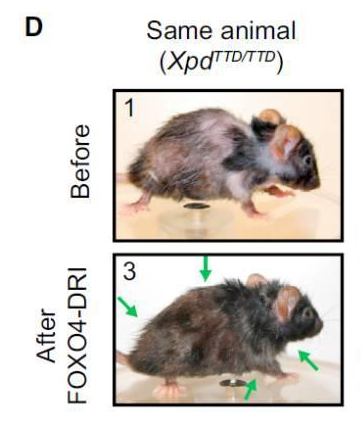
Attachment: senescent mice injected with FOX04-dir showed significant improvement in kidney function and hair began to repair itself.

Bingyan Gao
Profile: Bingyan Gao ke "molebeli oa heke oa ho qetela" oa bohloeki le boleng ba peptide. O hloahloa tšebelisong ea lisebelisoa tse fapaneng tsa tlhahlobo ea maemo a holimo mme o ipabola ho nts'etsopeleng mekhoa e ikhethileng ea karohano ea chromatographic bakeng sa li-peptide tse fetotsoeng tse rarahaneng haholo.. O thehile mokhoa o matla oa ho hlahisa litšila tse sa hloekang o sa tiiseng feela bohloeki ba sehlahisoa sa 99% kapa e phahameng empa hape e tsebahatsa ka nepo le ho felisa litšila tse ka bakang immunogenicity. Ka kutloisiso e tebileng ea litlhoko tsa taolo tsa FDA le EMA bakeng sa lithethefatsi tsa peptide, o etsa bonnete ba hore sehlopha se seng le se seng se lokolotsoeng setsing se tsamaea le Setifikeiti sa Tlhahlobo se felletseng le se nang le matla. (COA).
- Likhutšoane tsa Amino Acid - Boloka Likhoutu tse sa hlakang le tse sa Lekanyetsoang 2026年11月9日
- Lihlopha tse Sireletsang Amino - Rera Phetoho ea Multistep Peptide 2026年11月8日
- Aspartimide Formation - Kotsi ea Tatelano, Maemo a Ts'ebetso le Matheba a Bofofu a Analytical 2026年11月8日
- Automated Peptide Synthesis - Liteko tsa Kamohelo bakeng sa Thepa le Lihlahisoa tsa Lik'hemik'hale 2026年11月8日
- AI-Assisted Custom Peptide Synthesis - Boiketlo ba Koetliso le Boikemisetso bo Ikemetseng 2026年11月7日
Mokhoa oa rona oa ho hlahloba lintlha
Re etelletsa pele ho nepahala le bots'epehi ho litaba tsa rona. Mona ke kamoo re bolokang litekanyetso tse phahameng:
- Tlhahlobo ea Setsebi: Lingoliloeng tsohle li hlahlojoa ke litsebi tsa litaba.
- Mohloli oa netefatso: Lintlha li tšehelitsoe ke tse tšepahalang, mehloli ea morao-rao.
- Ponaletso: Re qotsa litšupiso ka ho hlaka le ho senola likhohlano tse ka bang teng.
Boto ea rona ea Tlhahlobo
Litaba tsa rona li hlahlojoa ka hloko ke litsebi tse nang le phihlelo ho netefatsa ho nepahala le bohlokoa.
- Litsebi Tse Tšoanelehang: Sengoliloeng se seng le se seng se hlahlojoa ke litsebi tse nang le tsebo e khethehileng ea tšimo.
- Litlhaloso tsa morao-rao: Re kenyelletsa lipatlisiso tsa morao-rao, mekhoa, le litekanyetso.
- Boitlamo ho Boleng: Bahlahlobi ba netefatsa ho hlaka, nepahalo, le botlalo.
Batla lengolo le hlahlobiloeng ke litsebi ho bala litaba tseo u ka li tšepang.