Hur Kaizen i QC-labbet börjar med en provflödeskarta

Innan du ändrar något, göra det aktuella tillståndet synligt. Mikroresultatet av denna första övning är en ensidig provflödeskarta: ett enstaka peptidprov spåras från mottagande till beredning, injektion, granskning och resultatsläpp, med förfluten tid och väntetid markerad vid varje överlämning.
Bygg den genom att gå den fysiska vägen själv och tidsstämpla varje handoff under en vecka. Lita inte bara på LIMS-rapporten, eftersom systemet registrerar när arbete är bokat, inte när ett prov faktiskt sitter och väntar.
Felläget som detta förhindrar är förbättringsansträngningar riktade mot fel mål. Lag attackerar ofta instrumenthastigheten först, ändå är schemaläggning en stor del av labbtiden: a 2018 Tunnell/MassBio fallstudie rapporterade att provschemaläggning står för mer än 13% av ett pharma QC-labbs drifttid, mätt på en enda icke namngiven klientplats, så behandla figuren som riktad snarare än universell.
Kontrollera att kartan fungerade: den bör visa minst en handoff där provet väntar längre än det bearbetas. Om det inte gör det, du har kartlagt den ideala processen, inte den riktiga.
Bygg en upprepning-analys root-orsak taxonomi
En omkörningslogg utan klassificeringsschema kan inte skilja ett förberedelseproblem från ett metodproblem, så du åtgärdar ingendera och den upprepade analysens grundorsak förblir oadresserad. Fyra klasser täcker de flesta QC-upprepningar av peptider.
|
Underkänd klass |
Typisk trigger |
Diagnostiska bevis |
Berättigad åtgärd |
|---|---|---|---|
|
Provberedning |
Hydrofoba eller aggregerande sekvenser; ofullständig upplösning |
Topparean varierar mellan injektioner medan summan av ytor förblir konstant |
Gör om förberedelserna; ändra spädningsmedel eller ultraljudsbehandlingstid |
|
Systemets lämplighet |
Kolumnåldring; mobilfasdrift |
Upplösning, tailing eller %RSD utanför metodkriterierna |
Återbalansera, ersätt kolumnen, återförbereda mobilfasen |
|
Metodinstabilitet |
Jonparningsreagens eller gradientkänslighet |
Selektivitet skiftar mellan körningar på samma prov |
Återvalidera metodvillkoren |
|
Äkta OOS |
Riktigt batchdefekt |
Repeterbart resultat på ett nytt preparat och en andra kolumn |
Tjänster Öppna en formell utredning |
Metodinstabilitet är den klass som oftast felmärks som ett provproblem. Waters visade att jonparning i mobilfas förändrade om en isomer löste sig från den huvudsakliga peptidtoppen: under myrsyra var lanreotidisomeren "väl separerad från huvudtoppen", medan "under TFA-mobil faser, bara en axeltopp dök upp Handla bredvid huvudtoppen” (Vattnen, Syntetisk peptidföroreningsanalys på kolumner med omvänd fas, 2018).
Shimadzus överföringsdiagnostik skiljer injektor från prov: toppareavariation med en varierande summa av ytor pekar på injektorn, variation i endast vissa toppar pekar på provets instabilitet, och en nollinjektion som fortfarande visar toppen utesluter nålen och provslingan (Shimadzu, Lösning av överföringsproblem i HPLC). Samma symptom-till-orsak logik i standard HPLC felsökning vägledning namn autosampler luftdrag, provnedbrytning, igensatta nålar, läckande tätningar och lösa beslag, vid sidan av otillräcklig jämvikt åtminstone 5-10 gånger kolumnvolymen" (Thermo Fisher Scientific, HPLC-felsökning).
Orenhetsidentitet skärper klassificeringen. En trunkering är "den märkta sekvensen saknar en eller flera rester från N-terminalen eftersom motsvarande kopplingscykel misslyckades", och eftersom trunkeringsprodukter är kortare och mindre hydrofoba "eluerar de vanligtvis tidigare än huvudtoppen", där "flera trunkeringsprodukter som eluerar nära varandra skapar det tidiga "fuzz"-mönstret på axeln på kromatogrammet" (Lyochem, Peptidföroreningsprofilering förklaras, 2026). En tidig axel är en syntessignal, och en upprepning rensar inte det.
Systemlämplighetsfel är en metod-hälsodom, inte ett provutslag. Konvergent praxis över peptid RP-HPLC-metoder sätter upplösningen till Rs ≥ 1.5 för det kritiska paret, svansfaktor ≤ 2.0, och replikatinjektionsprecision på %RSD ≤ 1-2% för topparea eller retentionstid (PepMax, How We Verify Peptide Purity, 2026). These are practice-typical values, not a regulatory threshold; USP <621> is the authoritative upstream source.
Key Takeaway: Classify every repeat before you run it. Preparation and method classes are fixed at the bench; only the OOS class justifies a formal investigation.
Bestäm vilka hastighetsspakar som är legitima
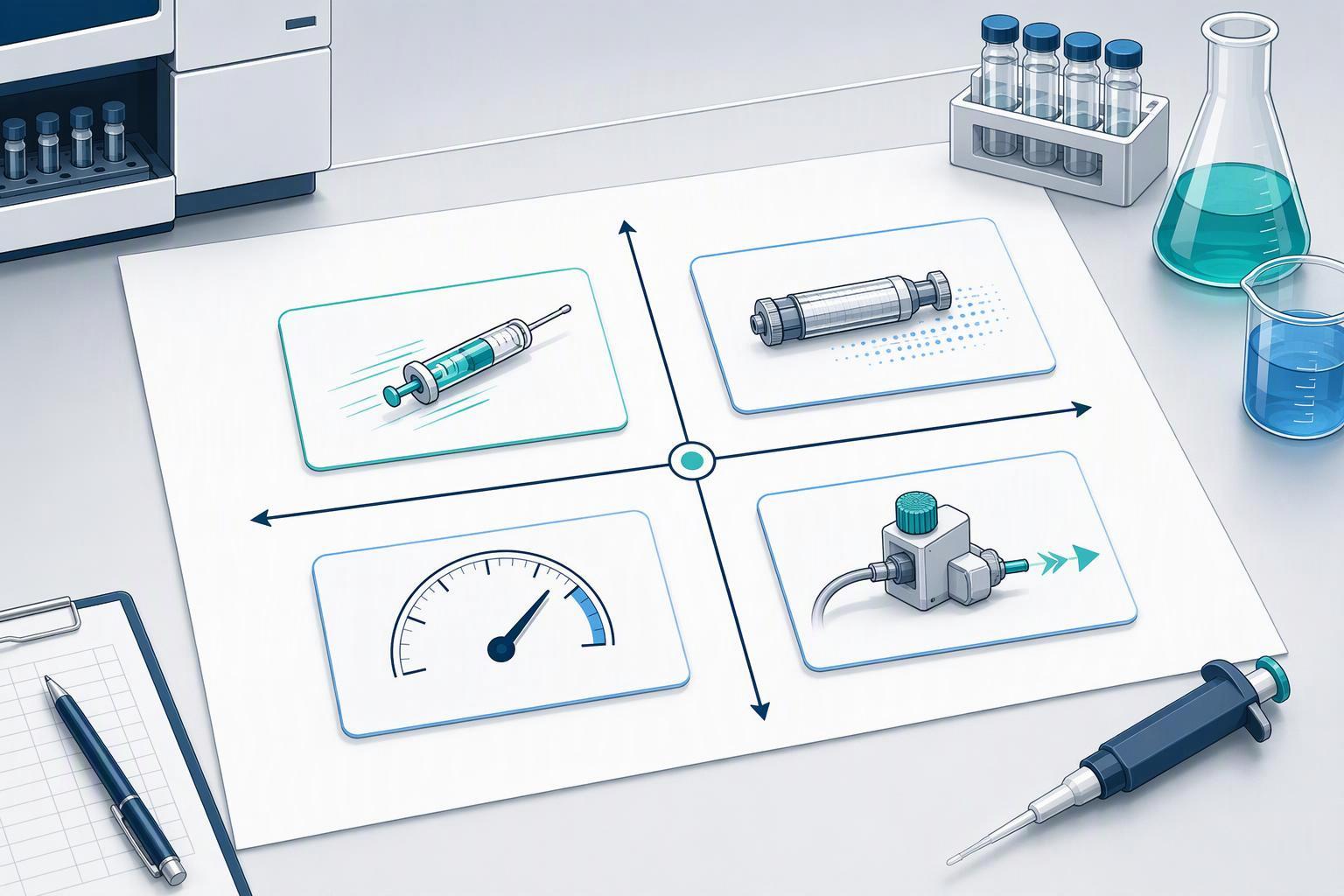
The levers that shorten peptide analytics turnaround without touching the validated method are scheduling and instrument discipline: batching samples by mobile phase, holding equilibration at 5 till 10 column volumes, controlling autosampler temperature, and prioritising the queue by commitment date. These change when work runs, not what the method does, so they carry no revalidation obligation. Levers that alter the method itself, such as a shorter gradient, a different column, or a raised flow rate, falla under I Q2(R2), adopted in November 2023, which requires that a change affecting the procedure’s performance be revalidated, at least for the affected characteristics.
That requirement is not a blanket ban on method change. The Q2(R2)/Q14 lifecycle approach treats a method as something you design to accommodate planned change, which is the legitimate route to a faster procedure.
Peptidsyntes The failure mode sits on the scheduling side. Cutting equilibration below 5 till 10 column volumes to save minutes produces retention-time drift, and the rerun costs more than the minutes saved.
Beräkna kapacitet mot efterfrågan innan du binder dig
The arithmetic that decides whether Kaizen in the QC lab needs more instrument time or more analyst time is small enough to do on one page. Start with the hours an HPLC actually has available: total scheduled hours, minus planned maintenance, minus the equilibration overhead that standard troubleshooting guidance puts at “at least 5–10 times the column volume” before a run is stable (Thermo Fisher Scientific, hämtas 2026-06-04). What remains is your real HPLC instrument utilization, and it is usually well below the number on the schedule.
Then compare that figure against sample demand. If available hours exceed demand, your constraint is downstream: review, data integrity checks and release. Buying or scheduling more instrument time at that point adds cost without shortening turnaround.
Key Takeaway: In peptide QC, turnaround loss concentrates in queue time and avoidable repeat analysis, and the two are coupled: a rerun consumes the instrument slot the next sample needed. Confirm which constraint you actually have before you commit budget to either one.
Gör Documentation Discipline till möjliggöraren, Inte skatten
Documentation is what makes a faster peptide QC workflow defensible. Data integrity in the QC lab is not a compliance exercise bolted onto the speed work; it is the mechanism that lets a repeat analysis close in hours instead of escalating into an investigation.
The regulatory baseline is specific. Under 21 CFR del 11, users of closed systems “shall employ procedures and controls designed to ensure the authenticity, integritet, och, when appropriate, the confidentiality of electronic records.” Section 11.10(e) requires “secure, datorgenererade, tidsstämplade revisionsspår,” and states that record changes “shall not obscure previously recorded information.” That clause decides whether a rerun is routine: if the original integration and the reason for the change are reconstructable, the repeat is a data point. Om inte, it becomes a deviation. De MHRA’s GxP data integrity guidance, published in March 2018 and updated in September 2021, carries the ALCOA+ framing most peptide labs are audited against. Cite that document, inte the withdrawn 2015 data integrity definitions it superseded. Instrument-side, USP <1058>’s fitness-for-intended-use framework, last revised in 2017, ties qualification records to the method the instrument is actually running.
For a peptide, a record that survives audit carries more than a purity number: sequence and sequence version, N- och C-terminal, modifieringsplats och kemi, motjonsform, massa, method ID, kolumn, lutning, wavelength and reference standard. Those fields separate the five things one “purity” figure conflates: purity as relative main-peak area percent by HPLC, identity by orthogonal confirmation, content or net peptide, stabilitet, och analyslämplighet.
Connected data packages are one way to hold that together. MOL Ändringar supports this pattern by pairing orthogonal HPLC purity measurement with high-resolution MS identity confirmation in a single traceable record rather than two disconnected reports.
The failure mode to design against is narrow and common: a rerun whose original result cannot be reconstructed from the record. The second injection then no longer answers the question the first one raised, and a two-hour repeat becomes a multi-week investigation.
Standardisera förändringen så att den överlever nästa granskning
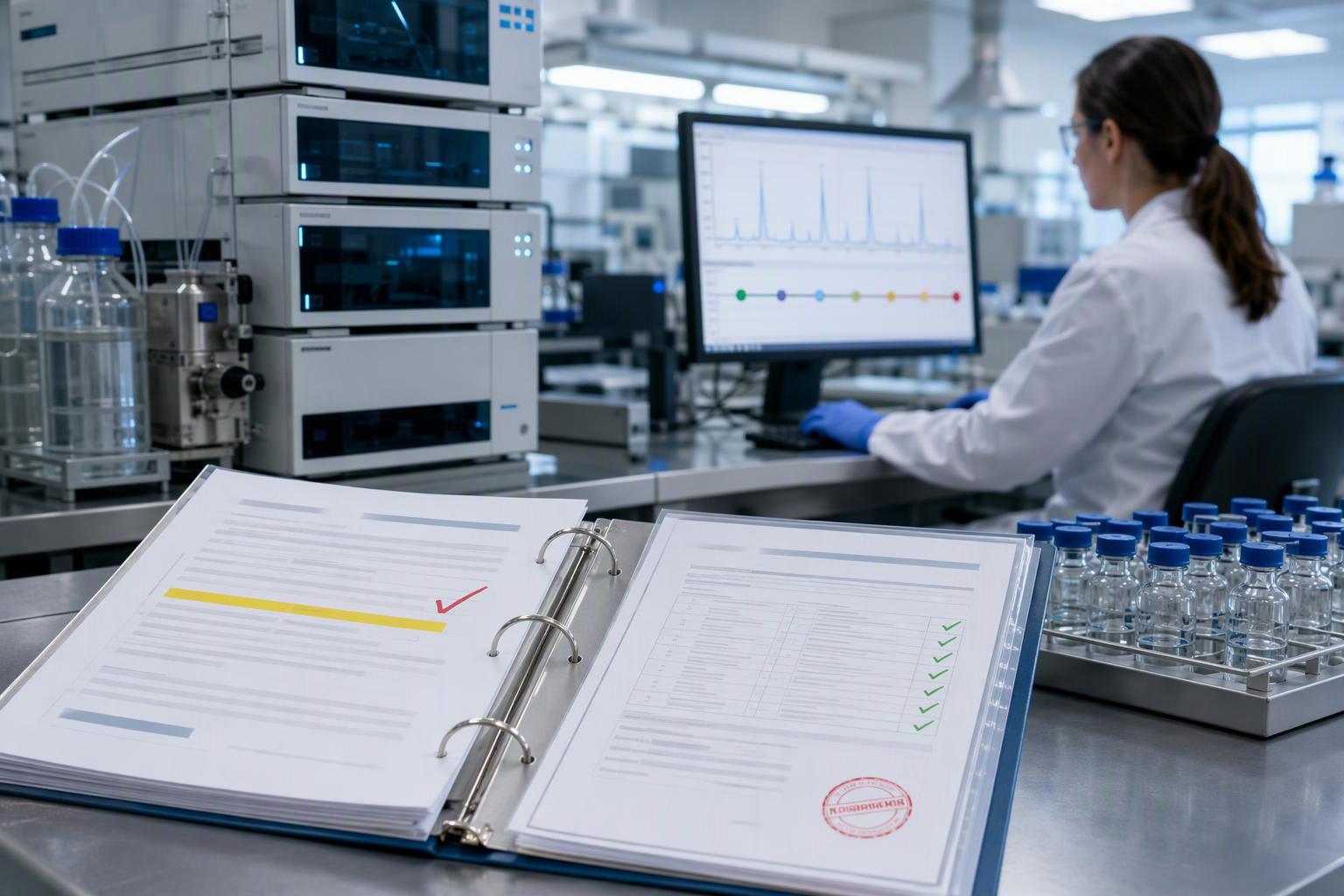
An improvement that lives in one analyst’s habit is not a Kaizen outcome. It disappears at the next staff change and cannot be defended in an inspection, because the controlled method still describes the old step.
Write the changed step into the controlled method or SOP, version it, and link the revalidation record and audit-trail entry to that version. I Q2(R2) requires revalidation when a change affects the procedure’s performance, so the trigger is the change’s effect on the method, not the size of the edit. USP <1058> frames the same question as fitness for intended use: show that the instrument and method still suit the purpose after the change.
Then keep it measurable. Track rerun rate by failure class, queue time per handoff, and right-first-time month over month.
Vanliga misstag att undvika
Treating undated vendor ranges as a benchmark. Consulting vendors publish headline improvement figures for QC-lab lean programmes, including 30–50% gains in resource utilisation, 10–20% increases in right-first-time, and 15–40% lead-time reduction from sample reception to result release, som vendor-reported ranges for QC-lab lean programmes from the Kaizen Institute show. The page carries no client, metod, or date, so the numbers describe an unknown population. The consequence: a QC lead who sets 40% as a target gets judged against a figure nobody can reproduce. Use your own baseline instead.
Shortening equilibration below 5–10 column volumes. The temptation is real when a peptide method runs long and the queue is deep, but the symptom-to-cause logic in standard HPLC troubleshooting guidance treats retention-time drift and split peaks as equilibration symptoms first. Cut the step and the failure surfaces as a repeat analysis, which costs more time than the equilibration saved.
Changing mobile-phase ion-pairing to sharpen a separation. Ion-pairing reagent changes shift selectivity, and ICH Q2(R2) requires revalidation when a change affects the procedure’s performance. Treating it as a tweak rather than a method change leaves the validation package describing a procedure you no longer run.
Logging reruns without a failure class. A rerun count with no cause attached cannot be trended, so the same failure recurs unnoticed. Assign a class at the bench, while the chromatogram is still open.
Citing the withdrawn 2015 MHRA data integrity definitions. De 2015 guidance was withdrawn and replaced by the 2018 document. Building an audit response on the withdrawn 2015 data integrity definitions invites a finding that has nothing to do with your data.
Resultat: Hur en fungerande peptid QC Kaizen ser ut
A working peptide QC Kaizen is visible in four artifacts, not in a feeling that the lab is busier. You should be able to open a flow map with wait times marked at every handoff, a rerun log that classifies each repeat analysis by failure class, a capacity calculation that names the single binding constraint, and a controlled record that reconstructs any rerun without interviewing the analyst who ran it.
Track four metrics against those artifacts: rerun rate by failure class, queue time per handoff, right-first-time, and turnaround from receipt to release. One reported QC lab transformation cut throughput time by 30% in three months, lifted right-first-time from 95% to above 99%, and raised analyst productivity by more than 25% without adding equipment or personnel (Tunnell Consulting, 2018). Treat that as a single unnamed site’s result: no sample size and no measurement method were published, so use it as a direction of travel rather than a benchmark you can promise.
The stretch goal is extending the same taxonomy to stability and content Syntetiska peptider testning, where repeat analysis is usually rarer but harder to diagnose.
Vanliga frågor
Hur lång tid tar en Kaizen-cykel i ett QC-labb?
Most peptide QC Kaizen cycles run four to eight weeks from sample-flow map to standardised change. Three things drive the spread: how long the repeat-analysis root-cause taxonomy takes to build from your own records, whether the chosen speed lever touches a validated method, and how fast the change clears documentation review. A cycle that only reorders sample intake or batches system-suitability runs lands near four weeks. One that changes an HPLC gradient lands near eight, because revalidation sits on the critical path.
Behöver en snabbare HPLC-metod fullständig revalidering under ICH Q2(R2)?
Not automatically. I Q2(R2) requires revalidation when a change affects the procedure’s performance, so the scope follows the characteristics your change actually touches. Shortening a gradient or switching column dimensions can affect specificity, accuracy and range, and those need re-testing. Changes that leave the separation mechanism and detection intact, such as adjusting run batching or equilibration time, generally call for less. Document the risk assessment that justifies the scope you chose; that record is what an auditor reads.
Vad ska jag göra när systemets lämplighet misslyckas på en hydrofob eller aggregerande peptidsekvens?
Work the symptom-to-cause logic in standard HPLC troubleshooting guidance before touching the method. For hydrophobic sequences, retention drift and peak broadening usually trace to column temperature, mobile-phase organic content, or accumulated peptide residue on the column. For aggregating sequences, the failure often sits upstream of the column: sample preparation, denaturant concentration, or time between reconstitution and injection. Run the suitability standard again on a fresh column before concluding the method is at fault.
Hur skiljer jag en trunkering från en radering när enbart massa är tvetydig?
Mass alone often cannot separate them, because a truncation and a deletion can produce the same nominal shift. Lyochem’s 2026 analysis of per-cycle efficiency explains why a 25-mer accumulates double-digit yield loss at 99.5% per-cycle efficiency, and that arithmetic is what makes truncation the more likely explanation in longer sequences. Resolve the ambiguity with MS/MS fragmentation rather than a second intact-mass measurement: fragment ions localise where the sequence breaks, which separates a missing terminal residue from a missing internal one.
Kräver dessa metoder ny instrumentering?
Inga. The workflow runs on the inventory a peptide QC function already has: analytical HPLC or UHPLC for purity, and high-resolution LC-MS for identity. A complete peptide certificate of analysis also draws on ICP-MS for elemental impurity data and GC-MS for residual solvents, but those support release testing rather than the Kaizen cycle itself. The constraint is scheduling time on shared instruments, not acquiring new ones. If your LC-MS queue is the bottleneck, the capacity calculation in the previous section is where that shows up.
Slutsats
You now have five working instruments: a sample-flow map, a rerun taxonomy by failure class, a legitimacy test for speed levers, a capacity calculation against demand, and a documentation standard that holds up under audit. Apply them in that order at the bench, and the decision rule is simple: fix the class with the highest rerun count before you buy speed anywhere else. Om
Track turnaround from receipt to release as the headline number, but watch rerun rate by class as the leading indicator. Turnaround tells you what happened last month; rerun rate by class tells you what will happen next month, and it moves first.
If you would rather work through the flow map and rerun taxonomy with someone who runs peptide analytics daily, talk to an expert about your current QC workflow.
Avslöjande: this article was prepared by MOL Changes, which provides peptide analytical and QC services. Peptidproduktion