



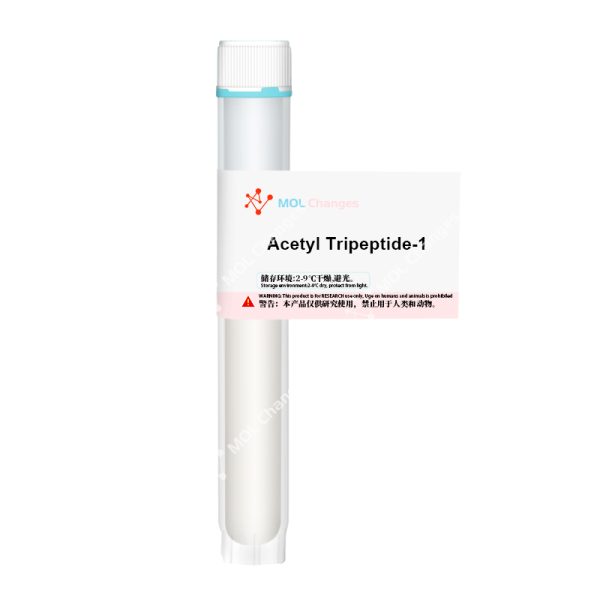
Acetyl Tripeptide-1 is a synthetic repair signal peptide, synthesized via N-terminal acetylation (“capping” modification) of the naturally occurring tripeptide GHK found in plasma and has a chemical structure similar to Acetylated Polypeptide-1. This structural modification addresses the aforementioned inherent challenges of the original GHK, including instability due to aminoxidases, inactivation in cosmetic formulations, and a short half-life.
In summary, Acetyl Tripeptide-1 effectively reduces fine lines and wrinkles, tightens the skin, and refines skin complexion. It is an anti-aging ingredient with a clear mechanism of action, high specificity, and demonstrated efficacy.
序列
Ac-Gly-His-Lys-OH
化学文摘社编号
350595-76-5
分子式
C16H26N6O5
分子量
382.42
Acetyl Tripeptide-1 Related Research
1.Core Mechanisms and Multi-faceted Effects
The acetylated GHK exhibits increased hydrophobicity and a prolonged half-life while preserving its reversible Cu²⁺-chelation properties. These properties facilitate the formation of copper-peptide complexes within the dermal layer, enhancing efficacy without increasing cytotoxicity.
It acts on dermal fibroblast cells to counteract aging induced by chronological or environmental factors. Through binding to specific cell surface receptors, it activates major intracellular signaling cascades to modulate cellular function at the genetic level.
It strongly stimulates the synthesis and secretion of Type I & III collagen and elastin, resulting in denser, thicker skin. This, in turn, reduces wrinkles, sagging, and hollowing caused by collagen loss.
It also suppresses excess matrix metalloproteinase activity, establishing a protective skin microenvironment that reduces degradation of the native extracellular matrix.
2.Promotes Collagen and Elastin Synthesis
Acetyl Tripeptide-1 reaches the dermal layer of the skin, where it acts as a ligand for specific receptors on the fibroblast cell membrane. This binding activates the mitogen-activated protein kinase (MAPK) and phosphoinositide 3-kinase (PI3K) signaling pathways, promoting fibroblast proliferation and upregulating anabolic metabolism.
At the transcriptional level, it enhances the expression and synthesis of Type I collagen, Type III collagen, and elastin, thereby increasing their concentration and density in the dermis. This leads to plumper, more voluminized skin. ¹
3.Inhibits Excessive Matrix Metalloproteinase Expression
Acetyl Tripeptide-1 modulates cellular signaling to limit the overproduction of matrix metalloproteinases (MMPs), while also mitigating ongoing extracellular matrix degradation by suppressing their synthesis at the transcriptional level.
Preserving existing collagen through this mechanism helps maintain dermal thickness and integrity, extends collagen turnover time, and thus contributes to delaying the aging process. ²,³
4.Enhances Cellular Skin Repair Function
Acetyl Tripeptide-1 activates the PI3K/Akt pathway, a key regulator of cellular survival, growth, and metabolism. This stimulation boosts fibroblast activity and enhances the repair of daily microtrauma.
It also scavenges free radicals generated via metal-ion catalysis, thereby indirectly preventing oxidative stress-induced cellular damage and promoting healthier skin. ⁴
COA
高效液相色谱法
MS

评价
目前还没有评价