Varför den konventionella renhets-första synen på porbildande peptiddesign är ofullständig

Det vanliga frisättningskriteriet för en membranaktiv peptid är ett enda nummer: omvänd fas HPLC-area, vanligtvis på eller över 95%, plus ett masspektrum som bekräftar den förväntade intakta massan. Den standarden är verkligen användbar, och det är värt att vara exakt om vad den fastställer. RP-HPLC rapporterar kromatografisk renhet, det vill säga andelen UV-absorberande material som sitter i huvudtoppen, medan masspektrometri rapporterar intakt massa och, med MS/MS, fragmenteringsstöd på sekvensnivå (Kapitel PMC-metoder). Tillsammans svarar de på en riktig fråga: vad som gjordes, och hur ren är den.
Nivåerna i sig är konventioner snarare än krav. Leverantörer anger vanligtvis ≥95 % RP-HPLC-area som golv av forskningsklass, ≥98% som det moderna forsknings- och GMP-golvet, och ≥99 % för premium eller kliniskt material (referensuppsättning för peptidrenhet, 2025). Dessa är rapporterade leverantörskonventioner, inte ett kompendiellt mandat.

Utsikten blev dominerande eftersom den är billig, snabb, ortogonal, och tillräckligt för de flesta icke-membranmål. Dess ursprung är analytisk-kemi praktik, inte biofysik, vilket är där de första begränsningarna för testning av peptidrenhet visas: renhet i procent anger inte de föroreningar som den utesluter.
⚠️ Varning: procentuell renhet kvantifierar inte deletionssekvenser, trunkationer, sameluerande diastereomerer, motjoner (TFA, acetat, klorid) eller vattenhalt, så nettoinnehållet av peptider kan skilja sig från etikettens vikt (guide för testning av peptidrenhet, 2026).

Peptidsyntes Två prover med samma nominella massa kan därför ha olika effektiva koncentrationer, och inget av certifikaten talar om för dig om peptiden infogas, oligomeriserar, eller bildar en stabil por i ett membran.
Vad det 2026 Porbildningsforskning visar faktiskt
Den omformuleringen börjar med 2026 Naturens kemiska biologi studie från Deb och kollegor, som behandlar porbildande peptiddesign som en sekvenskodad egenskap snarare än ett reningsresultat. Laget sprang 51 µs av opartisk grovkornig molekylär dynamik (Martini 2.2 / GROMACS) över ungefär 150 förmonterade oktameriska transmembrana cylinderporer i POPC, validerade banorna med 2 µs all-atom simuleringar, sedan syntetiseras 22 peptider och testade dem genom kalceinläckage, plan dubbelskiktselektrofysiologi, AFM i realtid, CD, och GUV-dextrantransport (American Peptide Society, 2026-08-06).
Två resultat är viktiga för alla som redigerar en sekvens. Första, konduktansen kom i diskreta steg: enporiga värden på 0.116, 0.251, 0.353, och 0.424 nS (American Peptide Society, 2026-08-06). En tunnstavspor, där peptider kantar en fixerad kanal, och en toroidal por, där själva lipiddubbelskiktet kröker sig in i slemhinnan, producera olika konduktanssignaturer, så det stegvisa mönstret är en avläsning av arkitekturen, inte bara av hur mycket peptid som är bundet. Andra, real-time AFM caught pores roughly 6 nm wide within 20 minutes of peptide addition (American Peptide Society, 2026-08-06).
The pipeline also distilled 52 permissible sequence templates in four classes, ranked by interaction density from a 150-peptide MD scan (American Peptide Society, 2026-08-06). Read those numbers as assay conditions, not constants: each conductance value belongs to a specific bilayer model, jonstyrka, and voltage, and none of them transfers directly to a different membrane system.
Hur sekvensredigeringar flyttar en peptid mellan porfenotyper

The unit that changes peptide sequence and membrane activity is the substitution, inte peptiden. Single and clustered edits can move one backbone between three states: no membrane activity, transient leakage, and a stable pore.
Aromatic placement is the clearest lever. I Deb et al.s design, optimala aromatiska positioner förskjutna från rester 13 och 19 i en 30-rester kärna till 13, 15, 8 och 26 när kärnan förkortades till 22 rester, och helixlutningen ändrades från 50° till 30° i förhållande till membrannormalen (American Peptide Society, 2026-08-06). Laddning kan ersätta den förankringen: fyra Arg–Asp saltbryggor per gränssnitt bibehöll porintegriteten även när aromatiska staplingar avlägsnades (American Peptide Society, 2026-08-06). Elektrostatiken sätter drivkraften, eftersom katjoniska peptider visade ungefär 20 kJ mol⁻1 större affinitet för anjonisk POPE:POPG än zwitterjoniska POPC-dubbelskikt (American Peptide Society, 2026-08-06).
Stereokemi är en oberoende andra axel. Att byta ut varje rest av DpPorA till dess D-enantiomer ändrade enhetlig konduktans från ca 4 nS till 1.5 ± 0.3 nS kl +100 mV in 1 M KCl (n = 75), och tvärs över 100 infogar D-formsdelningen 75%/25% mellan ~1,5 nS och ~4 nS tillstånden med PK⁺/PCl⁻ ≈ 7:1 (Ge et al., Nat Common, 2022-09-14).
|
Sekvensfunktion |
Expected membrane effect |
Assay that detects it |
|---|---|---|
|
Helicity |
Whether the peptide can span the bilayer as a continuous helix |
Circular dichroism in POPC vs POPE:POPG vesicles |
|
Hydrofobt ögonblick |
Depth and stability of membrane insertion |
Tryptophan fluorescence shift; vesicle leakage kinetics |
|
Charge placement |
Lipid-headgroup selectivity and salt-bridge stabilization |
Zeta potential; conductance in anionic vs zwitterionic bilayers |
|
Aromatic placement |
Interfacial anchoring and helix tilt |
Oriented circular dichroism; solid-state NMR tilt angles |
|
Geometry and tilt |
Which architecture forms: barrel-stave, toroidal or β-sheet |
Single-channel conductance; oriented CD; FTIR amide I |
Lysin, arginine and bulkier residues act as membrane-desorption gatekeepers, blocking deep insertion or bulk translocation (PMC, 2021-12-24).
Varför renhetstestning inte kan förutsäga membranbeteende
You have probably seen this already: two vials, same nominal mass, same certificate, and one of them simply does not behave the way the assay says it should. The certificate is not wrong. It is answering a narrower question than the one you are asking.
Reverse-phase HPLC and mass spectrometry establish identity and chromatographic purity. Neither establishes fold or secondary structure, oligomert tillstånd, aggregation state under native conditions, or membrane behaviour; those require separate biophysical or cell-based assays (PMC analytical review). Percent-area purity also carries a counterion and residual-water confound, so two samples of equal nominal mass can deliver different effective concentrations once dissolved. Different effective concentration means different apparent membrane activity, even when the sequence is identical.
Functional results are noisy for their own reasons. Minimum inhibitory concentration values commonly move by one to two dilution steps between laboratories, users and methods, and omitting controls, using the wrong inoculum (specified as 5 × 10⁵ CFU/mL) or deviating from growth conditions can distort results (MIC methods review, 2024). The reproducibility problem extends to prediction: i en 2026 benchmark of 48 published antimicrobial-peptide prediction methods, fewer than 25% were reproducible (BATTLE-AMP benchmark, bioRxiv, 2026). That is a preprint benchmark of methods, not of peptides, but it sets expectations for how much of a design decision can be settled on paper.
This is where custom peptide characterization ends and your own work begins.
Key Takeaway: analytical release testing is vendor-side; membrane-function testing is customer-side.
Ett bättre ramverk för porbildande peptiddesign
Design pore-forming peptides against a target pore architecture and a target assay, not against a purity specification. That single change in the design target reorganizes the whole project.
Five principles follow from the 2026 data:
-
Choose the architecture first. Decide whether you want a barrel-stave, toroidal, or disordered-thinning pore before you touch the sequence, because each architecture implies a different set of sequence constraints.
-
Treat aromatic placement and salt bridges as the stability layer. They govern how long the assembly holds together in a membrane, not how strongly it binds.
-
Treat charge placement as the selectivity layer. Where the cationic residues sit relative to the hydrophobic face sets which membranes the peptide discriminates between.
-
Treat stereochemistry as a phenotype variable. A D-amino acid substitution is not a footnote; it can move a peptide between pore phenotypes.
-
Pre-commit to the functional readout before synthesis. Decide the assay, the lipid system, and the peptide-to-lipid ratios in advance, so the synthesis batch has something to be tested against.
The proof point is that this is workable at scale. A 2026 design pipeline moved from a 150-peptide in-silico scan to 22 synthesized peptides, with calcein leakage and computed pore hydration correlating across the set. The lead peptide, KDFA2i + 9-NH2, produced roughly 20% calcein release at a peptide-to-lipid ratio of 1:2,000, rising at higher ratios (American Peptide Society, 2026). Note what that number is: a functional result at a defined ratio in a defined system, which is exactly the kind of evidence a certificate of analysis cannot supply.
For teams without in-house synthesis, MOL Changes supports custom sequence design and modification work, which can be used to turn a chosen architecture into an orderable peptide while the functional testing stays in your own assay.
None of this is deterministic. Sequence-to-pore rules are probabilistic, and some well-designed peptides will still fail their first assay. The framework’s value is that it makes the failure informative rather than ambiguous.
Att välja funktionella analyser som kompletterar renhetsdata
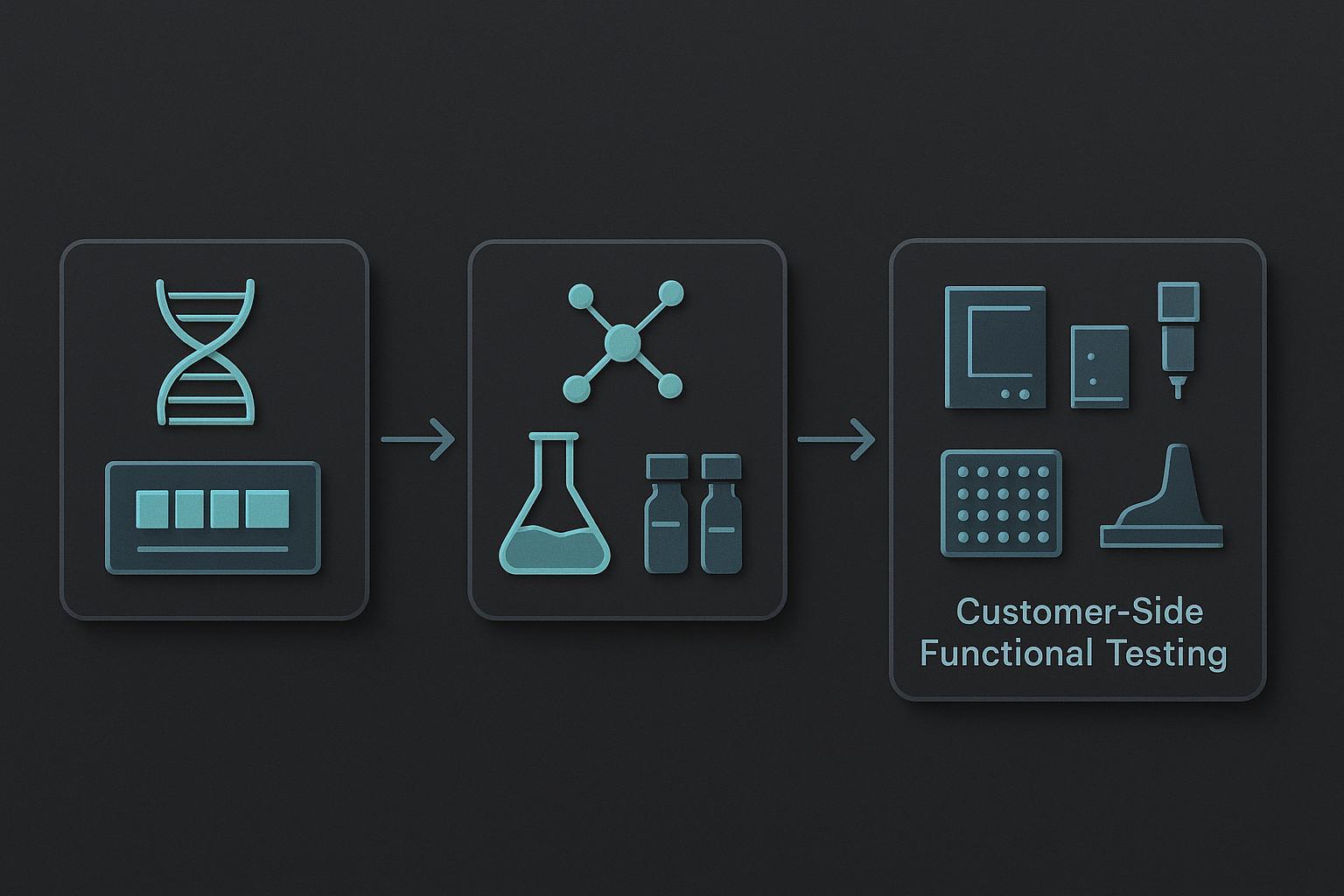
The first action step is to pick the assay that answers the question purity testing cannot: not “what is in this vial,” but “what does this peptide do to a membrane.” For Syntetiska peptider functional assays for membrane-active peptides, that means matching the readout to the pore property under test rather than defaulting to whichever plate reader is free.
Calcein leakage measures dye release from lipid vesicles and reports bulk permeabilization. DiSC₃-5 depolarization tracks the loss of a membrane potential across a bacterial membrane, so it reports membrane disruption in a more physiological context. Planar bilayer single-channel recording measures current through one pore at a time, which is the only one of the three that resolves unitary conductance.
The three sit on very different sensitivity scales. Calcein leakage typically needs peptide concentrations in the 1 till 25 µM range against roughly 20 µM lipid with 75 mM intraliposomal calcein, while DiSC₃-5 depolarization effects cluster around 19 µM. Single-channel work reaches sub-micromolar to low-micromolar concentrations, with published detections at 0.3 µM, 0.8 till 4.1 µM, och 6.2 µM, resolving conductances from about 6 till 360 pS up to the nanosiemens range. A peptide that looks inert in a leakage assay may simply be below the detection floor of that readout.
|
Analysera |
Fråga den svarar |
Required control |
Blind spot |
|---|---|---|---|
|
Calcein leakage |
Does the peptide permeabilize lipid bilayers in bulk? |
Vesicles without peptide; detergent for 100% släppa |
Averages away transient or rare pores |
|
DiSC₃-5 depolarization |
Does it collapse membrane potential? |
Protonophore control; peptide-free membrane |
Cannot separate pore formation from membrane solubilization |
|
Planar bilayer single-channel |
What is the unitary conductance and lifetime of one pore? |
Peptide-free bilayer; voltage-reversal runs |
Low throughput; one pore may not represent the population |
The blind spot in the first row is not hypothetical. A Wza-based D-peptide, DcWza, produced unitary conductance of 0.95 ± 0.1 nS kl +200 mV in 1 M KCl across 50 events, yet vesicle permeabilization after one hour was 4.6 ± 2.5% against a control of 4.2 ± 2.1% (Ge et al., Naturkommunikation, 2022). Transient pores that eject rather than persist leave almost no trace in a bulk leakage readout. That is the case for running single-channel work alongside, not instead of, vesicle assays.
Implementation, in order:
-
Define the membrane model and lipid composition. Match the lipid mix to the biological membrane you care about. Quick win: a day of reading and a decision.
-
Select the readout. Bulk leakage for a first pass, depolarization for a physiological context, single-channel for mechanism. Longer-term: single-channel rigs take weeks to commission.
-
Fix the controls. Peptide-free vesicles, a positive disruptor, and a solvent-only blank. Quick win, but skipping it invalidates everything downstream.
-
Set the concentration range. Span at least two orders of magnitude around your expected threshold, and remember the detection floors above.
-
Pre-register the pass criterion. Write down what counts as active before you run the plate. This is the step most teams skip and most regret.
Measure leakage rate, unitary conductance, and selectivity ratio. A realistic timeline is two to four weeks for a validated vesicle assay and two to three months before single-channel data is publication-grade.
Varningar och var den konventionella utsikten fortfarande håller
The design rules are probabilistic, not deterministic, and some designed pores fail. That is the most important limitation to state plainly, because it is also the honest reason purity-first thinking persists: purity is measurable, repeatable, and cheap to certify, while membrane behavior is none of those things. Peptidproduktion
Context matters more than the argument does. For non-membrane targets, or for screening libraries where the readout is binding rather than permeabilization, RP-HPLC and MS purity genuinely is the right release criterion, and peptide purity testing limitations only become a problem when that certificate is asked to answer a question it was never designed to answer.
The weakest part of the case is the evidence base itself. Much of the 2026 design guidance derives from a single coarse-grained MD pipeline run in POPC, and the salt-bridge rescue was demonstrated in simulation before anyone synthesized the peptide. Neither result is wrong; both are narrower than a design rule implies.
Treat the framework as a hypothesis generator, inte en specifikation. It tells you which sequence edits are worth making and which assays are worth running, and it still expects some of those pores to fail.
But Doesn’t High Purity Guarantee Reproducible Membrane Activity?
Inga. Purity constrains what is in the vial, not how that material assembles in a bilayer. A ≥98% specification is not meaningless, fast: it removes a large class of confounds, including truncated sequences, radering av föroreningar, and scavenger by-products that would otherwise muddy any activity readout. What it cannot do is tell you whether the peptide inserts, oligomeriserar, or forms the pore architecture your design assumed.
If a project is already locked into a purity-only release workflow, you do not need to rebuild the program. Add one orthogonal functional readout, such as a vesicle leakage assay or a planar bilayer conductance measurement, and use it to confirm that the released lot behaves as the design intended.
Treat activity reported from a peptide characterized only by HPLC and MS as provisional. Without visible assay conditions and controls, you cannot tell whether the observed effect came from the peptide, a residual counterion, or the buffer.
Slutsats: Från renhetscertifikat till funktionella bevis
Purity is necessary but not sufficient for pore-forming peptide design: a chromatogram can confirm what a molecule is, never what it does at a membrane.
The practical shift is in release criteria. For membrane-active peptides, analytical data should travel with at least one functional readout, and published activity numbers should arrive alongside the assay conditions and controls that produced them. That pairing is what makes a result reproducible in someone else’s hands rather than only in the lab that generated it.
None of this asks you to rebuild an existing program. Start by mapping the sequence features you already control onto the membrane behavior you actually need, then pick the assay that detects that behavior. A design workflow and characterization checklist can make that mapping explicit before the next lot is ordered.
The direction of travel is toward design rules that are probabilistic but usable: good enough to narrow a sequence space, honest enough to say when a designed pore will not behave as intended.