什么是人工智能辅助肽研究治理框架?

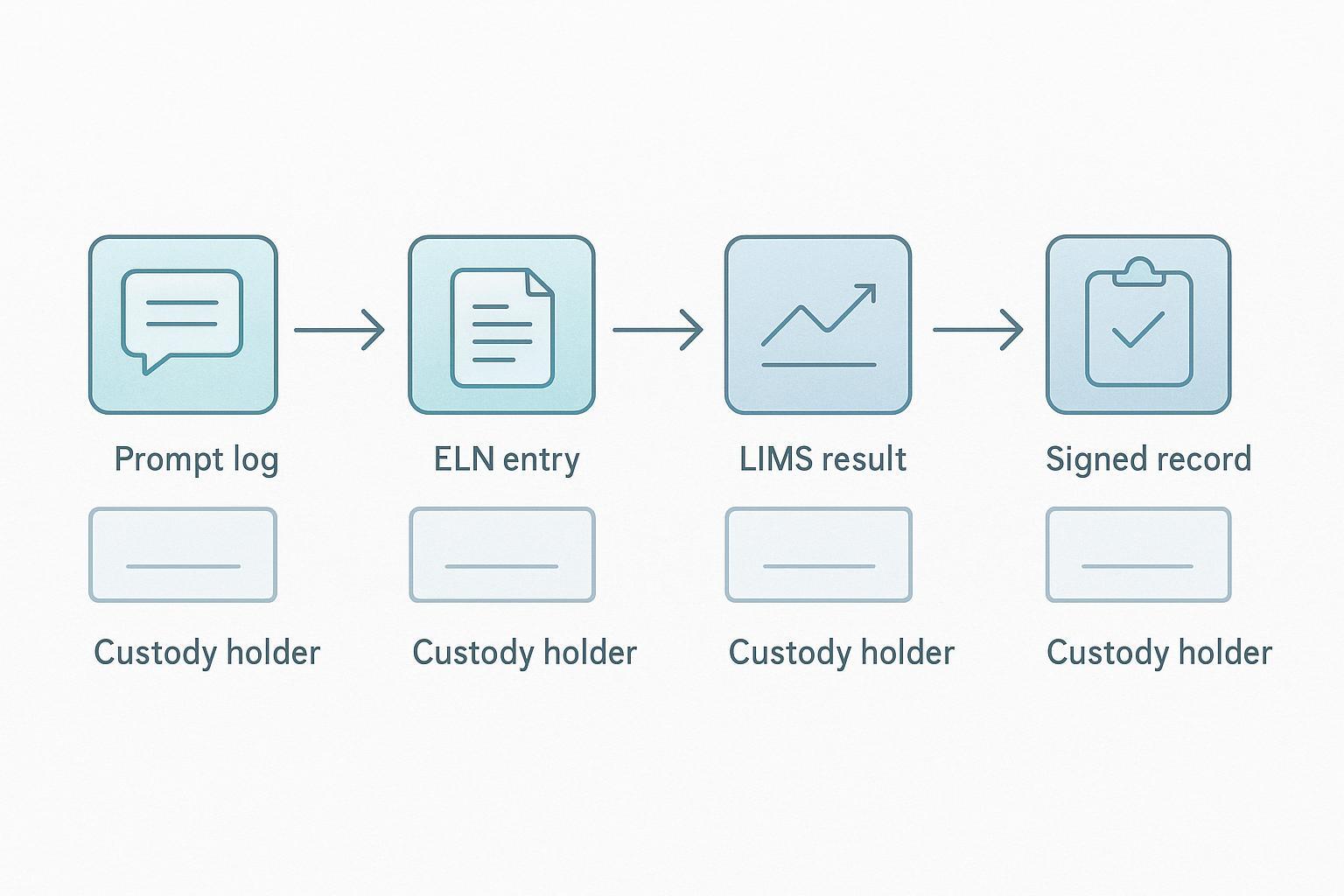
人工智能辅助肽研究治理框架是一套规则, 记录, 审查门,使人工智能起草的设计可以追溯到可以捍卫它的指定人员. 它与实验室已经运行的质量体系并存, 不高于他们, 它的存在是因为四种不同的归因系统现在在同一个工作台上重叠.
这四个系统回答不同的问题并由不同的机构管辖. 美国专利商标局修订后的发明人指南规定,只有自然人才能被正确命名为发明人, 并将人工智能系统视为人类发明家使用的工具,遵循适用于所有其他发明的相同法律标准. 监管归因在单独的轨道上运行: FDA 的部分 11 范围和应用指南适用于创建的电子记录, 修改的, 维持, 已归档, 检索到的, 或根据 FDA 法规中的记录要求传输, 这些基本要求充当谓词规则.
|
归因系统 |
它决定什么 |
谁能扛得住 |
AI能扛得住吗 |
记录所需证据 |
|---|---|---|---|---|
|
保管 |
谁持有该材料以及何时持有该材料 |
指定的人或网站 |
不 |
监管链日志, 存储和传输条目 |
|
作者身份 |
谁写的原理和分析 |
指名的人 |
不 |
注明日期的条目, 提示及输出记录, 搁笔 |
|
发明权 |
谁构思了要求保护的发明 |
仅限自然人 |
多肽合成 不 |
受孕记录, 贡献叙述 |
|
监管归属 |
谁对机构负责 |
法人实体及责任人 |
不 |
谓词规则记录, 审计追踪, 电子签名 |
这里的词汇平淡无奇却很有承重. ALCOA+ 描述唱片质量: 可归因的, 清晰易读, 同时期的, 原来的, 准确的, 加完整, 持续的, 持久, 并可用. ELN 是电子实验室笔记本; LIMS 是实验室信息管理系统; 正交方法通过化学独立原理确认结果,而不是重复相同的测量.
合成肽 c=”https://molchanges.com/wp-content/uploads/2026/09/pub_20260921_225551_664_f7182fac5c724f199d0c23c32516026d.png”>
实验记录所有权和数据完整性位于所有四个系统的交叉点, 这就是框架在要求任何人更改工作流程之前将它们分开的原因. 常见的误解是治理会减慢科学发展的速度. 实际上,它消除了有争议的结果之后的重建工作, 重建是缓慢的部分.
为什么人工智能辅助的肽研究治理现在很重要

生成式人工智能已从化学领域的新颖性转向生产性, 专利记录表明了这一点. 产权组织 7 月 2026 GenAI 专利更新数量约为 14,000 生成式人工智能专利族 2023 以及超过 37,800 在 2025. WIPO 的 GenAI 专利分析 把 2024 数字在 18,862 和 2025 数字在 37,808, 因此申请量在一年内大约增加了一倍.
监管机构同时出手. 这 2025 美国专利商标局发明人指南的修订废除了 2 月份的发明人指南 2024 全面的人工智能发明指导并实施行政命令 14179.
忽视这一点的后果是具体的. An experimental record assembled from a chat thread and an unlabelled aliquot cannot support an inventorship claim, a reproducibility claim or a safety claim. This is where AI-assisted peptide design documentation stops being paperwork and becomes the asset itself.
药丸 1: 记录提示和设计原理

Documenting prompts and design rationale means capturing the AI interaction and the human judgement that followed it as one linked record, not two separate artefacts. The prompt alone proves nothing: it shows what the model returned, not why a scientist advanced one candidate and rejected the rest.
The field list below is common practice drawn from software-vendor prompt-management tooling. Only the record attributes are grounded in the regulatory cluster. A workable log entry carries the model name and version, the prompt text as sent, parameters and seed, a timestamp, the operator, the candidate set returned, and a written rationale for each accept or reject decision. Each field then maps to the electronic laboratory notebook (ELN) entry it must accompany, so the design record and the experimental record stay joined.
That mapping matters because of how regulators read the rules. FDA 解释部分 11 scope narrowly: it applies to records required under predicate rules that are kept electronically in place of paper, or kept electronically in addition to paper and relied on to perform regulated activities (美国FDA, 部分 11 scope and application, page current as of 2018-08-24). 这 MHRA’s GxP data-integrity guidance supplies the attributes that make such a record defensible: ALCOA+ (可归因, Legible, 同期, 原来的, Accurate, plus Complete, 持续的, 持久, 可用的), and an audit trail defined as metadata that allows reconstruction of a record’s history, including who, what, when and why.
故障模式很熟悉. A design rationale that lives only in a chat thread cannot be reconstructed when inventorship is challenged, because the human contribution is invisible. How much of the prompt chain you retain scales with program stage: research-grade work can keep the final prompt and rationale, while GMP-bound material needs the full chain, including rejected candidates.
药丸 2: 人工智能辅助研究的人工审查门
A review gate is a decision point with a named owner, a defined rejection criterion and a route for appeal. It is not a meeting where a draft is discussed and then quietly advanced.
The distinction matters because the accountability question is already settled in law. The USPTO’s position is that AI systems are tools used by human inventors, 和 USPTO’s AI-inventorship FAQs confirm the analysis stays focused on human contribution: the guidance “does not create a heightened standard for inventorship” and adds no separate AI-disclosure duty beyond existing rules (USPTO, 2025-01-14). Whatever the model proposed, a person owns the decision.
服务 Four gates carry that ownership in practice.
|
门 |
Reviewer competence |
Sign-off authority |
Rejection criteria |
Escalation path |
|---|---|---|---|---|
|
Candidate advancement |
Domain scientist familiar with the target and prior art |
Principal investigator or project lead |
Rationale not reproducible from the prompt log; no orthogonal rationale for the proposed modification |
Program director, with the prompt log attached |
|
Wet-lab commitment |
Chemist or process owner who will run or commission the work |
Laboratory manager |
Route not feasible at required scale; reagent or equipment constraints unresolved |
Head of R&D |
|
分析发布 |
Analyst qualified on 店铺 the specific method |
QC lead |
Identity or purity data incomplete for the intended use |
Quality manager |
|
Safety-relevant impurity disposition |
Toxicologist or qualified safety reviewer |
Quality manager, or the qualified person where the material is GMP-bound |
Impurity above the limit set for the intended use, with no justified control |
Quality manager and regulatory affairs jointly |
Who may sign changes with the material’s status. A research-grade reagent can be released on a qualified analyst’s review. A GMP-bound material cannot: release requires the named qualified person under the applicable quality system, and no AI output substitutes for that signature.
要点: A review gate without a named sign-off authority and a defined rejection criterion is not a control, it is a meeting.
故障模式很安静. A gate exists on paper, the discussion happens, and an AI-drafted candidate enters synthesis with nobody accountable for the decision. When the record is later questioned, the trail shows a conversation, not an approval.
药丸 3: 实验记录所有权和数据完整性

Ownership is four questions, 没有一个. Custody asks who physically holds the record; authorship asks who wrote it; inventorship asks who contributed to the invention; regulatory attribution asks who is accountable to an inspector. In most AI-assisted programs those land with four different people, and the record has to satisfy all four at once.
The MHRA’s GxP data-integrity guidance defines ALCOA+ as nine attributes: 可归因, Legible, 同期, 原来的, Accurate, plus Complete, 持续的, Enduring and Available. The same guidance treats the audit trail as metadata capturing who, what, when and why, with every change dated, attributed and justified. FDA’s CGMP definition is narrower in wording and identical in effect: a secure, 计算机生成的, time-stamped record that allows reconstruction of the course of events.
Scope is where teams misread the rules. FDA 的部分 11 scope-and-application guidance attaches the regulation to records created, 修改的, 维持, 已归档, retrieved or transmitted under a records requirement in FDA regulations, and FDA’s narrow reading of Part 11’s scope means paper-equivalent obligations follow the predicate rule, not the software.
The failure mode is fragmentation. Raw data, intermediate files, analysis scripts and model outputs sit in four places, so no single record reconstructs the run and nobody can say who signed off. Retention and audit-trail review obligations then scale with program stage: a research-grade record tolerates lighter review than a GMP-bound one.
药丸 4: 确认肽的身份
No single analytical method confirms a peptide’s identity. Orthogonal confirmation, meaning two or more methods that rely on different physical or chemical principles, is what turns a plausible result into a defensible identity record for peptide identity purity and impurity confirmation.
Mass spectrometry with MS-MS fragmentation establishes the molecular mass and, through fragment ions, the amino-acid sequence. It cannot tell you whether the material is the correct diastereomer, and it will not distinguish a sequence from a closely related deletion analogue that fragments similarly. Amino-acid analysis establishes the compositional ratio after hydrolysis, which catches substitutions and truncations that mass alone can miss, but it destroys sequence order information and says nothing about chirality. Chromatographic retention against a reference standard establishes that the material behaves identically to a characterised lot under defined conditions, which is a strong similarity statement rather than a structural one.
Run together, the three methods cover each other’s blind spots. Run alone, each leaves a gap that a reviewer or a regulator will find. The method table below sets out what each technique establishes, what it cannot establish, and the program stage at which it becomes mandatory.
|
Orthogonal identity method |
它建立了什么 |
What it cannot establish |
Mandatory at |
|---|---|---|---|
|
Mass spectrometry with MS-MS fragmentation |
Molecular mass and fragment-derived sequence |
Diastereomer identity; distinction from some closely related analogues |
Research grade onward |
|
Amino-acid analysis |
Compositional ratio after hydrolysis |
Sequence order; chirality |
Research grade onward |
|
Chromatographic retention vs. reference standard |
Behavioural identity to a characterised lot |
Structural identity |
Research grade onward |
The expectations for how these methods are validated sit in 我Q2(R2), the current revision of the analytical-procedure validation guideline, which was adopted at Step 4 and took legal effect in the EU on 14 六月 2024, replacing Q2(R1) 的 1995. The EMA’s ICH Q2(R2) guideline page records that effective date. Q2(R2) covers validation tests and terminology for procedures used in release and stability testing, and it can be applied to other procedures in the control strategy on a risk-based basis. Instrument suitability is a separate obligation: 美国药典 <1058> on analytical instrument qualification requires documented evidence that an instrument is fit for its intended purpose across design, installation, operational and performance qualification.
The failure mode is specific and common. A vendor certificate or a model-generated identity summary is filed as the identity record, with no orthogonal confirmation and no instrument-qualification trail behind it. The record then asserts an identity that no one can reconstruct from primary data.
The research-grade versus GMP-bound difference is a matter of degree and evidence. Research-grade work can reasonably rely on a single primary method with a second confirmatory technique where the material’s use justifies it. GMP-bound material raises the bar: the full orthogonal set, each method validated under Q2(R2), and every instrument carrying a current qualification record under USP <1058>.
药丸 5: 纯度和安全相关的杂质分析
An HPLC area-percent number is not a purity specification. It reports the share of UV-absorbing signal at 214 或者 220 纳米, so it cannot see the trifluoroacetate counterion, 残留溶剂, elemental impurities, or water carried alongside the peptide. 测定, counterion content and moisture have to be accounted for together before any purity figure means anything.
The familiar thresholds are convention, not pharmacopeial rule. Suppliers and industry practice commonly quote ≥95% for research-grade material and ≥98%–99% for pharmaceutical-grade, but no compendial chapter fixes those numbers as a pass criterion for a peptide. Treat them as purchasing shorthand and define your own specification against the intended use.
What separates research-grade from GMP-bound material is not the headline percentage but which impurity classes must be quantified rather than merely observed. A research reagent can tolerate a reported counterion and an unspecified solvent profile. A GMP-bound batch cannot: safety-relevant impurities peptide work requires each class to be named, measured against a limit, and dispositioned on the record.
The classes to name and disposition are residual solvents, elemental impurities, trifluoroacetate counterion carryover, deletion and truncation sequences from incomplete coupling, and endotoxin where the route demands it. For parenterals, 美国药典 <85>, 细菌内毒素检查, sets the limit from the maximum human dose per kilogram per hour using the formula K/M, 与 K = 5 EU/kg/h for most routes and 0.2 EU/kg/h for intrathecal administration (美国药典 <85>). Where sterility is claimed, 美国药典 <71> sterility testing requires 14-day incubation in Fluid Thioglycollate Medium and Soybean–Casein Digest Medium, with no growth for a pass (FDA pyrogen and endotoxin testing Q&一个).
Automation does not remove this burden. 一个 2025 review of LLMs in organic synthesis records IBM RoboRXN+ completing a 12-step synthesis of a nonribosomal peptide at 92% 纯度, and MoleculeX reporting kinase-inhibitor route planning cut from weeks to hours at 70% 屈服 (Tharwani et al., 2025). Both figures are area-percent or isolated-yield outcomes. Neither tells you what else is in the vial.
That gap is the failure mode. A 24-mer with a TFA counterion gets carried into a cell assay on the strength of an area-percent number alone, and the assay reads the counterion as much as the peptide. Peptide identity, purity and impurity confirmation are three separate determinations, and only the third one tells you whether the material is fit for the experiment you are about to run.
药丸 6: 背景下的活动数据和安全相关杂质

An activity value means little on its own. A single unreplicated result is a data point, 不是证据, and the reproducibility literature shows why: 在 Baker’s 2016 Nature reproducibility survey, 多于 70% 的 1,576 surveyed researchers reported failing at least once to reproduce another scientist’s experiment. That figure is self-reported, not a measured replication rate, but it establishes the practical point. Activity data earn their weight through repetition and through traceability to the material they were generated against.
That traceability is what links activity results to safety-relevant impurities in a peptide program. Every activity value should carry the lot identifier, the purity profile, and the impurity disposition it was measured against, so that a later finding can be traced back to every result it may invalidate. Orthogonal confirmation of peptide identity belongs in the same record, because an activity readout from a misidentified lot is not recoverable after the fact.
The research-grade versus GMP-bound distinction changes both the replication requirement and the threshold at which an impurity finding triggers a re-test. Where a research-grade reagent may tolerate a single determination, a GMP-bound material requires the stricter route-dependent limits described in USP <85>, 细菌内毒素检查, and any impurity finding above threshold forces affected results back into question.
The failure mode is blunt. An activity result that cannot be tied to the lot it came from leaves no way to scope the damage when a safety-relevant impurity surfaces later, and the whole dataset is discarded rather than selectively re-tested.
先进的: 将证据负担扩大到计划阶段
If your team already runs an AI-assisted workflow, the insight that matters is this: the AI-assisted peptide research governance framework is not applied uniformly. It scales with patient-safety and quality impact, so a research-grade program that adopts the full GMP-bound package will over-document and stall, while a program heading toward a regulatory submission that adopts the research-grade package will under-document and lose the record.
The scaling rule is simple. Match the evidence burden to the stage: research-grade work needs prompt logs, design rationale, and rejected-candidate retention; development work adds qualified instruments and validated methods; GMP-bound work adds full release and stability testing. The trigger that moves a program up a tier is a regulatory commitment, not a calendar date. 我Q2(R2), the current revision of the analytical-procedure validation guideline, explicitly allows its validation tests and terminology to be applied to other procedures on a risk-based basis, which is the same logic that should govern your documentation depth. 美国药典 <1058> on analytical instrument qualification applies the same lifecycle thinking to instruments.
Honestly, this framework is heavier than a pure discovery program needs. Do not scale down two things, 尽管.
对于小费: Never scale down human sign-off authority or rejected-candidate retention. Neither can be reconstructed after the fact, and both are the elements regulators and reviewers ask for first.
保留被拒绝的候选人和负面结果
A rejected candidate is evidence, not housekeeping. The design that lost, the reason it lost, the prompt and model version that produced it, and the reviewer who turned it down together show the human judgment that selected the winner. Strip those out and the record proves an output existed, but not that a person chose it. That gap is exactly where the question of who owns the experimental record becomes hard to answer.
The retention rule scales with program stage. Research-grade work can keep rejected candidates in an archive with a defined retention period, as long as the rejection rationale stays retrievable. A GMP-bound program should hold them in the controlled record itself, because the selection decision is part of the batch history a reviewer will later reconstruct.
The failure mode is common and quiet: only the winning design survives, so the record reads as if the sequence arrived fully formed. The USPTO’s revised inventorship guidance states that only natural persons may be named inventors, and its AI-inventorship FAQs confirm the analysis turns on human contribution rather than a heightened standard. Rejected candidates are often the clearest proof of that contribution.
工具和记录结构
Three record structures matter before any software decision: the controlled record system, the prompt and model metadata layer, and the analytical data system. An electronic laboratory notebook (ELN) or laboratory information management system (LIMS) is the controlled record system, and it must carry an audit trail that records who changed what and when. That audit trail is metadata, not a narrative field, and the MHRA’s GxP data-integrity guidance frames it through the nine ALCOA+ attributes: 可归因的, 清晰易读, 同时期的, 原来的, 准确的, 完全的, 持续的, 持久, 并可用. The prompt and model metadata layer is the addition most teams still lack, and it must capture the model version, the prompt text, and the human who accepted the output. The analytical data system holds raw instrument files, and it must preserve them unaltered alongside the processed result. Experimental record ownership and data integrity depend on all three connecting, and on one thing none of them supplies: a named sign-off authority. FDA’s narrow reading of Part 11’s scope makes clear that a validated system is not the same as an accountable person.
|
类别 |
Required capability 关于 |
Typical owner |
Usually already present? |
|---|---|---|---|
|
Controlled record system (ELN/LIMS) |
Audit trail, version history, e-signature |
Quality or data-integrity lead |
是的, in a regulated stack |
|
Prompt and model metadata layer |
Model version, prompt text, acceptance record |
Research lead or informatics |
Rarely; usually an addition 多肽生产 |
|
Analytical data system |
Raw file retention, unaltered originals |
Analytical or QC lead |
Partly; raw-file retention often needs work |
MOL Changes supports analytical verification and lot traceability as a peptide partner. This is a commercial interest, disclosed here rather than presented as a performance claim.
入门
Open the most recent AI-assisted design decision in your program and try to reconstruct it from the record alone: the prompt as it was written, the model and version that produced the output, and the human rationale for accepting or rejecting it. If any of those three is missing, you have found your first gap, and you found it in five minutes without a meeting.
下一个, name the sign-off authority for the gate ahead and write the rejection criterion down before the work reaches them. A gate with no named owner and no written criterion is a rubber stamp, and the MHRA’s GxP data-integrity guidance is explicit that attributable, contemporaneous records are the baseline, not an aspiration (MHRA GxP Data Integrity Guidance and Definitions, 2018). The same logic runs through inventorship: the USPTO’s revised inventorship guidance confirms that only natural persons may be named inventors, which means an AI system cannot hold the accountability your record implies (USPTO Revised Inventorship Guidance, 2024).
Then pick one pillar and adopt it end to end before adding a second. Prompt traceability is usually the cheapest place to start.
First action: Before you leave this page, open one AI-assisted design decision and check three things: is the prompt recoverable, is the model version recorded, and is the human rationale written down?
The common hesitation is that retrofitting documentation into an existing ELN workflow will disrupt the bench. Starting with a single pillar is how you avoid that: one change, applied completely, tells you what the workflow will tolerate before you commit the program to it.
MOL Changes provides custom peptide synthesis and analytical services, so we have a commercial interest in this topic. If it would help to see how the record structure looks in practice, you can review the documentation model or open a technical discussion with our analytical team.
常见问题解答
什么是人工智能辅助的肽研究治理框架?
It is the set of record structures, review gates and sign-off authorities that keep a qualified human accountable for every controlled decision in an AI-assisted peptide workflow. It sits alongside the data-integrity and quality systems a laboratory already runs rather than replacing them, and it does not create a new regulatory regime. 这 definition section above sets out how the framework maps onto ALCOA+ and 21 CFR部分 11.
当人工智能工具起草设计时,谁拥有实验记录?
保管, 作者身份, inventorship and regulatory attribution are four separate questions held by four different parties, and none of them is held by the AI system. Custody decides who can alter the record and when; authorship decides who signed the rationale; inventorship decides who is named on a filing; attribution decides who answers to an inspector. The distinctions table in the definition section assigns each one.
使用人工智能设计肽是否会影响谁可以被任命为发明家?
No separate legal standard exists for AI-assisted inventions, and only natural persons may be named as inventors. The assessment turns on the human contribution to the claimed subject matter, so a designer who set the constraints, selected the candidate and verified the result is assessed the same way as one working without a model. No heightened standard and no new AI-disclosure duty is created; the USPTO rows in the definition section carry the specifics.
在设计进入 ELN 之前,提示日志必须包含哪些内容?
Model name and version, prompt text, parameters, timestamp and the identity of the person who accepted the output. Without the version and the acceptance record, a reviewer cannot reconstruct why a candidate was carried forward, which is the failure mode Pillar 1 地址.
Is a vendor’s purity certificate sufficient for a GMP-bound material?
不. A certificate establishes what the vendor measured on its own sample; it does not establish identity, and it does not profile safety-relevant impurities the vendor’s method was never designed to see. A 24-mer with a TFA counterion carried into a cell assay is the standard illustration: the counterion and any deletion sequences sit outside a purity percentage. 药丸 4 和支柱 5 cover orthogonal confirmation and impurity profiling.
被拒绝的候选人必须保留多长时间?
Retention follows program stage, and two elements are not retrofittable: the prompt and design rationale, and the identity of the person who accepted the output. A research-grade program can keep rejected candidates in a research archive with the rationale attached; a GMP-bound material needs them inside the controlled record. The scaling section sets out where the line falls.
我们可以将被拒绝的候选人存档而不是将其保留在受控记录中吗?
For a research-grade program, yes, provided the rationale and the accepting reviewer travel with the candidate. The failure mode is an archive that holds the structure but not the reason it was rejected, because the next program repeats the same synthesis.
结论
The AI-assisted peptide research governance framework does not settle who owns the experimental record. It makes the human contribution visible enough that the question can be answered at all. Every pillar in this guide serves that single end: documenting prompts and design rationale so the reasoning behind a molecule survives the session that produced it, human review gates that place a named person between a model’s output and the bench, experimental record ownership and data integrity rules that keep the chain unbroken from request to result, peptide identity purity and impurity confirmation backed by orthogonal methods, and activity data read alongside the impurities that could explain it. None of this is new law. The USPTO’s revised inventorship guidance still reserves inventorship to natural persons, and the USPTO’s position that AI systems are tools used by human inventors applies no separate legal standard to them. What moves is the tooling around that stable baseline, which is why the record, not the model, is the asset worth protecting.
Disclosure: MOL Changes provides custom peptide synthesis and analytical services, so we have a commercial interest in how documentation expectations develop. If you want to see how these pillars translate into practice, review the documentation model or open a technical discussion with the analytical team.