Quali codici genetici espansi per la progettazione personalizzata dei peptidi cambiano effettivamente
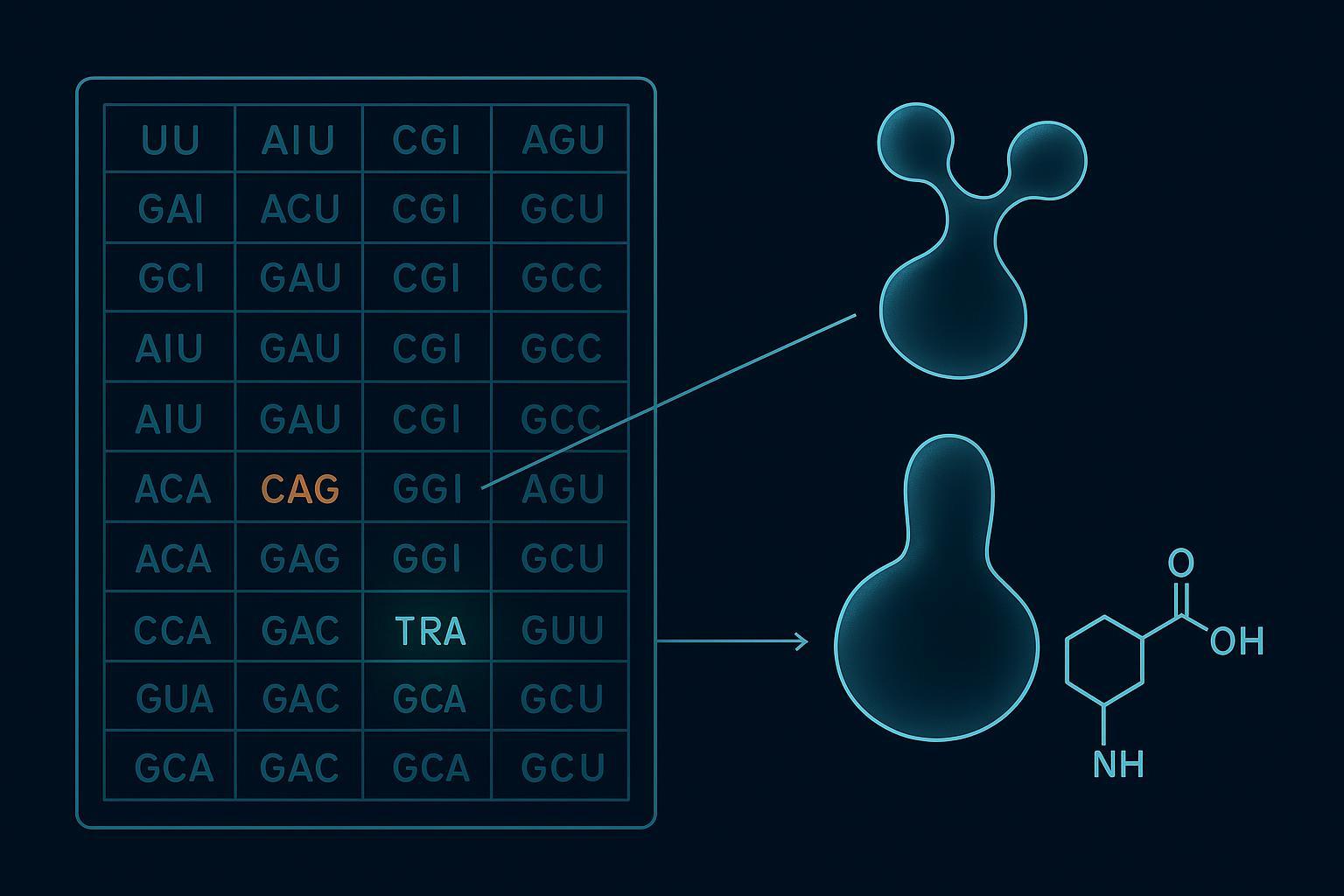
Il codice genetico standard assegna 64 codoni: 61 codoni di senso e 3 codoni di arresto, e ciascun codone di senso specifica uno dei 20 amminoacidi canonici (Collezione di espansione del codice genetico Addgene, ultima revisione 19 novembre 2025). Un codice genetico espanso riscrive quell’assegnazione. Uno o più codoni vengono reindirizzati a un amminoacido non canonico attraverso la riassegnazione del codone, installato localmente da un tRNA ortogonale / coppia di aminoacil-tRNA sintetasi che carica solo il proprio tRNA ingegnerizzato e nient'altro nell'ospite.

Quella definizione conta meno della modalità di fallimento che blocca. Ambra (UAG) la soppressione legge attraverso un codone di stop, quindi compete direttamente con il fattore di rilascio 1. Quando la soppressione perde quella corsa, il risultato è una terminazione prematura e un prodotto troncato, una perdita che gli host ricodificati o knockout RF1 sono specificamente progettati per ridurre (Biotecnologie della natura, 11 settembre 2024). La riassegnazione del codone di senso fallisce in modo diverso: il codone riassegnato compete ancora con il suo significato originale, quindi il prodotto arriva come una miscela contenente misincorporanti canonici piuttosto che come una filiera corta.
Chiave da asporto: La soppressione dell'ambra fallisce per troncamento; la riassegnazione del codone di senso fallisce per miscelazione. Resa e purezza si muovono quindi in maniera indipendente, e la modalità di fallimento che erediti è impostata dalla strategia del codone che scegli, non da quanto sia qualificato il fornitore.
[DIAGRAMMA: tabella a 64 codoni etichettata con UAG e un codone di senso evidenziato, ciascuno indicato con la freccia verso la sua coppia ortogonale tRNA/sintetasi]

Perché la casella degli strumenti si è mossa più velocemente delle recensioni
Il materiale di riferimento che la maggior parte dei team raggiunge è in ritardo rispetto alla chimica. UN 2025 la revisione pone il conteggio alla fine 300 amminoacidi non canonici utilizzati con successo nell'espansione del codice genetico (Comunicazioni sulla natura, 29 settembre 2025), mentre la recensione più citata nei risultati di ricerca su questo argomento risale a 2014. Le risorse a livello plasmidico hanno mantenuto un ritmo più serrato: La raccolta GCE in espansione di Addgene elenca approssimativamente 150 plasmidi della sintetasi e 26 ceppi batterici, con il contenuto rivisto l'ultima volta il 19 novembre 2025 (Addgene). Se la tua lista di selezione è stata creata da una recensione vecchia di dieci anni, sta descrivendo una cassetta degli attrezzi più piccola di quella esistente.
Come i codici genetici espansi rimodellano la selezione degli aminoacidi non canonici
Quella stessa strategia del codone stabilisce anche i termini della selezione degli amminoacidi non canonici, dove scelta della coppia, non residui di scelta, è il vincolo vincolante. Quattro fattori decidono quale coppia tRNA-sintetasi è possibile utilizzare: adattamento del substrato, strategia dei codoni, organismo ospite, e se è necessario codificare più di un ncAA alla volta. Esaminateli in quest'ordine e la maggior parte dell'apparente libertà nel catalogo dei residui scomparirà.
Dominano due piattaforme. IL Metanocaldococcus jannaschii La coppia TyrRS/tRNA^Tyr accetta catene laterali simili alla tirosina e aromatiche. L'impalcatura della pirrolisil-tRNA sintetasi e le sue varianti evolute assumono residui simili a lisina e voluminosi, and tolerate more structural variety. Note that RF1 knockout is a host strategy that raises suppression efficiency, not a third pair.
|
Servizi Caratteristica |
M. jannaschii TyrRS/tRNA^Tyr |
PylRS/tRNA^Pyl variants |
|---|---|---|
|
Substrate scope |
Tyrosine-like, aromatic |
Lysine-like, bulky, structurally diverse |
|
Codon strategy |
Ambra (UAG) suppression |
Ambra, ochre, or sense-codon reassignment |
|
Host compatibility |
E. coli, lievito, mammalian cells |
E. coli, mammalian cells, cell-free systems |
|
Multiplexing suitability |
Limited; overlapping substrate tolerance |
Better suited to orthogonal pair expansion |
Multiplexing is where the field is moving. UN 2024 codon-compression strategy identified 12 mutually orthogonal tRNA-synthetase pairs compatible with the known GCE resource set, which matters if your design needs two or more distinct ncAAs in one chain.
Then there is the boundary between what a ribosome can install and what only SPPS can. Side-chain modifications on an α-amino-acid backbone are GCE-compatible. β-amminoacidi, UN,α-disubstituted residues, depsipeptides, and many N-methylated residues are not; they are SPPS-only or in vitro-only. If your target residue sits on that list, no pair selection will rescue it.
Leggere onestamente l'efficienza della soppressione
Suppression efficiency is a range, and the range only means something with the strain and reporter attached. Earlier systems delivered roughly 10–20% for a single amber codon. Optimized and evolved systems reach 50–117% depending on context, and 76–104% in the RF1-deleted C321 strain. Those figures describe different constructs, so they are not a ladder you can climb by picking the highest number.
Incorporation efficiency is also not the same metric as near-cognate readthrough. Readthrough runs about 1% in Top10, Di 3% in BL21, and up to 17% in MG1655, reaching as high as 47.5% at a given amber site in an RF1-deleted background. One measures how much ncAA you install; the other measures how much wrong amino acid you install alongside it.
La conseguenza pratica: a specification that names only a percentage, without naming the strain and the reporter, is not a specification. Ask for both before you accept an efficiency figure.
Progettazione di librerie di peptidi con amminoacidi non canonici
Once the pair is fixed, the display platform you choose sets the ceiling on which noncanonical amino acids your library can contain at all. mRNA display and RaPID sit highest on ncAA tolerance because the whole cycle runs in vitro: flexizyme charges the tRNA directly, so the ribosome never has to compete with a host synthetase, and backbone-modified residues stay in play. Ribosome display ranks high but system-dependent, since tolerance shifts with the lysate and the release-factor setup. Phage display remains workable, because phage display can carry noncanonical residues via amber-encoding helper phage, though the host machinery constrains which residues survive. Yeast display is the most constrained of the four.
Position matters as much as platform. Position-wise versus global ncAA diversification split the design space: single or few defined sites suit a mechanistic probe or one conjugation handle and stay easy to characterize, while pervasive substitution suits stability or protease-resistance screens and is far harder to verify residue by residue.
Dove il design della biblioteca incontra la selezione del percorso

A library built around a backbone-modified residue cannot be produced by genetic code expansion at all, so the display decision and the production decision have to be made together rather than in sequence. The stability payoff is what makes that constraint worth accepting. In one inhibitor series, cyclic β2,3 residues pushed serum half-life past 168 hours at 37 °C in human serum, contro 4.6 hours for the corresponding alanine variant; a second scaffold in the same work reached 48 hours versus Negozio 4.2 ore. N-methylation extended proteinase-K stability from 6 minutes to roughly 110 minutes in its own assay, and D-amino-acid substitutions moved half-life from minutes to hours in theirs. None of these figures generalizes to peptides as a class: each belongs to its own scaffold and assay. The practical consequence is narrow and firm. If your stability target requires a backbone modification, the route is chosen for you, and the library has to be designed inside that limit from the start.
Strategie di coniugazione specifiche del sito abilitate da codici espansi
That route decision carries straight into conjugation, where an ncAA handle buys positional control that no canonical residue can match, and it changes the failure mode rather than eliminating failure. A bioorthogonal handle installed at a defined position gives the highest positional control and the lowest off-target burden of any site-specific peptide conjugation strategy, but the failure you then manage is incomplete incorporation or unreacted starting material, not mis-targeting. Cysteine is chemoselective and cheap, yet over-alkylation, oxidation and disulfide scrambling are routine. Lysine coupling gives regioisomer mixtures. N-terminal chemistry improves on lysine but stays sequence- and context-dependent.
|
Chimica |
Selettività |
Cinetica |
Copper |
Failure mode it produces |
|---|---|---|---|---|
|
SPAAC (azide + cyclooctyne) |
Alto |
Moderare |
Non richiesto |
Unreacted azide handle |
|
CuAAC (azide + alchino) |
Alto |
Veloce |
Necessario |
Copper-mediated side reactions |
|
Tetrazine-TCO |
Sintesi peptidica Alto |
Fastest |
Non richiesto |
Hydrolysed tetrazine |
|
Electrophilic ncAA cyclization |
High when geometry is preorganized |
Intramolecular |
Non richiesto |
Competing intermolecular product |
The menu is short. SPAAC is copper-free and operationally simple; CuAAC is the most robust but copper sensitivity is the liability; tetrazine-TCO labels fastest; and electrophilic ncAA cyclization is intramolecular and clean when the geometry is preorganized, as reported for doubly bio-orthogonal ncAA handles (Comunicazioni sulla natura, 2023).
Scelta tra coniugazione bioortogonale e legatura chimica nativa
Native chemical ligation and ncAA conjugation solve different problems and are not substitutes. NCL is the route when the target requires a backbone modification, a D-residue, or a segment that no orthogonal pair will charge; its prerequisite is a viable ligation junction and a thioester segment. ncAA conjugation is the route when the target is a standard α-backbone peptide that needs one defined attachment point, and its prerequisite is a pair whose substrate scope accepts the handle plus a host or extract that suppresses the competing canonical readthrough.
La conseguenza pratica: make the conjugation decision at the same time as the ncAA decision. A handle the chosen pair will not charge is a redesign, not a substitution.
Controlli analitici che dimostrano la fedeltà della sequenza
Whatever conjugation route you settle on, the control package is what converts a synthesis claim into a defensible specification, and it has to be designed before the first lot is made, not assembled after a deviation. For any peptide carrying a noncanonical residue, sequence fidelity analytical controls rest on five elements: exact-mass confirmation of the intact peptide plus sequence-localizing fragment ions spanning the modified residue by LC-MS/MS; incorporation-efficiency quantitation, meaning the fraction of peptide bearing the ncAA versus canonical misincorporants or unlabeled product; a diastereomer/epimer control against a synthetic reference or an orthogonal chiral or retention-time method, because standard LC-MS often cannot distinguish epimers; orthogonal translation system validation with negative controls and no detectable off-target readthrough; E, for element-tagged ncAAs such as selenium or boron variants, amino acid analysis or ICP-MS (2026 review on precision bioconjugation and site-specific incorporation, recuperato 2026-02-04).
Impostazione dei criteri di accettazione prima del primo lotto

Each control becomes useful only when it carries a number. Tie mass accuracy to the residue being confirmed, tie the incorporation-efficiency threshold to the resolving power of the assay that measures it, and require the epimer control to name the reference standard it compares against. Where the peptide is a parenteral candidate, the pharmacopeial limit is dose-derived: USP <85> sets endotoxin limit = K/M, con K = 5 EU/kg/hour for non-intrathecal routes and K = 0.2 EU/kg/hour intrathecal, expressed per mg or per mL of the maximum human dose. Io Q2(R2) sets the validation parameters, and the MHRA ALCOA principles frame the data integrity expectations around them.
A control that is not written into the specification before the first lot is a control you will be negotiating after a deviation.
Aumentare la scalabilità: SPSS, CFPS e rischio di fedeltà lotto-lotto
Those controls then have to survive scale-up, because the route that produced your research batch is not automatically the route that produces your clinical batch, and the fidelity risk profile changes with it. Solid-phase peptide synthesis operates at milligrams to grams per batch, with preparative and industrial workflows reaching tens to hundreds of grams, and some sequences into kilogram scale. Cell-free systems typically deliver mg per litre: Di 96 ± 3 mg/L for a protein carrying 40 identical noncanonical amino acids, while an optimized RF1-deficient extract reached roughly 1,780 ± 30 mg/L for sfGFP (cell-free ncAA incorporation literature, 2020). The scale gulf between cell-free and solid-phase routes is real, and it shapes which fidelity risks dominate at each stage.
Two lot-to-lot risks follow from that split. Under amber suppression, truncation and readthrough products vary with host state, so the impurity profile can shift between fermentation runs even when the target band looks unchanged. Under sense-codon reassignment, the noncanonical-to-canonical ratio can drift while total yield stays flat, which means a yield-only release test will not catch it.
La conseguenza pratica: the fidelity controls from the previous section belong in the release specification for every lot, not only in the qualification batch.
Cosa chiedere a un partner prima di impegnarsi
Take six questions into the conversation. Which noncanonical amino acid and orthogonal pair? Which codon strategy, amber suppression or sense-codon reassignment? Which host or cell-free extract, and what is its documented suppression performance? Which conjugation route, and does it preserve the incorporated residue? Which of the five fidelity controls run on every lot? And what acceptance criteria define a passing lot before the first one is made?
A structured design-to-QC workflow supports this. MOL Changes can be used to align ncAA selection, synthesis route and analytical release criteria in one handoff, so the controls agreed at design stage are the controls run at scale. Ask for the lot-level control panel in writing, and compare it against your own specification before committing.
Idee sbagliate comuni sui codici genetici espansi
Four errors show up often enough in program reviews that they are worth naming directly.
The first is that an expanded genetic code means a rewritten genome. In practice it usually means one reassigned codon and one orthogonal pair, added to a host that is otherwise unchanged.
The second is that higher incorporation efficiency means higher purity. The two can move in opposite directions: sense-codon reassignment can hold yield while purity falls, because the reassigned codon is now available to near-cognate tRNAs as well as to the orthogonal pair.
The third is that any noncanonical amino acid can be slotted into any production route. The backbone-modification split is a hard boundary, not a preference: residues that alter the backbone cannot be installed by ribosomal incorporation, and residues that require the ribosome cannot be made by SPPS.
The fourth concerns release testing.
⚠️ Attenzione: A single intact mass does not confirm the sequence. Without fragment ions spanning the modified residue, an epimer or a misincorporation at a nearby position can pass the same specification.
Dove sta andando la cassetta degli attrezzi
With those misconceptions cleared, the direction of travel is toward using more of the code at once. Where early work relied on a single orthogonal pair, recent systems have shown that mutually orthogonal pairs used together can operate in the same cell, which is what makes multi-site incorporation of different noncanonical amino acids a design option rather than a thought experiment.
A second shift is architectural. Interest has moved toward cell-free and extract-based systems that avoid permanent modification of the host genome, which shortens the cycle between designing a construct and testing it. Alongside that, four-nucleotide codon work extends the available codon space beyond the standard 64, widening the room available for reassignment.
The honest caveat is unchanged: suppression efficiency remains ncAA- and sequence-context-dependent, and not every noncanonical amino acid is compatible with every route. That is why the evaluation framework in Peptidi sintetici this guide, rather than any particular pair or platform, is the part worth keeping: expanded genetic codes for custom peptide design will keep changing, but the controls that prove what you built will not.
Passaggi successivi
Bring a specific sequence and a specific fidelity requirement to the first technical conversation about expanded genetic codes for custom peptide design, not a general inquiry. The evaluation checklist below turns the four-part framework in this guide into questions a partner should be able to answer without hedging:
-
Which orthogonal pair, and what suppression efficiency has been observed for it in your expression host?
-
Which codon strategy: amber suppression, sense-codon reassignment, or a quadruplet codon?
-
Which route for this sequence: SPSS, cell-free synthesis, or fermentation, and why that one?
-
Which conjugation chemistry, and does it stay orthogonal to the residues already in the chain?
-
Which of the five sequence fidelity analytical controls are run per lot, and what are the acceptance criteria?
A partner who can answer all five, and say plainly where a given ncAA or route will not work, is worth more than a lower quote. MOL Changes supports this kind of design-to-QC conversation across 300+ gruppi funzionali, SPPS and microbial fermentation, mg-to-kg scale, and HPLC/MS and sterility QC under Class 100 cleanroom conditions.
Divulgazione: MOL Changes is the sponsor of this guide. The framework and evaluation criteria above are presented for research and comparison purposes. Di
Domande frequenti
Che cos'è un codice genetico espanso?
An expanded genetic code is a translation system in which one or more codons have been reassigned to specify a noncanonical amino acid instead of the standard one. The reassignment is targeted rather than global: an orthogonal tRNA and its aminoacyl-tRNA synthetase pair are introduced so the synthetase charges only its cognate engineered tRNA, leaving the host’s own translation machinery untouched. In the standard 64-codon frame, that leaves room to install a new chemical function at a chosen position without rewriting the rest of the proteome.
Quanti amminoacidi non canonici possono essere codificati geneticamente?
UN 2025 review estimate puts the number of genetically encodable noncanonical amino acids at over 300, though that figure describes the field’s cumulative toolbox rather than what any single system can deliver. The practical count is far smaller, because each ncAA needs a compatible orthogonal pair and a host that tolerates the reassignment. Treat the headline number as an upper bound on what has been demonstrated somewhere, not as a menu you can order from.
Qual è la differenza tra la soppressione dell'ambra e la riassegnazione del codone di senso?
Amber suppression reads through the UAG stop codon and competes directly with release factor 1, so its characteristic failure mode is truncated product. Sense-codon reassignment swaps a codon that normally encodes a standard residue, so its failure mode is a mixed population: yield can stay high while purity falls, because the wild-type residue is still incorporated alongside the ncAA. That difference determines which controls you need, since truncation shows up in intact mass while mistranslation does not.
Quali amminoacidi non canonici possono essere prodotti dall'SPPS piuttosto che dall'espansione del codice genetico?
β-amminoacidi, UN,α-disubstituted residues, depsipeptide linkages and many N-methylated residues are usually accessible only by solid-phase synthesis or in vitro chemistry, because the ribosome will not accept them as substrates. The genetically encodable class is narrower: side-chain modifications built on an α-amino-acid backbone. Selenocysteine is the natural exception, encoded through its own dedicated machinery rather than through an engineered pair. Produzione di peptidi
Come si conferma che un amminoacido non canonico è stato incorporato nel sito previsto?
Confirmation requires exact mass plus sequence-localizing fragment ions that span the modified residue, typically by LC-MS/MS, together with a quantitation of incorporation efficiency and an epimer control against a synthetic reference. Intact mass alone is insufficient because it cannot distinguish the intended site from a positional isomer or a deletion variant of similar mass. The fragment ions are what localize the residue; the mass only tells you something changed.
Gli amminoacidi non canonici possono essere incorporati in più di un sito?
SÌ, but multi-site incorporation multiplies the analytical burden rather than simply repeating a single-site workflow. Each additional position adds its own suppression or reassignment event, and the fraction of product carrying the ncAA at every intended site falls as positions accumulate, so the population becomes a distribution of partially modified species. You need to decide up front whether the assay resolves that distribution, because a method validated for one site will not automatically report on four.
L'espansione del codice genetico è scalabile per la produzione di peptidi in fase clinica?
Scalability depends on which route you choose, and the two routes fail differently. Cell-free protein synthesis has demonstrated yields in the ranges reported earlier in this article, but those figures come from defined experimental systems and do not transfer automatically to a GMP process. Solid-phase synthesis scales more predictably for shorter sequences but cannot reach the residues that are SPPS-only. For clinical-stage work, the practical question is not whether the chemistry scales but whether your analytical package can prove lot-to-lot sequence fidelity at that scale.
Conclusione
The codon strategy you choose determines the failure mode you inherit, so the control package that proves sequence fidelity has to be specified before the first lot, non dopo. That is the thread running through this guide: expanded genetic codes for custom peptide design are an evaluation problem before they are a synthesis problem.
The four decisions a partner must be able to defend in writing are the noncanonical amino acid and its suppression behavior in your sequence context, the library design and how it constrains the route, the conjugation chemistry and what it leaves intact, and the analytical acceptance criteria with their methods and limits. Each one narrows the next.
The direction of travel is toward mutually orthogonal pairs used together, cell-free and extract-based systems that leave the host genome untouched, and four-nucleotide codons that extend the available codon space past the standard 64. The honest caveat is that suppression efficiency stays dependent on the ncAA and the surrounding sequence, and not every ncAA is compatible with every route.
Use the checklist in Next Steps as the basis for your first technical conversation.
About the author: [Author name], [credentials], writes on peptide design and analytical control strategy for MOL Changes.
Divulgazione: MOL Changes provides peptide design, synthesis and analytical services, including the capabilities discussed in this guide.