Wat er is gebeurd en waarom het belangrijk is voor AI-ready peptidedetectie
Op 2026-09-16, GenScript's eigen aankondiging van de TuneLab-overeenkomst bevestigde in de aankondiging dat het bedrijf nu wet-lab-voorwaarden met voorkeurstarieven aanbiedt: eiwit expressie, zuivering en karakterisering van geprioriteerde sequenties, uitgevoerd onder gestandaardiseerd, volledig gedocumenteerde protocollen. Lees de reikwijdte aandachtig. Geen peptidegegevensstandaard, er wordt nergens een machineleesbaar formaat en geen peptide-specifieke deliverables genoemd.
Die kloof is het verhaal. Ray Chen, Voorzitter van de GenScript Life Science Group, kaderde de grondgedachte in de door GenScript verklaarde grondgedachte voor het partnerschap: “De ontdekking van geneesmiddelen op basis van AI zal slechts zo snel vooruitgaan als de industrie betrouwbaar biologisch bewijs kan genereren.”

TuneLab zelf is niet nieuw. Lilly's lanceringsaankondiging voor TuneLab dateert het naar 2025-09-09, beheerd door Eli Lilly in plaats van een onafhankelijk bedrijf, met een eerste release die betrekking heeft op de dispositie van geneesmiddelen, veiligheids- en preklinische modellen. De schaal daarachter is de reden dat leveranciers opletten: bedrijfseigen gegevens verkregen tegen een kostprijs van meer dan $1 miljard, afkomstig uit honderdduizenden unieke moleculen, volgens de schaal van de gegevens achter TuneLab. De toegang loopt via het federatieve leerontwerp van TuneLab, waarmee biotechbedrijven gebruik kunnen maken van de modellen van Lilly zonder hun eigen bedrijfseigen gegevens of die van Lilly direct openbaar te maken.
Het platform wordt ook ingebed in de software die computationele teams al gebruiken, door de Schrödinger LiveDesign-integratie aangekondigd 2026-01-09 en de TuneLab-integratie van CDD Vault aangekondigd 2026-05-20.

Beschouw dit dus als een signaal over het genereren van bewijs, geen specificatie. Niets in de aankondiging vertelt u wat AI-ready peptide-ontdekking van uw administratie vereist. Die last rust op het laboratorium.
Schone gegevens: De vier pijlers van AI-ready peptidedetectie
Dankzij AI-ready peptide-ontdekking kan uw experimentele output worden gelezen, samengevoegd en hergebruikt door een model zonder dat een mens het opnieuw hoeft te typen. Machineleesbare gegevens dragen hun eenheden, voorbeeldidentiteit en methodeversie in gestructureerde velden in plaats van een PDF- of notitieboekjepagina. De ontwerp-bouw-test-leercyclus is de lus waarop deze modellen draaien: ontwerpreeksen, synthetiseren en testen, de resultaten terugkoppelen, opnieuw ontwerpen.
Vier pijlers houden die lus overeind: schonere experimentele gegevens, reproduceerbare syntheserecords, analyseklare formaten en analytische datasets. De lat ligt lager dan de meeste teams aannemen. Cradle's richtlijnen voor gegevensverzameling voor eiwitontwerp plaatst generatief-ML-eiwitontwerp binnen het bereik van elk laboratorium dat consequent kan testen 96 eiwitsequentievarianten voor elke eigenschap, en merkt op dat enkele tientallen verstandig gekozen reeksen aanzienlijke vooruitgang kunnen opleveren. Gepubliceerde richtlijnen voor best practices op het gebied van ML-ondersteunde eiwitengineering meldt dat eiwit-engineering ML-datasets vaak minder dan 1,000 exemplaren, Daarom wordt bij validatie gewoonlijk gebruik gemaakt van een tienvoudige kruisvalidatie in plaats van een enkele uitgestelde splitsing.
Kleine datasets bestraffen slordige records. GEN's analyse van waarom de inspanningen voor het ontdekken van AI-medicijnen ondermaats presteren stelt dat modellen inconsistent zijn gevoed, onvolledig, dubbelzinnige of slecht geformatteerde gegevens leren de ruis samen met het signaal, wat zelfverzekerde maar minder betrouwbare voorspellingen oplevert. Het faalpatroon is alledaags: eenheden geregistreerd als mg/ml in de ene run en µg/μl in de volgende run, voorbeeldnamen met vrije tekst waaraan geen enkele join-sleutel kan voldoen, ontbrekende batch-ID's, en geen versiebeheer van de testmethode of de analysecode. Elk van deze zorgt ervoor dat een dataset niet tussen runs wordt samengevoegd.
De stroomopwaartse oorzaak is fragmentatie, niet onzorgvuldigheid. LabKey’s overzicht van praktisch analysegegevensbeheer beschrijft testgegevens die in silo's leven, op gedeelde Drives, in laboratoriumnotitieboekjes, of ingebed in e-mails, met instrumentheterogeniteit tussen leveranciers en bestandstypen en geen consistent formaat. De kwaliteit van peptidegegevens voor AI-modellen is daarom eerder een registratieprobleem dan een modelleringsprobleem.
Sleutel afhaalmaaltijd: Een campagne die rondtesten 96 varianten per woning bevindt zich al in het gebied van generatief ontwerp. Wat de dataset diskwalificeert zijn inconsistente eenheden, voorbeeldnamen met vrije tekst, ontbrekende batch-ID's en methoden zonder versiebeheer, niet het aantal monsters.
Reproduceerbare syntheserecords en analyseklare formaten
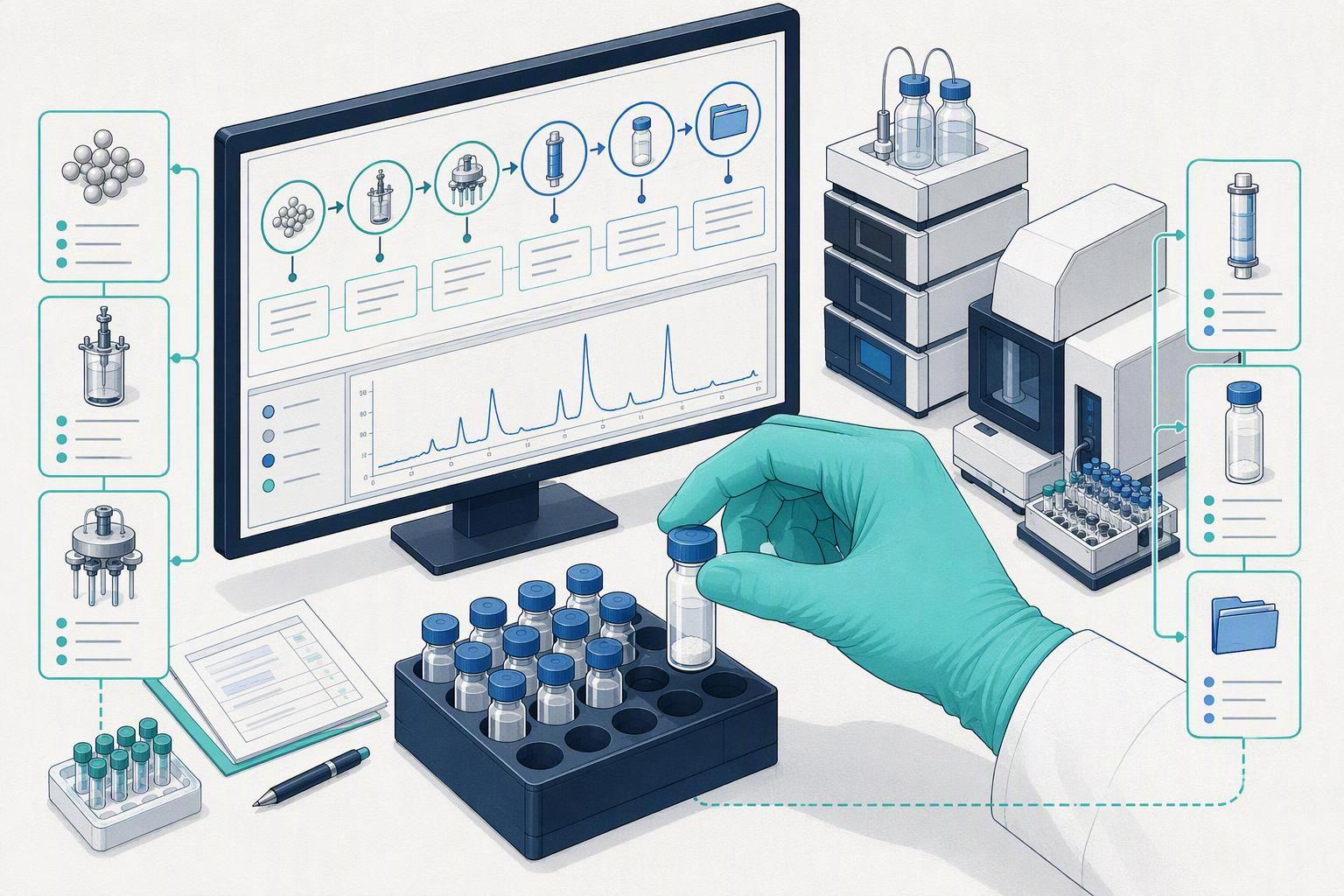
A certificate of analysis is not a reproducible peptide synthesis record. The unit of reproducibility is the lot file: de SPPS-primer van de American Peptide Society describes a batch record detailed enough for a third party to recreate the run, covering resin type and loading, per-cycle deprotection and coupling with reagents and equivalents, wash steps and equipment. The standard manual Fmoc cycle it documents prescribes 20% piperidine/DMF deprotection (5 notulen, then 15 notulen) En 3 × 1 mL DMF washes per cycle. MOL Changes’ stage-by-stage chain-of-custody framework extends that into nine stages, from raw material sourcing and incoming qualification through synthesis lot records, isotope labelling traceability, analytical release and complete lot-file assembly, citing ICH Q7 for starting-material characterization and flagging a supplier who cannot name the resin lot or amino-acid source.
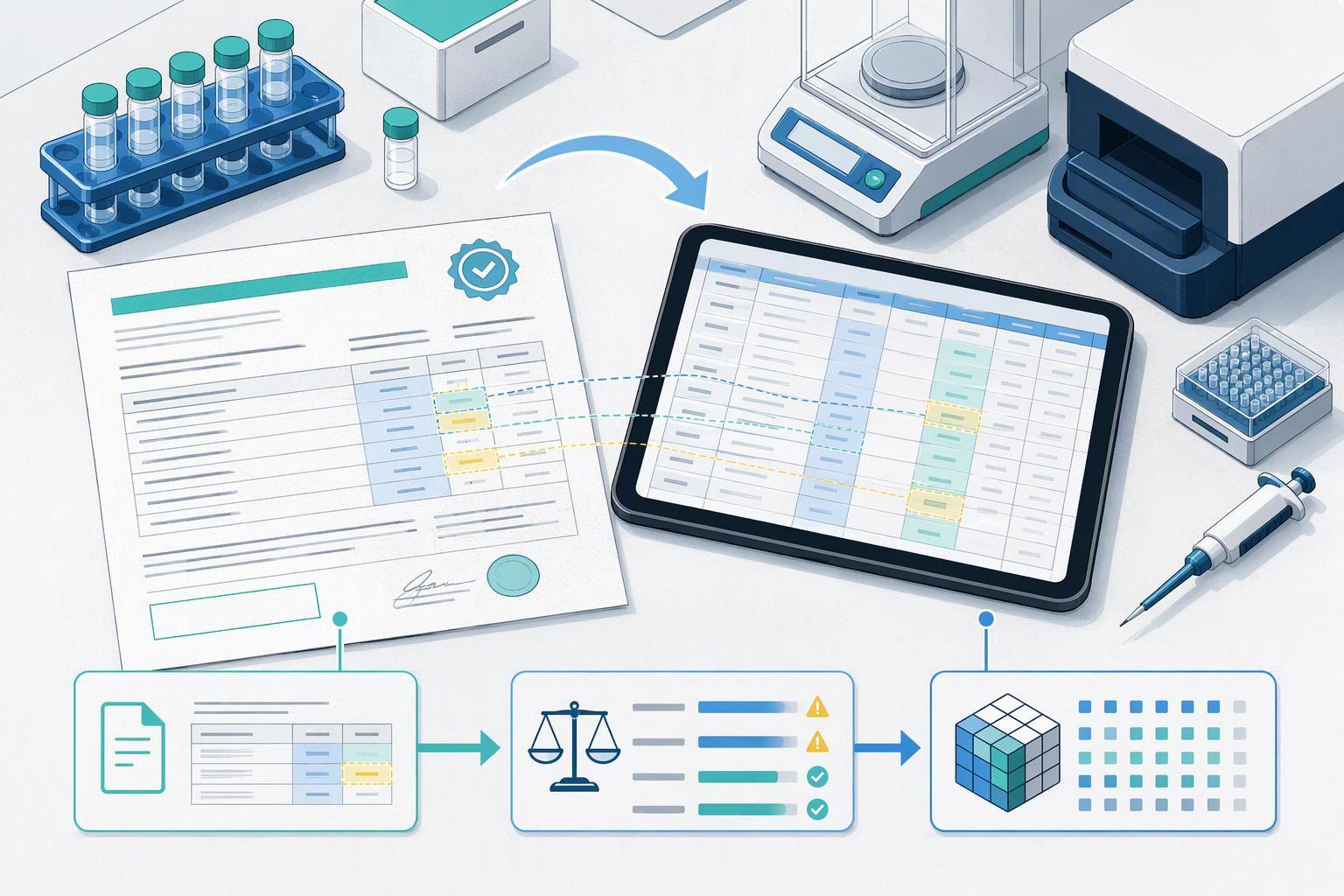
Assay-ready peptide data formats carry a parallel requirement. LabKey’s overview of practical assay data management identifies what recurs across CSV, JSON, AnIML and SDRF: stable identifiers for samples, files and runs; controlled vocabularies or ontologies; explicit units and datatypes; links between raw data, processed data and metadata; and open, long-lived formats. Identity confirmation by mass spectrometry is not purity determination by HPLC, and neither settles counterion or content questions such as TFA counterion exchange. ik Q2(R2), gepubliceerd 30 November 2023, requires an analytical procedure to be shown fit for its intended purpose under a predefined validation protocol, with the reportable range confirmed to include upper and lower specification or reporting limits, and extends those principles to mass spectrometry and other spectrometric data.
|
What a standard supplier package contains |
What a computational team needs |
|---|---|
|
CoA plus summary analytics |
Lot-linked records with stable identifiers |
|
Final purity and identity values |
Per-cycle synthesis detail and versioning |
|
Peptide 1 Static PDF or printed report |
Cyclic Peptide Synthesis Machine-readable tables with explicit units |
|
Certificate as the deliverable |
Provenance from raw Peptide-diensten material to release |
No documentation standard removes the need Peptide 2 for orthogonal confirmation of hits.
Wat dit betekent voor leveranciers, Computationele teams en kopers
The announcement lands differently depending on where you sit. For the synthesizing supplier, documentation completeness becomes a differentiator rather than an afterthought. GenScript’s AIDD service page advertises sequence-to-data in as fast as 4 calendar days, 4000+ designs per day, 20M+ AI-ready data points generated per year, onder $10 per data point, En 3500+ global partner organizations. Read it closely, hoewel, and it names no peptides at all; its listed modalities are VHHs, miniproteins, IgG, bispecifics, enzymes and de novo proteins. Peptide chemistry is not yet the demonstrated centre of that pipeline, which is the opening for suppliers who can show it. Calcitonin Synthesis
For the computational team, the binding constraint is dataset size and metadata sufficiency. Published best-practice guidance on ML-assisted protein engineering treats 10-fold cross-validation as the norm on sub-1,000-instance datasets, which tells you how thin the training material usually is. TuneLab’s federated-learning design matters here: biotechs tap into Lilly’s models without directly exposing proprietary data. The non-obvious implication is that the Schrödinger LiveDesign integration means most teams will meet these models inside software they already run. The models are not the variable you control. The data you feed them is.
For the buyer or QC lead, “documented” already has a definition. The ten ALCOA+ data-integrity principles require records to be attributable, leesbaar, gelijktijdig, origineel, nauwkeurig, compleet, consistent, duurzaam en beschikbaar, and the ICH Q2(R2) analytical validation guideline requires an analytical procedure to be shown fit for its intended purpose under a predefined validation protocol, with the revision extending those principles to mass spectrometry. A documentation-complete peptide delivery, in those terms, means a lot file where the sample identifier ties back to the batch, the assay version and units travel with the result, and the controls and error metrics are stated rather than implied. MOL Changes is one supplier whose analytical package is built around that chain, though no independent audit of its AI-specific data formats was found.
Four questions to ask of your own records today: Can a model read this table? Can a third party recreate this batch? Does this assay output carry identifiers and units? Can this dataset be merged with last quarter’s? Peptide 3
Wat u nu moet doen en het grotere geheel
Start with the export, not the platform. Three actions, in order of urgency.
-
This week: audit one recent campaign’s assay export against your machine-readable field list and write down what is missing. Most teams find the gaps in an afternoon.
-
This month: add batch identifiers, eenheden, assay version and analysis-code version to the export template, and start versioning the assay method itself.
-
This quarter: request the full lot file, including resin lot and amino-acid source, before committing to a campaign. A supplier who cannot name the resin lot or the amino-acid source is a red flag.
Two things not to do. Do not rebuild a data platform before fixing the export format, and do not treat a CoA as a training-ready dataset.
The cautionary context is worth keeping in view. In a manual FAIR reusability audit of archived datasets, 45.9% of assessed open datasets were rated reusable, meaning 54.1% were not. In the energy-domain dataset audit, 82% of datasets had missing data in at least one key dimension and 27% were missing more than half. Figures of this type vary by source and domain, and they are cited here as an illustration of metadata loss rates, not as peptide benchmarks.
That is the bigger picture for AI-ready peptide discovery: evidence generation, not model capability, is becoming the rate-limiting step. Documentation standards are turning into a procurement criterion, and the labs that version their records now will be the ones whose data is still usable in three years.
Volgende stap: review the chain-of-custody documentation framework and use its nine-stage checklist to score your current lot files.
Openbaring: MOL Changes publishes this blog as a peptide vendor.
Veelgestelde vragen
Heeft het GenScript-TuneLab-partnerschap betrekking op peptiden??
Nee. GenScript’s own announcement of the TuneLab agreement scopes the service to protein expression, zuivering en karakterisering van geprioriteerde sequenties. Peptide synthesis is not named in that scope, so peptide teams should read the announcement as a signal about where AI-assisted discovery is heading rather than as a service they can buy today.
What does “AI-ready” data actually mean in practice?
It means five concrete properties: stable identifiers for every entity, controlled vocabularies instead of free-text fields, explicit units and datatypes, linked raw, processed and metadata files, and open long-lived formats rather than vendor-locked exports. LabKey’s overview of practical assay data management sets out these requirements for assay data. A file that satisfies them can be parsed by a model without a human rewriting column headers first. That is the whole test.
Hoe groot moet een peptide-analytische dataset zijn voordat machinaal leren helpt?
Smaller than most teams assume, but not trivially small. Cradle’s data-collection guidance for protein design puts generative design at practical from around 96 variants per property. Typical protein-engineering datasets, daarentegen, hold fewer than 1,000 instances and are validated with 10-fold cross-validation, as published best-practice guidance on ML-assisted protein engineering describes. The binding constraint is usually consistency across those instances, not their count.
Waar moet ik een leverancier om vragen??
Ask for the full lot file, not the CoA alone. MOL Changes’ stage-by-stage chain-of-custody framework treats a supplier who cannot name the resin lot or the amino-acid source as a red flag, and asks for machine-readable analytical data alongside the certificate. If the assay-ready peptide data formats you receive cannot be loaded without manual transcription, the AI-ready peptide discovery pipeline stops at your inbox.
Conclusie
The GenScript-TuneLab partnership is a signal about how peptide evidence gets generated, not a peptide data standard. No independent test data published after 2024 was found that would let anyone treat the announcement as a settled specification, so the practical work stays where it always was: in the record your lab already produces.
That record has four requirements you can act on now. Clean data means fields a model can parse without manual repair. Reproducible peptide synthesis records mean lot-level traceability back to resin and amino acid sources. Assay-ready peptide data formats mean results that survive transfer between instruments and collaborators. Peptide analytical datasets for computational design mean the underlying measurements stay attached to the sequences they describe.
The next logical step is small and unglamorous: take one completed campaign, export it as it stands today, and check it field by field against a machine-readable specification. Whatever fails that audit is your AI-ready peptide discovery roadmap, and it will be more specific than any announcement.