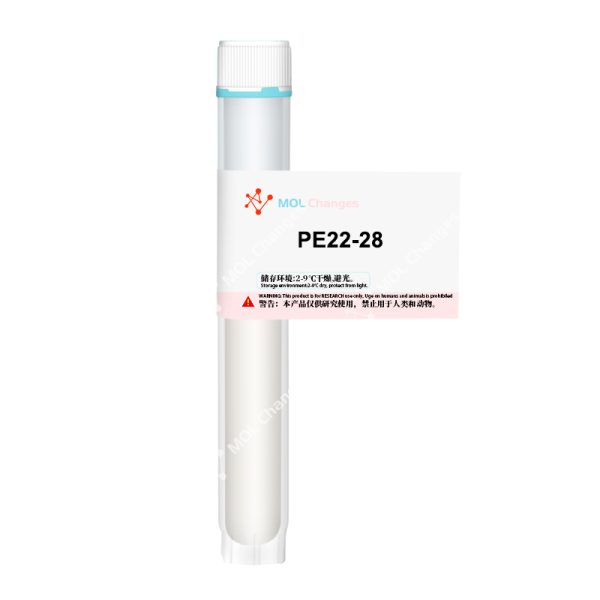
PE-22-28 is a synthetic analog of spadin, exhibiting both enhanced stability and efficacy when compared to the original.
Originating from research on the TREK-1 (KCNK2) channel – a member of the two-pore potassium channel (K2P) family – it regulates numerous physiological processes; neural excitability being one of the more well-established, along with pain perception, depression, and various forms of neuroprotection.
Initial studies established sortilin as the modulating protein affecting TREK-1 activity.
Further subsequent research clarified this effect occurs through sortilin releasing a propeptide (PE) into the bloodstream, ultimately blocking transmission through the channel.
PE-22-28 itself is a synthetic peptide derived from cleaving and subsequently modifying the core active fragment of this propeptide.
Superior stability is observed over spadin, with activity maintained for over 23 hours.
Clinical trials are currently underway, but all indications point to a new generation of targeted drugs for depression, chronic pain and related neurological disorders.
Sự liên tiếp
Gly-Val-Ser-Trp-Gly-Leu-Arg
CAS Number
1801959-12-5
Molecular Formula
C35H55N11O9
Molecular Weight
773.8930
PE22-28 Related Research
1.Therapeutic Profile and Selectivity
The therapeutic effect on depression specifically outperforms all previously studied TREK-1 blocking antidepressants; marked suppression of at least one set of depressive symptoms appearing within four days, side effects being entirely absent.
Neuroprotective effects are also seen, smaller cerebral infarction areas and an improved (to some degree recoverable) neural environment being two measurable outcomes.
High selectivity makes PE-22-28 a near perfect template for future TREK-1 based therapeutics.
2.Antidepressant Effects
Inhibition of the TREK-1 channels (as mentioned above) is the primary mechanism.
Depolarization of the neuronal membrane through increased excitability and the consequent enhancement of synaptic plasticity, is what reverses many of the pathological features of depression.
Rapid shortening of immobility time in multiple animal models is a demonstrated efficacy indicator.
TREK-1 knockout mice further confirm the direct link to and dependence on the channel.
3.Analgesic Effects
Chronic pain is generally closely associated with abnormal neuronal excitation.
TREK-1 channels are highly expressed on primary sensory neurons within pain-conducting pathways; dorsal root ganglia (DRG) and the dorsal horn of the spinal cord being prime examples.
Their activation serves as a form of negative regulation of pain signals.
Dysfunction or significant inhibition of these channels leads to the excessive excitation specific to various pain pathways – the induction and subsequent maintenance of chronic pain being direct consequences of this.
PE-22-28 effectively modulates the activity of voltage-gated calcium channels (VGCCs) and to a large extent NMDA receptors, by depolarizing these sensory neurons.
Reshaping the excitability of the entire associated neural circuit, a ‘resetting’ from a pathologically hyper-excited state is the end result.
Clinical trials have shown significant elevation of both mechanical and thermal pain thresholds (for at least compressive injury types of pain, sciatica being an exemplary case study) along with reduced allodynia and true hyperalgesia.
4.Neuroprotective Effects
The more recently reported neuroprotective effects of PE-22-28 are not yet widely accepted, but ion channel closure mechanisms indicate some form of protection during the acute phase of nervous system injury.
Long term, promoting neurotrophic factor expression, various survival signaling pathways and inhibition of apoptosis are all believed to be part of its action.
Precise neuroprotective mechanisms remain to be fully defined, but evidence suggests PE-22-28 is at least partially neuroprotective.
COA
HPLC
bệnh đa xơ cứng